Showing posts with label knowledge. Show all posts

2 Peter 1-3 Partake of the Divine Nature

TMS Proverbs 3:9-10 Give First Fruits, Get Filled
Pr 3:9 “Honor the LORD with your possessions,
And with the firstfruits of all your increase;
10 So your barns will be filled with plenty,
And your vats will overflow with new wine.”

Observations: 3:9-10 This is a great passage on giving God our best, to experience His best. If our giving honors God, He will honor us. Giving Him the first fruits means that He gets His “cut” of your increase (profit) first. In OT times, one gave the first fruits to God not just as a sign of His ownership, but also in faith that He would provide the rest to meet your needs. The author indicates that God will not just meet your needs, but do so abundantly (cf Philippians 4:19). This first fruits principle can also apply to your use of time. Give God the first portion of your life each day, and see how He provides during the rest of the day. Don't make Him “Lord of Your Leftovers” as the Israelites did in Malachi. See comments in the original post and in the series on Faithfulness with our Giving to God in the back of the TOYL book on Truthbase.net.
Application: Honor God with what You give Him, and see how He will honor you.
Prayer: God, thanks that I can always trust You to protect and prosper me when I am rightly related to YOU, acknowledging Your right to first place in my life. Amen.


2 Peter 1-3 This epistle is packed full of practical exhortations and truth of which many are ignorant, and false teachers avoid (since it exposes their false thinking and lifestyles). Those who wish to be richly rewarded in the coming Kingdom of Righteousness, would do well to read and heed, very diligently (just like Peter commands). If they do they will receive a rich reward as they share in the very nature of God. Those who don't will remain tangled in their sin, and wish they had paid attention when Christ returns.


2 Peter 1 Partake of the Divine Nature
1:1 Simon Peter, a servant and apostle of Jesus Christ, to those who have obtained a like precious faith with us in the righteousness of our God and Savior, Jesus Christ: 2 Grace to you and peace be multiplied in/by the knowledge of God and of Jesus our Lord,
3 seeing that his divine power has granted to us all things that pertain to life and godliness,
through the knowledge of him who called us to his own glory and virtue/excellence; 4 by/dia which he has granted to us his precious and exceedingly great promises; that through/dia these you may become partakers of the divine nature, having escaped from the corruption that is in the world by/en lust.
5 Yes, and for this very cause giving/contributing all diligence, supply to/in your faith virtue/moral excellence; and to virtue/moral excellence, knowledge; 6 and to knowledge, self-control; and to self-control patience/endurance; and to patience/endurance godliness; 7 and to godliness brotherly affection; and to brotherly affection, love. 8 For if these things are yours and abound, they make you to be not barren nor unfruitful in/eis the knowledge of our Lord Jesus Christ.
9 For he who lacks these things is blind, seeing only what is near, having forgotten the cleansing from his old sins. 10 Therefore, brothers, be more diligent to make your calling and election sure. For if you do these things, you will never stumble. 11 For thus you will be richly supplied with the entrance into the eternal Kingdom of our Lord and Savior, Jesus Christ.
12 Therefore I will not be negligent to remind you of these things, though you know them, and are established in the present truth. 13 I think it right, as long as I am in this tent, to stir you up by reminding you; 14 knowing that the putting off of my tent comes swiftly, even as our Lord Jesus Christ made clear to me. 15 Yes, I will make every effort that you may always be able to remember these things even after my departure.
16 For we did not follow cunningly devised fables, when we made known to you the power and coming of our Lord Jesus Christ, but we were eyewitnesses of his majesty. 17 For he received from God the Father honor and glory, when the voice came to him from the Majestic Glory, "This is my beloved Son, in whom I am well pleased." 18 We heard this voice come out of heaven when we were with him on the holy mountain.
19 We have the more sure word of prophecy; and you do well that you heed it, as to a lamp shining in a dark place, until the day dawns, and the morning star arises in your hearts: 20 knowing this first, that no prophecy of Scripture is of private interpretation. 21 For no prophecy ever came by the will of man: but holy men of God spoke, being moved by the Holy Spirit.

Observations: 1:1-2 Peter writes to believers who have the same faith he does (an important point to keep in mind), which is faith in the righteousness of God. He desires that his readers have grace and peace multiplied to them, which is a clear indication that these are covenantal blessings, not static items given in the past (cf 3:18 – grow in grace). The means by which grace and peace are multiplied is in the experiential knowledge of God and the Lord Jesus (see comments on Titus 1 for how gnosis-knowledge differs from epignosis-experiential knowledge).
1:3-4 The reason grace is multiplied (as a covenantal blessing or reward) by incorporating the knowledge of God into our lives is because His divine power/authority has granted or bestowed on us all things that pertain to life (abundant life, dominion in the Age to come), but only through the knowledge (epignosis) of Him, who has called us to share in His glory and virtue (moral excellence). By His authority, He has also granted to us great promises, through which we can be be partakers of the divine nature (share in His glory), after having escaped the corruption/decay that is in the world via lust/desire. In other words, if we incorporate God's revelation into our lives, we will share in His glory/nature, and be free from the decay to which all temporal creatures are subject. Note that if in His promises we have all we need, then two ideas follow: we don't need anything else, be it additional revelation or a different doctrine; and there is no excuse for not sharing in God's glory, except our failure to know and apply (epignosis) His promises.
1:5-8 For the purpose of experiencing the blessing of sharing in His glory outlined above, Peter gives an outline of the steps believers must take to reach this goal. To their faith in the righteousness of God, believers are commanded (imperative mood) to give (literally “contribute” as “give along side”) all diligence/haste to sequentially add to their faith a list of character traits. The word for “add” is used of outfitting a chorus with all the supplies needed for a production. So we need to put a lot of effort into building upon our faith, so that it is ready for prime time (the return of Christ and Judgment Day).
The first item to add is:
  • Virtue (arete – the Greek word for virtue or excellence, considered the highest quality for the attainment of happiness). The English translation “virtue” isn't bad, but “moral excellence” captures the sense of applying what we know to be right in the moral realm so that we are not deficient; only then can we build to the next level:
  • Knowledge (gnosis) this isn't the word for experiential knowledge enjoined above, but probably relates more to knowing or having insight into God's will, on the more subjective level. If we're not obeying the objective revealed will, we will not be able to discern the subjective aspects of God's will (John 7:17);
  • Self-control (“power under control”) is used of controlling one's passions and desires so that we do what God wants rather than what we want. See the sermon on Self-control on Truthbase.net for how to develop the power to exhibit or inhibit an impulse.
  • Patience (“remain under”) is better translated “endurance,” the strength to continue to carry a load or remain under a burden when everything temporal within you wants to quit;
  • Godliness (knowing and doing what the gods require) was used of the pagan priests who learned what the gods wanted, and carried it out “religiously.” Paul was an apostle for the purpose of developing this trait in believers (see comments on Titus 1);
  • Brotherly kindness (philadelphia) is the fond affection that believers share as brothers and sisters in the family of God. It's difficult to have such affection for “black sheep” or selfish and self-centered unsanctified believers, hence the need for having the previous traits;
  • Love (agape) this is the crowning jewel of Christlike character, the loyal sacrifice of ourselves for the benefit of another. It is parallel to the OT hesed.
If believers put the effort into putting these qualities into their lives, to the extent that they own them and abound, they will be neither barren lazy/unproductive nor unfruitful in the epignosis of the Lord Jesus the Messiah, which is how one gets to share in the divine glory and nature.
1:9-11 The believer who has failed to incorporate these qualities into their lives, and has only their naked faith come judgment day, will not go into the lake of fire, but will not be clothed with glory (see 2Cor 4-5 post). They will be barren and unfruitful, and fail to realize the purpose for which Christ saved/justified them. Peter says they are blind (the work of Satan, blinding people to the light of the glory -2Cor 4:4), and short-sighted (seeing only the temporal things in front of them. The pairing of blind and short-sighted emphasized the lack of ability to see the glory God wants them to have). Not only is their vision and behavior bad, so is their memory. They have forgotten (literally ”taken hold of ignorance” which highlights the willful rejection of truth) the purging from their sins to live a new life. Instead of being barren and unfruitful, believers should give diligence (as instructed in verse 5) to make their call to glory, and election (select or choice) certain or steadfast. This is not about making sure they have believed that Jesus died for their sins, because election is not about forgiveness, and it is clear they already have faith. Nor is it about doing good works to prove they have faith and are saved/forgiven (a common, but totally ignorant and demonic deception. For those of you who have been following DTB from the beginning, we've yet to see a verse that supports this false teaching which is tantamount to faith in our works, rather than faith in the work of God). But it's about justified believers doing the will of God so they can receive the blessing of God (glorification), and not miss it. If believers “do” the things Peter instructs, they will never stumble (so as to miss their reward, cf Rm 11:11). Instead of stumbling, they will have a rich entrance into the eternal Kingdom of their Lord and Savior, Jesus the Messiah. Note that the kingdom is viewed as yet future, and this book is written at the end of Peter's life (1:14). There are differing degrees of entrance and reward. Those who have all their works burned up in Gehenna (1Cor 3:15) will be saved/justified, but miss the glorification of faithful believers.
1:12-18 Peter (or any Bible teacher) would be negligent if they failed to keep the promise of reward and possibility of missing it in the forefront of the thinking of those to whom they minister. The Lord Jesus revealed to Peter that he would shortly depart from this world, putting away the earthly tent to take up residence in his heavenly mansion. So Peter wants to make sure that believers will be able to remember what he had told, and is now writing to them. In relating the power and coming of the Lord, he didn't tell them legends or fables, but was an eyewitness to the glory of the Messiah. On the Mount of Transfiguration (Mt 17:1-13) Peter saw and heard the fulfillment of Jesus' promise in Matthew 16:28 that some of His disciples would not die until they saw the Son of Man coming in His kingdom. Peter here states that he was an eyewitness to the coming glory. He elaborates that he heard the Father gave Jesus honor and glory. Having experienced the Mount of Transfiguration, Peter affirms the certainty of the prophecies of the Messianic Kingdom, so that believers can be more careful to obey for glory. The message of glory is like a light shining in a dark place (world), giving guidance, until the Day of the Lord dawns, and the morning star (glory of Christ - Revelations 2:28; 22:16) arises in their hearts (they become partakers of the divine nature).
Peter reminds his readers that no prophecy is a matter of making things mean whatever you want them to mean, but there was an intended meaning as the Holy Spirit guided the prophets so they said what He wanted them to say. This is a cornerstone of Biblical revelation and inspiration (cf 2 Timothy 3:16).
Application: God has given us great promises of partaking of His nature and glory, which we can receive by diligently learning and applying the truth. That's the only way we'll experience the blessing He has in store for us in the future Kingdom of the Messiah.
Prayer: Heavenly Father, thanks for graciously saving me, and for the incredible promises of being able to share in Your very nature; may I spend my days on earth experiencing You in my daily life, so I can spend my eternity reveling in Your delights. Amen.


2 Peter 2 False Teachers Deny Lordship
2:1 But false prophets also arose among the people, as false teachers will also be among you, who will secretly bring in destructive heresies, denying even the Lord/Master who bought them, bringing on themselves swift destruction. 2 Many will follow their destructive ways, and as a result, the way of the truth will be maligned.
3 In covetousness they will exploit you with deceptive words: whose sentence now from of old doesn’t linger, and their destruction will not slumber. 4 For if God didn’t spare angels when they sinned, but cast them down to Tartarus, and committed them to pits of darkness, to be reserved for judgment; 5 and didn’t spare the ancient world, but preserved Noah with seven others, a preacher of righteousness, when he brought a flood on the world of the ungodly; 6 and turning the cities of Sodom and Gomorrah into ashes, condemned them to destruction, having made them an example to those who would live ungodly;
7 and delivered righteous Lot, who was very distressed by the lustful life of the wicked 8 (for that righteous man dwelling among them, was tormented in his righteous soul from day to day with seeing and hearing lawless deeds): 9 the Lord knows how to deliver the godly out of temptation and to keep the unrighteous for the day of judgment to be punished.
10 but chiefly those who walk after the flesh in the lust of defilement, and despise authority. Presumptuous, self-willed, they are not afraid to speak evil of glory; 11 whereas angels, though greater in might and power, don’t bring a railing judgment against them before the Lord. 12 But these, as unreasoning creatures, born natural animals to be taken and destroyed, speaking evil in matters about which they are ignorant, will in their destroying surely be destroyed, 13 receiving the wages of unrighteousness; people who count it pleasure to revel in the daytime, spots and blemishes, revelling in their deceit while they feast with you; 14 having eyes full of adultery, and who can’t cease from sin; enticing unsettled souls; having a heart trained in greed; children of cursing; 15 forsaking the right way, they went astray, having followed the way of Balaam the son of Beor, who loved the wages of wrongdoing; 16 but he was rebuked for his own disobedience. A mute donkey spoke with a man’s voice and stopped the madness of the prophet. 17 These are wells without water, clouds driven by a storm; for whom the mists of darkness has been reserved.
18 For, uttering great swelling words of emptiness, they entice in the lusts of the flesh, by licentiousness, those who are indeed escaping from those who live in error; 19 promising them liberty, while they themselves are slaves of corruption; for a man is brought into bondage by whoever overcomes him. 20 For if, after they have escaped the defilement of the world through the knowledge of the Lord and Savior Jesus Christ, they are again entangled in it and overcome, the last state has become worse for them than the first. 21 For it would be better for them not to have known the way of righteousness, than, after knowing it, to turn back from the holy commandment delivered to them. 22 But it has happened to them according to the true proverb, "The dog turns to his own vomit again," and "the sow that has washed to wallowing in the mire."

Observations: 2:1-2 Just as there were false prophets among the people of Israel in the OT, so there will be false teachers among the Body of believers in the NT era. I've actually heard some say that nothing in chapter 2 applies to believers, in direct denial of the text. Those who distort truth wind up misleading people and doing the devil's work of keeping believers from glorifying God by gaining His glory. In NT times, Peter (and Paul -Acts 20:29) warned of teachers who would surreptitiously bring in teachings that would destroy believer's hope of reward, even denying the Lord who bought them. This is not denying Christ's existence, nor His death on their behalf. The thing that is being denied is the Lordship of Christ over their lives. The world for Lord is better translated “Master” (despotas – from which we get the English “despot” and is usually used of a Master's total ownership rights over a slave – see Synonyms in the OLB under Strong's #1203). There are those today who falsely teach we're free to do whatever we want because we're all under grace (cx Gal 5:13 and Rom 6 comments). There are others who teach that God has done it all, and we don't have to do anything (let go and let God) in contrast to what Peter taught in the previous chapter. There are a host of other false approaches to living the Christ-following, glory-gaining life, which at their root have a denial of God's ownership of us, and His will for our life. Notice the denial (which is sometimes translated “refuse”) is of the Master (who owns us). It's not a denial of the fact that He purchased us with His blood, but of His Lordship. Since He owns us, we should serve Him, seeking His will not our own, and be careful to add to our faith the things which result in glorification.
1Corinthians 6:20 “For you were bought at a price; therefore glorify God in your body and in your spirit, which are God's.”
However, it is easier to follow teaching that accords with our unsanctified desires, but results in destruction rather than glorification, and loss of reward rather than sharing in the divine nature. Many follow the self-indulgent teaching of the false teacher and rather than living lives that result in God being glorified (1Pt 2:12) they selfishly live resulting in the truth being blasphemed (spoken against).
2:3-9 The false teachers will tell people what they want to hear (2Tim 4:3) for the sake of profit. Their judgment is sure. False teachers are redeemed believers (people who denied Jesus existed, or died for sins, wouldn't have been allowed in NT churches since that was the entrance prerequisite; sadly, it's a different story today). Those who think otherwise, are reading both their theology and modern context into the NT text and times. Peter is now going to give a number of reasons for why He says the judgment of false teachers is certain, so that his readers would be sure to avoid their teaching and share their fate.
God didn't spare sinning angels (who were better and brighter) so He won't spare these lesser lights. The angels were cast into Tartarus (used only here in the NT, a place in Greek thought reserved for the wicked dead) where they await judgment, which is different from where they are now. Peter doesn't say the false teachers go there (although it wouldn't be a bad idea) but that the teachers will be judged as certainly as the fallen angels are.
The second illustration of certain judgment is the flood on Noah's generation (see comments on 1Pt 3). Note that Noah is called a preacher of righteousness, through whom the Spirit of Christ preached to that generation.
Sodom and Gomorrah are next on the list of those experiencing catastrophic (katastrophe) judgment. All they had built was reduced to ashes (cf 1Cor 3:15). They serve as an example to those that would live in a ungodly manner (not those who haven't accepted Christ).
On the other hand, speaking of Sodom brought to mind Lot, Abraham's nephew, who is called righteous more than once (knowing and doing what is right in God's sight) and was distressed daily by the lustful life of his neighbors (maybe he should have considered moving). But the Lord knows how to deliver the righteous out of trials, and just like He delivered Lot, he can keep the unrighteous for the Day of Judgment to be punished (literally “cut off” or dwarfed).
2:10-17 Chief among those who will be punished are those who walk after the flesh (rather than the Spirit, a distinct possibility for believers -Rom 8:1-4; Gal 5:16). These folks get no pleasure from pleasing God, so they seek it in self-indulgence and pride. They are arrogant, self-willed, and clueless to the fact that they will be judged for every unprofitable word they speak (as Jesus promised in Mt 12:36). They even speak against glories (the word is literally “glory” and some translate it as “dignitaries” missing the argument of chapter one, and 1Peter, of self-denial for glory). Even angels, greater in power and might, are more circumspect in their speech. The false teachers live for the here and now, not the glories of God.
The false teachers are not controlled by Spirit, and live like the animals (natural rather than spiritual and unreasoning -alogos), headed for destruction (or the stew pot). The false teachers speak boldly about things they don't understand. They will receive the wages of unrighteousness as payback, rather than the recompense of reward. They attend the Christian feast (Lord's Supper???) not as holy saints, but as blemished sinners, enticing others to follow in their sin. They have forsaken the right way, which means they once knew it (2:21), and were on it. This is parallel to Israel forsaking the way of the Lord to do their own thing and thus forfeit their reward/blessing in the Promised Land. Like Balaam, a prophet of God, they loved the wages of wrongdoing and were on their way to being rebuked for their disobedience (not lack of faith or forgiveness). The false teachers are wells that produce no live giving water. They are like clouds driven into the darkness.
2:18-23 By appealing to the unsanctified desires of those who are just escaping the defilement of the flesh, the false teachers keep them ensnared. They promise the untaught liberty and freedom, but the teachers themselves don't live in victory nor freedom. A person is the slave of whatever masters him (the sanctification argument of Paul in Romans 6). This truism applies to both the false teachers and their pupils, but Peter probably has the untaught in view, since the section began with those “just escaping” in verse 18, and he spent the earlier part of the chapter on the false teachers. If, after they have escaped the defilement of the world through the experiential knowledge of the Lord and Savior Jesus Christ (that pretty much makes them as born-again as one gets), they are again entangled in it (since they were out of it) and overcome (literally two verbs: “become” and “inferior or conquered”) by sin, the last state of “defeated defilement” is worse than the first state of defilement. It would be better for them not to have known the way of the righteousness God requires for blessing, than to have known it and turned form the holy commandment (not gracious gift of salvation by faith) delivered to them to obey.
Those with a cranial capacity the size of a French pea (as in Veggie Tales), can't understand that this is not talking about sins being covered by the gracious provision of the blood of Christ's atoning sacrifice received by faith, but rather the diligent obedience God demands of His redeemed people for entrance into the promised blessings. Maybe they missed that righteousness for reward differs from the righteousness of redemption imputed on the basis of Christ's death and their faith. Or that faith and obedience are not the same word. Those who think so have to conclude that forgiveness from the penalty of sin is on the basis of obedient works rather than faith. Or maybe they missed the whole parallel between redeemed Israel failing to get the promised blessing and disobedient redeemed NT believers missing their reward which Paul talked about in 1Corinthians 10. In any event they are missing the truth (and the glory) like the false teachers and their pupils did. It could not be better to never have known the way escape from the lake of fire, than to have known it and turned from it (thus suffering eternal torment in the lake of fire). However, it would be better to have not known the commandment of God given them to obey (for then they would receive less discipline) than to have known it and ignored it (for those would receive greater discipline). For those who don't think bad things happen to bad believers, see comment on French peas above).
Luke 12:47 And that servant who knew his master's will, and did not prepare himself or do according to his will, shall be beaten with many stripes. 48 But he who did not know, yet committed things deserving of stripes, shall be beaten with few. For everyone to whom much is given, from him much will be required; and to whom much has been committed, of him they will ask the more.
Peter says that those who go back to the way they were (see warning passages in Hebrews; I'll avoid the temptation to insert the entire NT to prove this point...just read DTB) will be like a dog going back to what it once removed from it's system, or a pig that was washed, wallowing in the filth from which it was cleansed. Such defilement does not get a rich entrance into the Kingdom of glory, but disqualifies for priestly service in the coming Kingdom.
Application: False teachers and their followers take the self-gratifying path that leads to destruction (Mt 7), rather than the self-denying path that leads to life.
Prayer: God, I pray that Your Holy Spirit would convict the arrogant and ignorant who ignore Your truth to teach what tickles the ears; and that they would repent of living for their temporal pleasure, so they can reap Your glory and You will receive greater glory. Amen.


2 Peter 3 It's All Gonna Melt
3:1 This is now, beloved, the second letter that I have written to you; and in both of them I stir up your sincere mind by reminding you; 2 that you should remember the words which were spoken before by the holy prophets, and the commandments of us, the apostles of the Lord and Savior:
3 knowing this first, that in the last days mockers will come, walking after their own lusts, 4 and saying, "Where is the promise of his coming? For, from the day that the fathers fell asleep, all things continue as they were from the beginning of the creation." 5 For this they wilfully forget, that there were heavens from of old, and an earth formed out of water and amid water, by the word of God; 6 by which means the world that then was, being overflowed with water, perished. 7 But the heavens that now are, and the earth, by the same word have been stored up for fire, being reserved against the day of judgment and destruction of ungodly men.
8 But don’t forget this one thing, beloved, that one day is with the Lord as a thousand years, and a thousand years as one day.
9 The Lord is not slow concerning his promise, as some count slowness; but is patient with us, not willing that any should perish, but that all should come to repentance. 10 But the day of the Lord will come as a thief in the night; in which the heavens will pass away with a great noise, and the elements will be dissolved with fervent heat, and the earth and the works that are in it will be burned up.
11 Therefore since all these things will be destroyed like this, what kind of people ought you to be in holy living and godliness, 12 looking for and earnestly desiring the coming of the day of God, which will cause the burning heavens to be dissolved, and the elements will melt with fervent heat? 13 But, according to his promise, we look for new heavens and a new earth, in which righteousness dwells. 14 Therefore, beloved, seeing that you look for these things, be diligent to be found in peace, without blemish and blameless in his sight.
15 Regard the patience of our Lord as salvation; even as our beloved brother Paul also, according to the wisdom given to him, wrote to you; 16 as also in all of his letters, speaking in them of these things. In those, there are some things that are hard to understand, which the ignorant and unsettled twist, as they also do to the other Scriptures, to their own destruction. 17 You therefore, beloved, knowing these things beforehand, beware, lest being carried away with the error of the wicked, you fall from your own steadfastness. 18 But grow in the grace and knowledge of our Lord and Savior Jesus Christ. To him be the glory both now and forever. Amen.

Observations: 3:1-2 Peter says that both of his letters are designed to remind them of the lifestyle commands of the OT prophets and NT apostles, so they would obey them, and receive praise glory and honor at the revelation of Jesus the Messiah (1Pt 1:7). The theme is glorification/reward by faithful obedience, not justification/forgiveness by faith.
3:3-8 Scoffers who walk/live for their lusts/desires rather than for God's will/desire deny not only His Lordship/Mastery over them, but also His second coming to reward the faithful. Just because He didn't return in their day, doesn't mean He won't return. His coming is based upon His word, as is our world. Peter gives a few illustrations (same modus operandi as the previous chapter) to prove his point. Creation is by the word of God, as was the flood of Noah's day. By the same word, the current world exists, and is appointed to future destruction. That destruction will come in God's impeccable timing. Since God is outside of time, He doesn't view it as we do. A thousand years is as a day, and a day as a thousand years. Some see in this “day” terminology a reference to the days of creation, others to the Millennial kingdom, and they both might be right.
3:9-10 The Lord is not slow concerning His promised coming, but is patient, not willing that any should perish, but that all should come to repentance. Plugging Strong's #622 into a concordance will reveal that “perish” is used most frequently (overwhelmingly actually) of losing reward or punishing unprofitable, disobedient servants. In its 92 occurrences, one would be hard pressed to find a reference to unbelievers being tossed into the lake of fire (happy hunting, check out the context of each on DTB if in doubt). God gives the disobedient time to repent because His plan to glorify Himself is by sharing His glory with them, but He has sovereignly decreed that blessings will only accompany obedience, just like discipline will accompany disobedience. When He returns, it will be suddenly and result in loss (like a thief who takes your stuff) for those who lived for the temporal, since everything temporal will be dissolved.
3:11-14 Drawing his conclusion, Peter asks a rhetorical question. Since everything is going to be destroyed, how should we then live? He does not make an appeal to accept Jesus as one's sin-bearer, but rather advocates holy living and godliness, and an eager zeal for the Day of the Lord, not for the pyrotechnics, but for the promised glory. According to His promise, faithful believers look for a new heavens and a new earth (the current one is cursed -Gen 3), where righteousness dwells (that will be a nice change). That would also be another piece of evidence that, since righteousness isn't dwelling here now, this isn't the Messiah's Kingdom (Kingdom of Righteousness ruled over by the King of Righteousness).
Those who look for such things are diligent (same word as 1:10, 15) to be found by Him in peace (cf 1Pt 3:11), holiness, without blemish, and blameless in His sight (as a result of adding the items in chapter 1 to our faith, not just making sure we believed that Jesus died for our sins).
3:15-18 Believers should regard the patient “delay” of the Lord as an opportunity to repent (salvation), as Paul wrote about. Peter here equates Paul's writings with the other Scriptures, furthering the case for NT inspiration. He notes, as most Bible students have, that Paul writes some things that are hard to understand (he should read some of what John wrote!). Peter notes that the French pea people and those not steadfast (only used elsewhere in 2:14), twist and torture (literally) to fit meanings and theologies never intended by the text, author, nor the Holy Spirit. Those who distort the text (rather than obey it) do so to their own destruction.
Peter now says the readers have foreknowledge (same word) indicating that they know what's going to happen (according to the promise of God) ahead of its actual occurrence, so they can be on their guard. They need to watch that they don't get carried away by the error of the wicked (a distinct possibility) nor fall from their own steadfastness (also a possibility, otherwise why watch?). Instead of going down the tubes with those who don't adhere to the truth, believers should grow in the grace and knowledge of their Lord, Savior, and Messiah, since that is how they will realize the hope for which they were saved, sharing in Jesus' glory when He returns to rule. Note that grace is not static, but has past justifying, present sanctifying, and future glorifying aspects, the latter two are meant here. See Survey of Glory on Truthbase.net if you've never studied the use of grace in the NT. Peter ends with an ascription of praise to our coming King.
Application: Are you holy and blameless as you anticipate the destruction of everything you can touch and see and the reception of glory that never fades?
Prayer: God, thanks for your patience with me when I am slow to learn; please help me know and embrace truth, so I can life the kind of life which pleases You, and which You are pleased to bless. Thanks again. Amen.


Digging Deeper

God in a nutshell: God wants us to share in His nature and glory, and has given us all we need to get there, biding upon our faith the characteristics that enable us to lead Christlike lives.

Build-a-Jesus: Jesus is the coming King who owns us, and whom we should totally serve.

Us in a nutshell: Believers must be diligent to grow in grace, and build upon their faith as God commanded if they wish to reap reward rather than discipline when Christ returns.


Where to Go for More:

Ezra 4-8 The Good Hand of God

Ezra 4-8 The Good Hand of God

Psalm 66:1-12 Glorify God
66:1 “Make a joyful shout to God, all the earth! 2 Sing to the glory of His name! Offer glory and praise! 3 Tell God, "How awesome are Your deeds! Through the greatness of Your power, Your enemies submit themselves to You. 4 All the earth will worship You, and will sing to You; they will sing to Your name." Selah. 5 Come, and see God’s deeds—awesome work on behalf of the children of men. 6 He turned the sea into dry land. They went through the river on foot. There, we rejoiced in Him. 7 He rules by His might forever. His eyes watch the nations. Don’t let the rebellious rise up against Him. Selah."
8 "Praise our God, you peoples! Make the sound of His praise heard, 9 who preserves our life among the living, and doesn’t allow our feet to be moved. 10 For You, God, have tested us. You have refined us, as silver is refined. 11 You brought us into prison. You laid a burden on our backs. 12 You allowed men to ride over our heads. We went through fire and through water, but You brought us to the place of abundance."

Observations: 66:1-6 God does awesome deeds for His people so others can see and eventually believe and worship Him. To glorify Him is to make Him look good in the eyes of others (Matthew 5:16).
66:7 Although it might not always look like it, God rules and restrains the rebellious.
66:8-12 Praise should be offered to God not only for initial deliverance/salvation but also the refining of His people. Those who value holiness will praise Him even for painful times that make us more pleasing in His sight.

Questions: What has God done for you lately?

Application: Telling others what God has done gives Him more glory than singing a song.

Prayer: God, You are awesome, and do awesome things; thanks for Your work in my life. May I glorify You with my life, revealing You to those around me. Amen.
Proverbs 17:10-12 Learners and Losers
Pr 17:10 “A rebuke enters deeper into one who has understanding than a hundred lashes into a fool. 11 An evil man seeks only rebellion; therefore a cruel messenger shall be sent against him. 12 Let a bear robbed of her cubs meet a man, rather than a fool in his folly.

Observations: 17:10-12 Tell or show a wise person their fault, and they will quickly seek to correct it. A fool will give you an argument, because they are not interested in being righteous, only in making themselves look right. So a hundred lashes with a whip, won't dent their delusion. Since a fool isn't doing things God's way, and won't be corrected, a cruel messenger will be knocking on their door/head. It's usually good to give fools a wide berth, since you don't want to share in their folly, nor judgment. It would be better to encounter an angry grizzly than a fool following their folly.

Application: Wise people learn at the lowest possible volume; fools may never learn.

Prayer: God, show me anything that isn't right in Your sight, so I can change and not reap the consequences of folly; help me be sensitive to learn at the low volume too. Thanks. Amen.


Ezra 4-8 These chapters focus on the difficulties and opposition faced in doing God's will, and show how wonderfully He provides for those who purpose to know and do His will. The temple building gets officially opposed, and then officially promoted. Ezra purposes to know God's word, and do it, and then move to Jerusalem to teach it, and God's good hand protects and prospers him.

Ezra 4 Bad Guys Win
4:1 Now when the adversaries of Judah and Benjamin heard that the children of the captivity were building a temple to Yahweh, the God of Israel; 2 then they drew near to Zerubbabel, and to the heads of fathers’ households, and said to them, "Let us build with you; for we seek your God, as you do; and we sacrifice to him since the days of Esar Haddon king of Assyria, who brought us up here." 3 But Zerubbabel, and Jeshua, and the rest of the heads of fathers’ households of Israel, said to them, "You have nothing to do with us in building a house to our God; but we ourselves together will build to Yahweh, the God of Israel, as king Cyrus the king of Persia has commanded us." 4 Then the people of the land weakened the hands of the people of Judah, and troubled them in building, 5 and hired counselors against them, to frustrate their purpose, all the days of Cyrus king of Persia, even until the reign of Darius king of Persia.
6 In the reign of Ahasuerus, in the beginning of his reign, wrote they an accusation against the inhabitants of Judah and Jerusalem. 7 In the days of Artaxerxes, Bishlam, Mithredath, Tabeel, and the rest of his companions, wrote to Artaxerxes king of Persia...12 Be it known to the king, that the Jews who came up from you have come to us to Jerusalem; they are building the rebellious and the bad city, and have finished the walls, and repaired the foundations. 13 Be it known now to the king that if this city is built, and the walls finished, they will not pay tribute, custom, or toll, and in the end it will be hurtful to the kings. 14 Now because we eat the salt of the palace, and it is not appropriate for us to see the king’s dishonor, therefore have we sent and informed the king; 15 that search may be made in the book of the records of your fathers: so you shall find in the book of the records, and know that this city is a rebellious city, and hurtful to kings and provinces, and that they have moved sedition within the same of old time; for which cause was this city laid waste. 16 We inform the king that, if this city be built, and the walls finished, by this means you shall have no portion beyond the River.
17 Then the king sent an answer to Rehum the chancellor, and to Shimshai the scribe, and to the rest of their companions who dwell in Samaria, and in the rest of the country beyond the River: Peace, and so forth. 18 The letter which you sent to us has been plainly read before me. 19 I decreed, and search has been made, and it is found that this city of old time has made insurrection against kings, and that rebellion and sedition have been made therein. 20 There have been mighty kings also over Jerusalem, who have ruled over all the country beyond the River; and tribute, custom, and toll, was paid to them. 21 Make a decree now to cause these men to cease, and that this city not be built, until a decree shall be made by me. 22 Take heed that you not be slack herein: why should damage grow to the hurt of the kings? 23 Then when the copy of king Artaxerxes’ letter was read before Rehum, and Shimshai the scribe, and their companions, they went in haste to Jerusalem to the Jews, and made them to cease by force and power. 24 Then ceased the work of the house of God which is at Jerusalem; and it ceased until the second year of the reign of Darius king of Persia.

Observations: 4:1-5 God's work, done God's way, will never lack Satan's opposition. First the adversaries claim they've been worshiping the same God all along, and want to “help.” Zerubbabel wisely avoids this unholy union. Then the “helpers” show their true colors in opposing the work with hired henchmen.
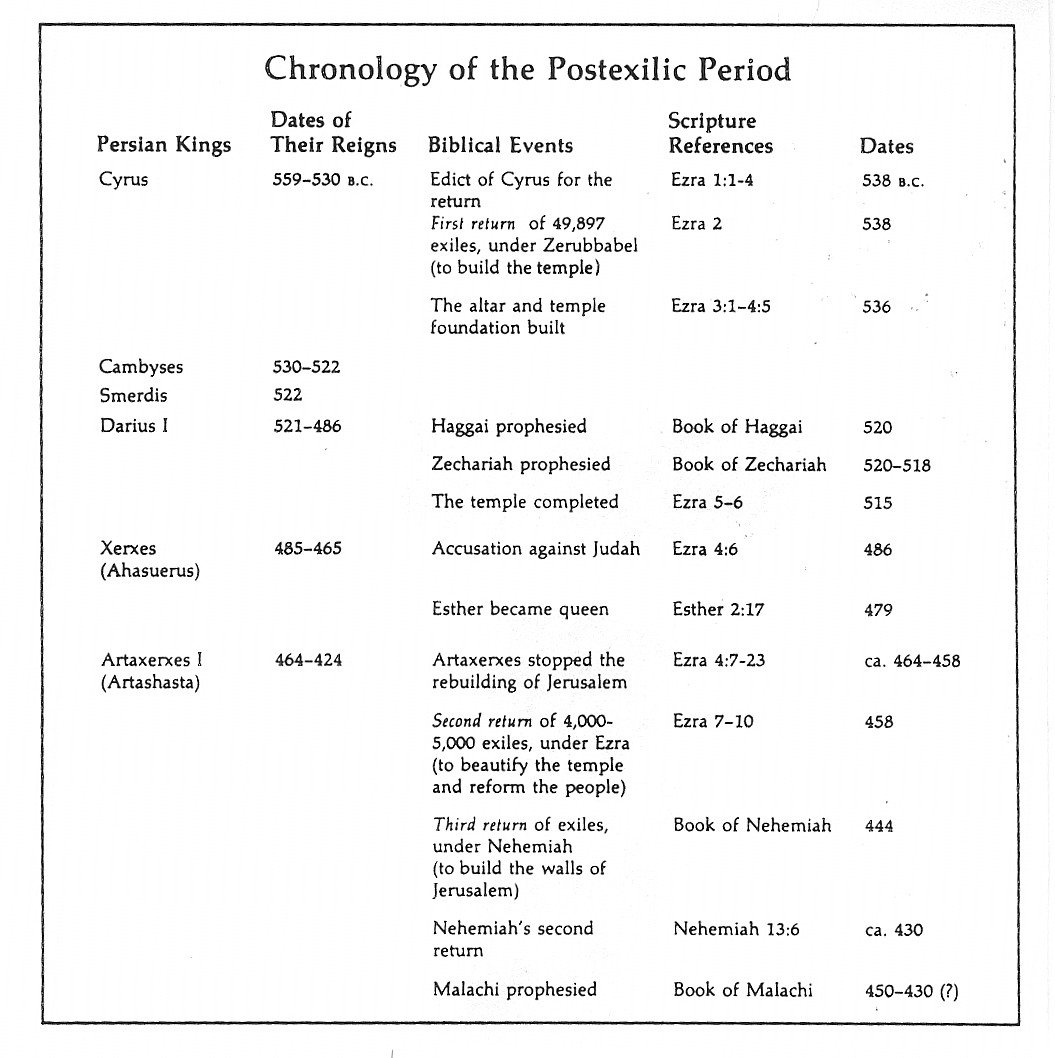
4:6-16 An aggressive letter writing campaign, that includes the Persian officials, asks one of Cyrus' successors to stop the work, emphasizing the potential damage to the king's revenues (which support them). Their letter indicates that the foundation of the walls was complete, but the height not finished, which adds support to the alternative chronology mentioned in the last post.
4:17-24 The new king confirms that threat of Jewish rebellion and orders the work to stop.
Application: Sometimes the bad guys win, for a while, making life difficult. God's will remains the same.
Prayer: Lord, I pray that You would restrain the forces and influences of evil that seek to prevent Your glory from being displayed, and give me grace and wisdom to overcome opposition. Amen.

Ezra 5 Two Prophets and Problem #2
5:1 Now the prophets, Haggai the prophet, and Zechariah the son of Iddo, prophesied to the Jews who were in Judah and Jerusalem; in the name of the God of Israel they prophesied to them. 2 Then Zerubbabel, and Jeshua, rose up and began to build the house of God which is at Jerusalem; and with them were the prophets of God, helping them.
3 At the same time came to them Tattenai, the governor beyond the River, and Shetharbozenai, and their companions, and said thus to them, "Who gave you a decree to build this house, and to finish this wall?" 4 Then we told them in this way, what the names of the men were who were making this building. 5 But the eye of their God was on the elders of the Jews, and they did not make them cease, until the matter should come to Darius, and then answer should be returned by letter concerning it. 7 They sent a letter to him, in which was written thus: To Darius the king, all peace. 8 Be it known to the king, that we went into the province of Judah, to the house of the great God, which is built with great stones, and timber is laid in the walls; and this work goes on with diligence and prospers in their hands. 9 Then we asked those elders, and said to them thus, "Who gave you a decree to build this house, and to finish this wall?" 10 We asked them their names also, to inform you that we might write the names of the men who were at their head. 11 Thus they returned us answer, saying, "We are the servants of the God of heaven and earth, and are building the house that was built these many years ago, which a great king of Israel built and finished. 12 But after that our fathers had provoked the God of heaven to wrath, he gave them into the hand of Nebuchadnezzar king of Babylon, the Chaldean, who destroyed this house, and carried the people away into Babylon. 13 But in the first year of Cyrus king of Babylon, Cyrus the king made a decree to build this house of God. 14 The gold and silver vessels also of the house of God, which Nebuchadnezzar took out of the temple that was in Jerusalem, and brought into the temple of Babylon, those Cyrus the king took out of the temple of Babylon, and they were delivered to one whose name was Sheshbazzar/Zerubbabel , whom he had made governor; 15 and he said to him, ‘Take these vessels, go, put them in the temple that is in Jerusalem, and let the house of God be built in its place.’ 16 Then the same Sheshbazzar came, and laid the foundations of the house of God which is in Jerusalem: and since that time even until now has it been in building, and yet it is not completed. 17 Now therefore, if it seem good to the king, let a search be made in the king’s treasure house, which is there at Babylon, whether it be so, that a decree was made of Cyrus the king to build this house of God at Jerusalem; and let the king send his pleasure to us concerning this matter."

Observations: 5:1-2 God sends a couple of prophets to get people back on track. The whole reason the people returned from exile was to rebuild the temple, and now they've given up.
Haggai 1:7 Thus says the LORD of hosts: "Consider your ways! 8 Go up to the mountains and bring wood and build the temple, that I may take pleasure in it and be glorified," says the LORD.9 "You looked for much, but indeed it came to little; and when you brought it home, I blew it away. Why?" says the LORD of hosts. "Because of My house that is in ruins, while every one of you runs to his own house.”
5:3-17 A second time the Persian officials inquire about the the work. The response is exceedingly wise, making a case for the temple, and omitting the decree to stop.

Ezra 6 Search and Decree, Round 2
6:1 Then Darius the king made a decree, and search was made in the house of the archives, where the treasures were laid up in Babylon. 2 There was found at Achmetha, in the palace that is in the province of Media, a scroll, and therein was thus written for a record: 3 In the first year of Cyrus the king, Cyrus the king made a decree: Concerning the house of God at Jerusalem, let the house be built, the place where they offer sacrifices, and let its foundations be strongly laid; its height sixty cubits, and its breadth sixty cubits; 4 with three courses of great stones, and a course of new timber: and let the expenses be given out of the king’s house. 5 Also let the gold and silver vessels of the house of God, which Nebuchadnezzar took forth out of the temple which is at Jerusalem, and brought to Babylon, be restored, and brought again to the temple which is at Jerusalem, everyone to its place; and you shall put them in the house of God. 6 Now therefore, Tattenai, governor beyond the River, you must stay far from there. 7 Leave the work of this house of God alone; let the governor of the Jews and the elders of the Jews build this house of God in its place. 8 Moreover I make a decree what you shall do to these elders of the Jews for the building of this house of God: that of the king’s goods, even of the tribute beyond the River, expenses be given with all diligence to these men, that they be not hindered. 9 That which they have need of, both young bulls, and rams, and lambs, for burnt offerings to the God of heaven; also wheat, salt, wine, and oil, according to the word of the priests who are at Jerusalem, let it be given them day by day without fail; 10 that they may offer sacrifices of pleasant aroma to the God of heaven, and pray for the life of the king, and of his sons. 11 Also I have made a decree, that whoever shall alter this word, let a beam be pulled out from his house, and let him be lifted up and fastened thereon; and let his house be made a dunghill for this: 12 and the God who has caused his name to dwell there overthrow all kings and peoples who shall put forth their hand to alter the same, to destroy this house of God which is at Jerusalem. I Darius have made a decree; let it be done with all diligence.
13 Then Tattenai, the governor beyond the River, and their companions, because Darius the king had sent a decree, did accordingly with all diligence. 14 The elders of the Jews built and prospered, through the prophesying of Haggai the prophet and Zechariah the son of Iddo. They built and finished it, according to the commandment of the God of Israel, and according to the decree of Cyrus, and Darius, and Artaxerxes king of Persia. 15 This house was finished on the third day of the month Adar, which was in the sixth year of the reign of Darius the king. 16 The children of Israel, the priests, and the Levites, and the rest of the children of the captivity, kept the dedication of this house of God with joy. 17 They offered at the dedication of this house of God one hundred bulls, two hundred rams, four hundred lambs; and for a sin offering for all Israel, twelve male goats, according to the number of the tribes of Israel. 18 They set the priests in their divisions, and the Levites in their courses, for the service of God, which is at Jerusalem; as it is written in the book of Moses. 19 The children of the captivity kept the Passover on the fourteenth day of the first month. 20 For the priests and the Levites had purified themselves together; all of them were pure: and they killed the Passover for all the children of the captivity, and for their brothers the priests, and for themselves. 21 The children of Israel who had come again out of the captivity, and all such as had separated themselves to them from the filthiness of the nations of the land, to seek Yahweh, the God of Israel, ate, 22 and kept the feast of unleavened bread seven days with joy: for Yahweh had made them joyful, and had turned the heart of the king of Assyria to them, to strengthen their hands in the work of the house of God, the God of Israel.

Observations: 6:1-22 This time, the problem turns into prosperity, as God honors their commitment to His work, and turns the heart and resources of the king toward them. Not only does God protect, but He prospers them, and the work. What's not to like?
Application: God's work, done God's way, will not only experience Satanic opposition, but God's protection and provision, resulting in prosperity.
Prayer: God, it seems that the only thing that limits Your blessing is my lack of faithful obedience; may I never hinder Your glory by my slowness to obey all the way. Amen.

Ezra 7 God's Hand on Ezra
7:1 Now after these things, in the reign of Artaxerxes king of Persia, Ezra the son of...5... Phinehas, the son of Eleazar, the son of Aaron the chief priest; 6 this Ezra went up from Babylon: and he was a ready scribe in the law of Moses, which Yahweh, the God of Israel, had given; and the king granted him all his request, according to the hand of Yahweh his God on him. 9...he came to Jerusalem, according to the good hand of his God on him. 10 For Ezra had set his heart to seek the law of Yahweh, and to do it, and to teach in Israel statutes and ordinances.
11 Now this is the copy of the letter that the king Artaxerxes gave to Ezra...12 Artaxerxes, king of kings, to Ezra the priest, the scribe of the law of the God of heaven, perfect and so forth. 13 I make a decree, that all those of the people of Israel, and their priests and the Levites, in my realm, who are minded of their own free will to go to Jerusalem, go with you. 14 Because you are sent of the king and his seven counselors, to inquire concerning Judah and Jerusalem, according to the law of your God which is in your hand, 15 and to carry the silver and gold, which the king and his counselors have freely offered to the God of Israel, whose habitation is in Jerusalem, 16 and all the silver and gold that you shall find in all the province of Babylon, with the freewill offering of the people, and of the priests, offering willingly for the house of their God which is in Jerusalem; 17 therefore you shall with all diligence buy with this money bulls, rams, lambs, with their meal offerings and their drink offerings, and shall offer them on the altar of the house of your God which is in Jerusalem. 18 Whatever shall seem good to you and to your brothers to do with the rest of the silver and the gold, do that after the will of your God. 19 The vessels that are given to you for the service of the house of your God, deliver before the God of Jerusalem. 20 Whatever more shall be needful for the house of your God, which you shall have occasion to bestow, bestow it out of the king’s treasure house. 21 I, even I Artaxerxes the king, do make a decree to all the treasurers who are beyond the River, that whatever Ezra the priest, the scribe of the law of the God of heaven, shall require of you, it be done with all diligence, 22 to one hundred talents of silver, and to one hundred measures of wheat, and to one hundred baths of wine, and to one hundred baths of oil, and salt without prescribing how much. 23 Whatever is commanded by the God of heaven, let it be done exactly for the house of the God of heaven; for why should there be wrath against the realm of the king and his sons? 24 Also we inform you, that touching any of the priests and Levites, the singers, porters, Nethinim, or servants of this house of God, it shall not be lawful to impose tribute, custom, or toll, on them. 25 You, Ezra, after the wisdom of your God who is in your hand, appoint magistrates and judges, who may judge all the people who are beyond the River, all such as know the laws of your God; and teach him who doesn’t know them. 26 Whoever will not do the law of your God, and the law of the king, let judgment be executed on him with all diligence, whether it be to death, or to banishment, or to confiscation of goods, or to imprisonment.
27 Blessed be Yahweh, the God of our fathers, who has put such a thing as this in the king’s heart, to beautify the house of Yahweh which is in Jerusalem; 28 and has extended hesed/loyal covenantal love to me before the king, and his counselors, and before all the king’s mighty princes. I was strengthened according to the hand of Yahweh my God on me, and I gathered together out of Israel chief men to go up with me.

Observations: 7:1-10 Ezra was greatly blessed by God, and used to bless others because he followed the “secret of successful kings” (see last Sunday's post, or Truthbase.net). He set his heart to: learn the truth, live the truth, and teach the truth in Israel. He could have stayed quite comfortably in Babylon, but He desired God's glory above his own.
7:11-26 God responded to Ezra's purpose by moving the king to respond to Ezra's request (to go to Jerusalem) with giving him people, authority, and abundant physical blessings (including tax exemption). Serving God in Jerusalem was a “free will” decision of the people (7:13). The king and his counselors freely gave to support the house of Yahweh, because they didn't want His wrath to fall on them (sounds like they got “fear of the Lord”). They also had the right perspective on obedience (7:23). Apparently they weren't huge fans of toleration and freedom of choice, using the power of the state to support “religion.” Such a policy is usually a bad idea, since most folks ideas about religion are bad.
Application: The reason you're reading this is because yours truly set his heart like Ezra's (7:10) albeit, to teach in NYC. You might consider a little do-it-yourself heart surgery, and get your heart set in the same direction as Ezra's: Learn the Truth, Live the Truth, Love others with the Truth.
Prayer: Lord God, thanks that You bless, protect, and prosper those whose hearts are set on glorifying You. Amen.

Ezra 8 God Protects and Delivers
8:1 Now these are the heads of their fathers’ households, and this is the genealogy of those who went up with me from Babylon, in the reign of Artaxerxes the king...15 I gathered them together to the river that runs to Ahava; and there we encamped three days: and I viewed the people, and the priests, and found there none of the sons of Levi. 16 Then I sent for Eliezer... who were teachers. 17 I sent them forth to Iddo...that they should bring to us ministers for the house of our God. 18 According to the good hand of our God on us they brought us a man of discretion...
21 Then I proclaimed a fast there, at the river Ahava, that we might humble ourselves before our God, to seek of him a straight way for us, and for our little ones, and for all our substance. 22 For I was ashamed to ask of the king a band of soldiers and horsemen to help us against the enemy in the way, because we had spoken to the king, saying, "The hand of our God is on all those who seek him, for good; but his power and his wrath is against all those who forsake him." 23 So we fasted and begged our God for this: and he was entreated of us.
24 Then I set apart twelve of the chiefs of the priests...26 I weighed into their hand six hundred fifty talents of silver, and silver vessels one hundred talents; of gold one hundred talents; 27 and twenty bowls of gold, of one thousand darics; and two vessels of fine bright brass, precious as gold. 28 I said to them, "You are holy to Yahweh, and the vessels are holy; and the silver and the gold are a freewill offering to Yahweh, the God of your fathers.29 Watch, and keep them, until you weigh them before the chiefs of the priests and the Levites, and the princes of the fathers' houses of Israel, at Jerusalem, in the chambers of the house of Yahweh." 31 Then we departed from the river Ahava on the twelfth day of the first month, to go to Jerusalem: and the hand of our God was on us, and he delivered us from the hand of the enemy and the bandit by the way. 32 We came to Jerusalem, and abode there three days.33 On the fourth day the silver and the gold and the vessels were weighed in the house of our God 36 They delivered the king's commissions to the king's satraps, and to the governors beyond the River: and they furthered the people and the house of God.

Observations: 8:1-18 Ezra recognized that ministry was a team sport, so he specifically sought Levitical teachers and ministers to assist in the work.
8:21-36 Ezra and company sought Yahweh for protection from bandits and the enemy because he didn't want to rely on the king's protection instead of Yahweh's, and thus diminish God's reputation in the king's sight. God answered their prayer and delivered them safely, and they delivered the goods to the house of Yahweh in Jerusalem.
Application: The good hand of God is upon those who seek Him, so seek His will in all you do.
Prayer: God, You delight in protecting and blessing Your people; may I seek You every day, and may Your hand be upon me for good. Thanks. Amen.

Digging Deeper:

God in a nutshell: God allows obstacles to His will so we will learn to trust and depend upon Him. He protects and prospers those who dependently seek Him and His purposes. He is against those who don't. Just because His will is difficult or opposed, it doesn't mean He wants us to abandon it. His hand is not randomly upon people for good, but only because they seek His ways. He moves the hearts of kings, in response to His people's requests, in order to accomplish His purposes. He doesn't make people make requests; that's up to them. He sends prophets and teachers to guide people in His will, if they would only pay attention.

Us in a nutshell: Those who seek God, must do so according to His word, learning it and living it, before passing it on. We can expect His blessing, protection and prosperity as we depend upon Him. We can expect both Satanic opposition and God's enabling grace in seeking to do His will, which at times might look impossible or very difficult. If we are seeking to do His will, He will provide a way to make it happen.


Where to Go for More:
Truthbase.net

Ezra complete text

Ezra 4
4:1 Now when the adversaries of Judah and Benjamin heard that the children of the captivity were building a temple to Yahweh, the God of Israel; 2 then they drew near to Zerubbabel, and to the heads of fathers’ households, and said to them, "Let us build with you; for we seek your God, as you do; and we sacrifice to him since the days of Esar Haddon king of Assyria, who brought us up here." 3 But Zerubbabel, and Jeshua, and the rest of the heads of fathers’ households of Israel, said to them, "You have nothing to do with us in building a house to our God; but we ourselves together will build to Yahweh, the God of Israel, as king Cyrus the king of Persia has commanded us." 4 Then the people of the land weakened the hands of the people of Judah, and troubled them in building, 5 and hired counsellors against them, to frustrate their purpose, all the days of Cyrus king of Persia, even until the reign of Darius king of Persia.
6 In the reign of Ahasuerus, in the beginning of his reign, wrote they an accusation against the inhabitants of Judah and Jerusalem. 7 In the days of Artaxerxes wrote Bishlam, Mithredath, Tabeel, and the rest of his companions, to Artaxerxes king of Persia; and the writing of the letter was written in Syrian, and set forth in the Syrian language. 8 Rehum the chancellor and Shimshai the scribe wrote a letter against Jerusalem to Artaxerxes the king in this sort: 9 then Rehum the chancellor, and Shimshai the scribe, and the rest of their companions, the Dinaites, and the Apharsathchites, the Tarpelites, the Apharsites, the Archevites, the Babylonians, the Shushanchites, the Dehaites, the Elamites, 10 and the rest of the nations whom the great and noble Osnappar brought over, and set in the city of Samaria, and in the rest of the country beyond the River, and so forth, wrote. 11 This is the copy of the letter that they sent to Artaxerxes the king: your servants the men beyond the River, and so forth. 12 Be it known to the king, that the Jews who came up from you have come to us to Jerusalem; they are building the rebellious and the bad city, and have finished the walls, and repaired the foundations. 13 Be it known now to the king that if this city is built, and the walls finished, they will not pay tribute, custom, or toll, and in the end it will be hurtful to the kings. 14 Now because we eat the salt of the palace, and it is not appropriate for us to see the king’s dishonour, therefore have we sent and informed the king; 15 that search may be made in the book of the records of your fathers: so you shall find in the book of the records, and know that this city is a rebellious city, and hurtful to kings and provinces, and that they have moved sedition within the same of old time; for which cause was this city laid waste. 16 We inform the king that, if this city be built, and the walls finished, by this means you shall have no portion beyond the River.
17 Then the king sent an answer to Rehum the chancellor, and to Shimshai the scribe, and to the rest of their companions who dwell in Samaria, and in the rest of the country beyond the River: Peace, and so forth. 18 The letter which you sent to us has been plainly read before me. 19 I decreed, and search has been made, and it is found that this city of old time has made insurrection against kings, and that rebellion and sedition have been made therein. 20 There have been mighty kings also over Jerusalem, who have ruled over all the country beyond the River; and tribute, custom, and toll, was paid to them. 21 Make a decree now to cause these men to cease, and that this city not be built, until a decree shall be made by me. 22 Take heed that you not be slack herein: why should damage grow to the hurt of the kings? 23 Then when the copy of king Artaxerxes’ letter was read before Rehum, and Shimshai the scribe, and their companions, they went in haste to Jerusalem to the Jews, and made them to cease by force and power. 24 Then ceased the work of the house of God which is at Jerusalem; and it ceased until the second year of the reign of Darius king of Persia.

Ezra 5
5:1 Now the prophets, Haggai the prophet, and Zechariah the son of Iddo, prophesied to the Jews who were in Judah and Jerusalem; in the name of the God of Israel they prophesied to them. 2 Then rose up Zerubbabel the son of Shealtiel, and Jeshua the son of Jozadak, and began to build the house of God which is at Jerusalem; and with them were the prophets of God, helping them.
3 At the same time came to them Tattenai, the governor beyond the River, and Shetharbozenai, and their companions, and said thus to them, "Who gave you a decree to build this house, and to finish this wall?" 4 Then we told them in this way, what the names of the men were who were making this building. 5 But the eye of their God was on the elders of the Jews, and they did not make them cease, until the matter should come to Darius, and then answer should be returned by letter concerning it. 6 The copy of the letter that Tattenai, the governor beyond the River, and Shetharbozenai, and his companions the Apharsachites, who were beyond the River, sent to Darius the king; 7 they sent a letter to him, in which was written thus: To Darius the king, all peace. 8 Be it known to the king, that we went into the province of Judah, to the house of the great God, which is built with great stones, and timber is laid in the walls; and this work goes on with diligence and prospers in their hands. 9 Then we asked those elders, and said to them thus, "Who gave you a decree to build this house, and to finish this wall?" 10 We asked them their names also, to inform you that we might write the names of the men who were at their head. 11 Thus they returned us answer, saying, "We are the servants of the God of heaven and earth, and are building the house that was built these many years ago, which a great king of Israel built and finished. 12 But after that our fathers had provoked the God of heaven to wrath, he gave them into the hand of Nebuchadnezzar king of Babylon, the Chaldean, who destroyed this house, and carried the people away into Babylon. 13 But in the first year of Cyrus king of Babylon, Cyrus the king made a decree to build this house of God. 14 The gold and silver vessels also of the house of God, which Nebuchadnezzar took out of the temple that was in Jerusalem, and brought into the temple of Babylon, those Cyrus the king took out of the temple of Babylon, and they were delivered to one whose name was Sheshbazzar, whom he had made governor; 15 and he said to him, ‘Take these vessels, go, put them in the temple that is in Jerusalem, and let the house of God be built in its place.’ 16 Then the same Sheshbazzar came, and laid the foundations of the house of God which is in Jerusalem: and since that time even until now has it been in building, and yet it is not completed. 17 Now therefore, if it seem good to the king, let a search be made in the king’s treasure house, which is there at Babylon, whether it be so, that a decree was made of Cyrus the king to build this house of God at Jerusalem; and let the king send his pleasure to us concerning this matter."

Ezra 6
6:1 Then Darius the king made a decree, and search was made in the house of the archives, where the treasures were laid up in Babylon. 2 There was found at Achmetha, in the palace that is in the province of Media, a scroll, and therein was thus written for a record: 3 In the first year of Cyrus the king, Cyrus the king made a decree: Concerning the house of God at Jerusalem, let the house be built, the place where they offer sacrifices, and let its foundations be strongly laid; its height sixty cubits, and its breadth sixty cubits; 4 with three courses of great stones, and a course of new timber: and let the expenses be given out of the king’s house. 5 Also let the gold and silver vessels of the house of God, which Nebuchadnezzar took forth out of the temple which is at Jerusalem, and brought to Babylon, be restored, and brought again to the temple which is at Jerusalem, everyone to its place; and you shall put them in the house of God. 6 Now therefore, Tattenai, governor beyond the River, Shetharbozenai, and your companions the Apharsachites, who are beyond the River, you must stay far from there. 7 Leave the work of this house of God alone; let the governor of the Jews and the elders of the Jews build this house of God in its place. 8 Moreover I make a decree what you shall do to these elders of the Jews for the building of this house of God: that of the king’s goods, even of the tribute beyond the River, expenses be given with all diligence to these men, that they be not hindered. 9 That which they have need of, both young bulls, and rams, and lambs, for burnt offerings to the God of heaven; also wheat, salt, wine, and oil, according to the word of the priests who are at Jerusalem, let it be given them day by day without fail; 10 that they may offer sacrifices of pleasant aroma to the God of heaven, and pray for the life of the king, and of his sons. 11 Also I have made a decree, that whoever shall alter this word, let a beam be pulled out from his house, and let him be lifted up and fastened thereon; and let his house be made a dunghill for this: 12 and the God who has caused his name to dwell there overthrow all kings and peoples who shall put forth their hand to alter the same, to destroy this house of God which is at Jerusalem. I Darius have made a decree; let it be done with all diligence.
13 Then Tattenai, the governor beyond the River, Shetharbozenai, and their companions, because Darius the king had sent a decree, did accordingly with all diligence. 14 The elders of the Jews built and prospered, through the prophesying of Haggai the prophet and Zechariah the son of Iddo. They built and finished it, according to the commandment of the God of Israel, and according to the decree of Cyrus, and Darius, and Artaxerxes king of Persia. 15 This house was finished on the third day of the month Adar, which was in the sixth year of the reign of Darius the king. 16 The children of Israel, the priests, and the Levites, and the rest of the children of the captivity, kept the dedication of this house of God with joy. 17 They offered at the dedication of this house of God one hundred bulls, two hundred rams, four hundred lambs; and for a sin offering for all Israel, twelve male goats, according to the number of the tribes of Israel. 18 They set the priests in their divisions, and the Levites in their courses, for the service of God, which is at Jerusalem; as it is written in the book of Moses. 19 The children of the captivity kept the Passover on the fourteenth day of the first month. 20 For the priests and the Levites had purified themselves together; all of them were pure: and they killed the Passover for all the children of the captivity, and for their brothers the priests, and for themselves. 21 The children of Israel who had come again out of the captivity, and all such as had separated themselves to them from the filthiness of the nations of the land, to seek Yahweh, the God of Israel, ate, 22 and kept the feast of unleavened bread seven days with joy: for Yahweh had made them joyful, and had turned the heart of the king of Assyria to them, to strengthen their hands in the work of the house of God, the God of Israel.

Ezra 7
7:1 Now after these things, in the reign of Artaxerxes king of Persia, Ezra the son of Seraiah, the son of Azariah, the son of Hilkiah, 2 the son of Shallum, the son of Zadok, the son of Ahitub, 3 the son of Amariah, the son of Azariah, the son of Meraioth, 4 the son of Zerahiah, the son of Uzzi, the son of Bukki, 5 the son of Abishua, the son of Phinehas, the son of Eleazar, the son of Aaron the chief priest; 6 this Ezra went up from Babylon: and he was a ready scribe in the law of Moses, which Yahweh, the God of Israel, had given; and the king granted him all his request, according to the hand of Yahweh his God on him. 7 There went up some of the children of Israel, and of the priests, and the Levites, and the singers, and the porters, and the Nethinim, to Jerusalem, in the seventh year of Artaxerxes the king. 8 He came to Jerusalem in the fifth month, which was in the seventh year of the king. 9 For on the first day of the first month began he to go up from Babylon; and on the first day of the fifth month came he to Jerusalem, according to the good hand of his God on him. 10 For Ezra had set his heart to seek the law of Yahweh, and to do it, and to teach in Israel statutes and ordinances.
11 Now this is the copy of the letter that the king Artaxerxes gave to Ezra the priest, the scribe, even the scribe of the words of the commandments of Yahweh, and of his statutes to Israel: 12 Artaxerxes, king of kings, to Ezra the priest, the scribe of the law of the God of heaven, perfect and so forth. 13 I make a decree, that all those of the people of Israel, and their priests and the Levites, in my realm, who are minded of their own free will to go to Jerusalem, go with you. 14 Because you are sent of the king and his seven counsellors, to inquire concerning Judah and Jerusalem, according to the law of your God which is in your hand, 15 and to carry the silver and gold, which the king and his counsellors have freely offered to the God of Israel, whose habitation is in Jerusalem, 16 and all the silver and gold that you shall find in all the province of Babylon, with the freewill offering of the people, and of the priests, offering willingly for the house of their God which is in Jerusalem; 17 therefore you shall with all diligence buy with this money bulls, rams, lambs, with their meal offerings and their drink offerings, and shall offer them on the altar of the house of your God which is in Jerusalem. 18 Whatever shall seem good to you and to your brothers to do with the rest of the silver and the gold, do that after the will of your God. 19 The vessels that are given to you for the service of the house of your God, deliver before the God of Jerusalem. 20 Whatever more shall be needful for the house of your God, which you shall have occasion to bestow, bestow it out of the king’s treasure house. 21 I, even I Artaxerxes the king, do make a decree to all the treasurers who are beyond the River, that whatever Ezra the priest, the scribe of the law of the God of heaven, shall require of you, it be done with all diligence, 22 to one hundred talents of silver, and to one hundred measures of wheat, and to one hundred baths of wine, and to one hundred baths of oil, and salt without prescribing how much. 23 Whatever is commanded by the God of heaven, let it be done exactly for the house of the God of heaven; for why should there be wrath against the realm of the king and his sons? 24 Also we inform you, that touching any of the priests and Levites, the singers, porters, Nethinim, or servants of this house of God, it shall not be lawful to impose tribute, custom, or toll, on them. 25 You, Ezra, after the wisdom of your God who is in your hand, appoint magistrates and judges, who may judge all the people who are beyond the River, all such as know the laws of your God; and teach him who doesn’t know them. 26 Whoever will not do the law of your God, and the law of the king, let judgment be executed on him with all diligence, whether it be to death, or to banishment, or to confiscation of goods, or to imprisonment.
27 Blessed be Yahweh, the God of our fathers, who has put such a thing as this in the king’s heart, to beautify the house of Yahweh which is in Jerusalem; 28 and has extended loving kindness to me before the king, and his counsellors, and before all the king’s mighty princes. I was strengthened according to the hand of Yahweh my God on me, and I gathered together out of Israel chief men to go up with me.

Ezra 8
8:1 Now these are the heads of their fathers’ households, and this is the genealogy of those who went up with me from Babylon, in the reign of Artaxerxes the king: 2 Of the sons of Phinehas, Gershom. Of the sons of Ithamar, Daniel. Of the sons of David, Hattush. 3 Of the sons of Shecaniah, of the sons of Parosh, Zechariah; and with him were reckoned by genealogy of the males one hundred fifty. 4 Of the sons of Pahathmoab, Eliehoenai the son of Zerahiah; and with him two hundred males. 5 Of the sons of Shecaniah, the son of Jahaziel; and with him three hundred males. 6 Of the sons of Adin, Ebed the son of Jonathan; and with him fifty males. 7 Of the sons of Elam, Jeshaiah the son of Athaliah; and with him seventy males. 8 Of the sons of Shephatiah, Zebadiah the son of Michael; and with him eighty males. 9 Of the sons of Joab, Obadiah the son of Jehiel; and with him two hundred and eighteen males. 10 Of the sons of Shelomith, the son of Josiphiah; and with him one hundred sixty males. 11 Of the sons of Bebai, Zechariah the son of Bebai; and with him twenty-eight males. 12 Of the sons of Azgad, Johanan the son of Hakkatan; and with him one hundred ten males. 13 Of the sons of Adonikam, who were the last; and these are their names: Eliphelet, Jeuel, and Shemaiah; and with them sixty males. 14 Of the sons of Bigvai, Uthai and Zabbud; and with them seventy males. 15 I gathered them together to the river that runs to Ahava; and there we encamped three days: and I viewed the people, and the priests, and found there none of the sons of Levi. 16 Then sent I for Eliezer, for Ariel, for Shemaiah, and for Elnathan, and for Jarib, and for Elnathan, and for Nathan, and for Zechariah, and for Meshullam, chief men; also for Joiarib, and for Elnathan, who were teachers. 17 I sent them forth to Iddo the chief at the place Casiphia; and I told them what they should tell Iddo, and his brothers the Nethinim, at the place Casiphia, that they should bring to us ministers for the house of our God. 18 According to the good hand of our God on us they brought us a man of discretion, of the sons of Mahli, the son of Levi, the son of Israel; and Sherebiah, with his sons and his brothers, eighteen; 19 and Hashabiah, and with him Jeshaiah of the sons of Merari, his brothers and their sons, twenty; 20 and of the Nethinim, whom David and the princes had given for the service of the Levites, two hundred and twenty Nethinim: all of them were mentioned by name.
21 Then I proclaimed a fast there, at the river Ahava, that we might humble ourselves before our God, to seek of him a straight way for us, and for our little ones, and for all our substance. 22 For I was ashamed to ask of the king a band of soldiers and horsemen to help us against the enemy in the way, because we had spoken to the king, saying, "The hand of our God is on all those who seek him, for good; but his power and his wrath is against all those who forsake him." 23 So we fasted and begged our God for this: and he was entreated of us.
24 Then I set apart twelve of the chiefs of the priests, even Sherebiah, Hashabiah, and ten of their brothers with them, 25 and weighed to them the silver, and the gold, and the vessels, even the offering for the house of our God, which the king, and his counsellors, and his princes, and all Israel there present, had offered: 26 I weighed into their hand six hundred fifty talents of silver, and silver vessels one hundred talents; of gold one hundred talents;27 and twenty bowls of gold, of one thousand darics; and two vessels of fine bright brass, precious as gold.28 I said to them, "You are holy to Yahweh, and the vessels are holy; and the silver and the gold are a freewill offering to Yahweh, the God of your fathers.29 Watch, and keep them, until you weigh them before the chiefs of the priests and the Levites, and the princes of the fathers' houses of Israel, at Jerusalem, in the chambers of the house of Yahweh."30 So the priests and the Levites received the weight of the silver and the gold, and the vessels, to bring them to Jerusalem to the house of our God.31 Then we departed from the river Ahava on the twelfth day of the first month, to go to Jerusalem: and the hand of our God was on us, and he delivered us from the hand of the enemy and the bandit by the way.32 We came to Jerusalem, and abode there three days.33 On the fourth day the silver and the gold and the vessels were weighed in the house of our God into the hand of Meremoth the son of Uriah the priest; and with him was Eleazar the son of Phinehas; and with them was Jozabad the son of Jeshua, and Noadiah the son of Binnui, the Levite;34 the whole by number and by weight: and all the weight was written at that time.35 The children of the captivity, who had come out of exile, offered burnt offerings to the God of Israel, twelve bulls for all Israel, ninety-six rams, seventy-seven lambs, and twelve male goats for a sin offering: all this was a burnt offering to Yahweh.36 They delivered the king's commissions to the king's satraps, and to the governors beyond the River: and they furthered the people and the house of God.