Showing posts with label commandment. Show all posts

Jude and Philemon - Truth and Love

TMS John 13:34-35 True Love
Jn 13:34 ”A new commandment I give to you,
that you love one another;
as I have loved you,
that you also love one another.
35 By this all will know that you are My disciples,
if you have love for one another."

Observations: 13:34-35 This is the major teaching of Jesus during the Last Supper as recorded by John (and elaborated upon in John's epistles as well). The hallmark of a disciple is the loyal love they have for their brothers and sisters in Christ. The OT taught that believers should love their neighbor (Lev 19:18) and Paul said such love summed up the law (Gal 5:14). Jesus' audience considered it the second greatest commandment upon which hung all the others. So what's new? The standard to which we are to measure our love is new. If we wish to obey this command, we must love others as Jesus modeled. His was a self-sacrificial love (yet at the time, He had not yet gone to the cross, but had spoken of laying down His life for others). In the earlier half of John 13, the only thing about the Lord's Supper which John recorded was the laying aside of Jesus' outer garments to wash the disciples' feet. Paul gives more insight on this in Philippians 2. Jesus modeled humbling oneself to meet the needs of others (for cleansing, but that might be pushing the analogy too far). In any event, in His life, Jesus loved others in teaching them truth that would benefit them eternally, and then gave the ultimate self-sacrifice on the cross.
Application: Our love must be like Christ's in sacrificially serving others if we wish to obey God.
Prayer: Jesus, thanks for loving me, dying for me, and giving me Your commandments; may I love others as I follow Your purposes for my life on this planet. Amen.


Jude and Philemon These two little letters pack powerful punches. The one to Philemon is the last and shortest of Paul's epistles (which are arranged by length). It addresses the forgiveness and reception of a runaway slave whom Paul led to Christ in prison, and was now sending back to his original master. It provides an allegorical picture of God's dealings with us, as well as a application of relationships characterized by love and forgiveness.
The last epistle of the NT, Jude was written by one of Jesus' half-brothers, and warns believers against abusing grace, denying the Lordship of Christ in their lives, and indulging their desires. The judgment awaiting such erring believers should motivate us to build ourselves up in our faith (whatever that means) and strive for future glory.


Jude 1 Faultless Faith
1:1 Jude, a servant of Jesus Christ, and brother of James, to those who are sanctified/loved by God the Father, and kept/guarded by/in Jesus Christ, the called: 2 Mercy to you and peace and love be multiplied.
3 Beloved, while I was very eager to write to you about our common salvation, I was constrained to write to you exhorting you to contend earnestly for the faith which was once for all delivered to the saints. 4 For there are certain men who crept in secretly, even those who were long ago marked out for this condemnation: ungodly men, turning the grace of our God into indecency, and denying our only Master, God, and Lord, Jesus Christ.
5 Now I desire to remind you, though you already know this, that the Lord, having saved a people out of the land of Egypt, afterward destroyed those who did not believe. 6 Angels who didn’t keep their first domain, but deserted their own dwelling place, he has kept in everlasting bonds under darkness for the judgment of the great day. 7 Even as Sodom and Gomorrah, and the cities around them, having, in the same way as these, given themselves over to sexual immorality and gone after strange flesh, are set forth as an example, suffering the punishment/justice of the fire of the age.
8 Yet in the same way, these dreamers defile the flesh, despise dominion/authority, and speak evil of glory/celestial beings. 9 But Michael, the archangel, when contending with the devil and arguing about the body of Moses, dared not bring against him an abusive condemnation, but said, "May the Lord rebuke you!" 10 But these speak evil of whatever things they don’t know. What they understand naturally, like the creatures without reason; by these things they corrupt/defile themselves. 11 Woe to them! For they went in the way of Cain, and ran riotously in the error of Balaam for hire, and perished in Korah’s rebellion.
12 These are hidden rocky reefs in your love feasts when they feast with you, shepherds who without fear feed themselves; clouds without water, carried along by winds; autumn leaves without fruit, twice dead, plucked up by the roots; 13 wild waves of the sea, foaming out their own shame; wandering stars, for whom the blackness of darkness has been reserved forever. 14 About these also Enoch, the seventh from Adam, prophesied, saying, "Behold, the Lord came with ten thousands of his holy ones,15 to execute judgment on all, and to convict all the ungodly of all their works of ungodliness which they have done in an ungodly way, and of all the hard things which ungodly sinners have spoken against him." 16 These are murmurers and complainers, walking after their lusts (and their mouth speaks proud things), showing respect of persons to gain advantage.
17 But you, beloved, remember the words which have been spoken before by the apostles of our Lord Jesus Christ. 18 They said to you that "In the last time there will be mockers, walking after their own ungodly lusts." 19 These are they who cause divisions, and are sensual, not having the Spirit. 20 But you, beloved, keep building up yourselves on your most holy faith, praying in the Holy Spirit. 21 Keep yourselves in the love of God, looking for the mercy of our Lord Jesus Christ to eternal life.
22 And [have mercy, who are doubting] [reprove, who are contending] 23 and/but de some save, snatching them out of the fire with fear, hating even the clothing stained by the flesh.
24 Now to him who is able to keep you from stumbling, and to present you faultless before the presence of his glory in great joy, 25 to God our Savior, who alone is wise, be glory and majesty, dominion and power, both now and forever. Amen.

Observations: 1:1-2 Jude, as the brother of James would have been the half-brother of Jesus (see comments on James 1), yet refers to himself as the servant of Jesus the Messiah. He writes to believers who are loved or sanctified by the Father (a textual variant yields the two different translations), and kept by the power of Jesus the Messiah, who thus can be called “the called/invited.” This last word occurs at the end of the Greek text for emphasis (as in the KJV), although many translations put it at the beginning of the sentence. Believers who are sanctified and preserved or guarded in their relationship with Christ are the ones who are invited to the wedding feast of the Lamb. Jude wishes that three blessings be multiplied to them, which many erroneously think of as static forces in the past, rather than dynamic forces in the present and future, which can be had in varying degrees. Mercy is the usual LXX translation of hesed or loyal covenantal love which can be experienced differentially based upon our loyalty. The same goes for peace and love.
1:3 Jude wanted to write about the common salvation they share, probably not telling them about the fact that Jesus died for their sins, since unless they were complete morons, they wouldn't need constant reminders about the justification aspects of their salvation, since they didn't become believers without embracing the truth that Jesus died in their place. It's more likely that he intended to emphasize the glorification rather than sanctification aspect of their salvation since he ends the letter on that in verses 24-25. But instead of talking about glory and the means to attaining it, he was forced by the infestation of false teachers to exhort them to contend/fight (epi-agonizomai an intensive agonized fight, struggle or labor) for the faith once and for all delivered to the saints. This is not just the belief that Jesus died for their sins, but the expectation that He would be returning to set up His kingdom and reward those who diligently sought to please Him, which is what would bring their hope of glory into the reality of their experience (see comments on Heb 11:6). Jude tells them to build themselves up in the faith in verse 20 (which again is not somehow building the belief in the atonement, but is used in the NT of building on the foundation of Christ by ministering to others with the expectation of judgment and reward -1Cor 3:10,12,14; Acts 20:32). The fact that the content of the faith that holy ones (saints) need to believe and obey was once and for all delivered to them, precludes the need for any other revelation or prophet or prophetess getting or giving “revelation” to God's people. Any such “additional” revelation would not have its source in God. Faithful believers must fight against false teaching.
1:4 The reason for Jude's change of subject matter is the infiltration of the creepy crawly false teachers whom Paul (Acts 20:29-30; 1Tim 4:1) and Peter (2Pt 2:1) warned about (cf Jude 17-18). They sneak into the church unnoticed, which would be a pretty impressive feat of legerdemain, or an incredible indictment of the gullibility of believers, if no one noticed that the teachers were denying that Jesus existed or died for their sins (although in modern times they could get away with such brazen lies -2Tim 4:3-4). Jude tells us exactly what they were doing, they were turning the grace of God, which every believer had embraced and experienced in being regenerated (born-again) into a license for sin. They were denying the Lordship of Christ, and the right of God to rule or be Master in their lives. We are saved/justified by grace (Eph 2:8-9) through exercising faith, but that doesn't mean we should continue to sin (as Paul emphatically states in Romans 6). These folks aren't denying the deity of Christ, nor the efficacy of His atonement (the Saviorship of Christ) but that God is their Master, and Jesus the Messiah is their Lord (see comments on 2Pt 2:1 where the same word Master/despot is used). Long ago (Dt 28) God had sovereignly attached condemnation/cursing rather than blessing to such ungodly behavior (not knowing and doing what he wanted -see Titus 1). Those who are not concerned about knowing and doing God's will, who live for their pleasure and glory rather than God's, are engaging in ungodly behavior. “It's all under the blood” or “Grace has got it covered” is true with respect to an individual going into the lake of fire for their sins, because Jesus did die for all their sins, but that does not spare them the judgment and condemnation of those who disobey God, as Jude will now illustrate (see comments on Mt 5-7; and the warning passages in Hebrews, more warning pasages in Hebrewsanother warning passage in Hebrewsfinal warning passage).
1:5-7 Jude reminds those who have bought into the lie that there are no negative consequences for those who are born again of some things that carnal Christians (those who live for their temporal desires -1Cor 2; Rm 8) delight in being ignorant about. The parallel between the nation of Israel and NT believers is clearly spelled out in 1Corinthians 10, even down to having the Spirit and Christ as well as in other places (Rm 15:4). God saved/redeemed the Jews out of Egypt but then destroyed those who were not faithful to obey Him and enter the Promised Land. Jude uses the aorist participle, “those who were not believing.” What did they not believe? The promises of God to bless and curse (Exodus 20; Num 14:27-37; Heb 3:17-19). It's not that they didn't believe God redeemed them in the past, but that they had an obligation to serve and obey Him to enjoy the future. Angels who rebelled in following Satan, or perhaps those referred to in Genesis 6 who didn't follow God's order for them, suffered a similar discipline, losing their glorified status, and being kept in everlasting (not the word for “age,” but the word for “always”) chains in darkness awaiting greater judgment on the great Day of the Lord. Similarly Sodom and Gomorrah gave themselves over to their unrestrained passions, particularly immorality and homosexuality, and serve as an example of those who please themselves rather than God, and are suffering (present tense) the punishment of the age (not the eternal one of the angels, nor the past one of the Israelites). All three of those who failed to do what God desired are cited as an example of those who suffer punishment and loss for their unwise and unfaithful choices. All three judgments are different, and it could be argued are mutually exclusive, so Jude is not saying unfaithful believers who follow the false teachings will experience the same judgments, just that they will experience similar unpleasantness.
1:8-11 Returning to the false teachers, Jude calls them dreamers (out of touch with reality) who like those above defile the flesh, despise dominion/authority, and speak evil of glory (literally as in 2Pt 2:10, but translated as beings in light of the next verse). Even Michael the archangel, when contending with the devil about the body of Moses (who knew?), didn't speak evil (same word root as the previous verse) but asked the Lord to rebuke him. This account isn't in the Scripture, but was present in Jewish tradition. Jude appeals to it to make his case as did Paul to the Cretan poet in Titus 1. The false teachers speak evil about whatever they don't understand, a trait common among those who just parrot party lines without knowing the Scriptures in their context. What the false teachers do say are understood naturally, like brute beasts (as opposed to learned by the Spirit of Truth), and these things they teach result in their corruption (and eventual destruction). Jude pronounces a warning of woe upon them because they are following the ways of Cain (Gen 4) Balaam (Num 22) and Korah (Num 16), who all ended poorly.
1:12-16 Some consider the references to the love feast (Lord's Supper) to be the chiastic center of the book. Others argue for verse 9 which fits the theme of contending. What is clear to Jude (and us) is that the false teachers were dangerous, like hidden reefs waiting to shipwreck believers' faith (1Tim 1:19) which prevents one from reaching the intended safe harbor of peace. The false teachers will say they love Jesus, and commemorate Him, but lack fear of God (as do most who parrot lies -Mt 12:36). They pose as shepherds/pastors or teachers who only feed themselves. They don't provide words by which others can live, but are like clouds without rain, and fruitless leaves, without roots in the truth. There's a lot of emotion and froth, but no truth. They are like wandering stars (the word for heresy is from the same root as planet, which looked like wandering stars which had deviated from the right path), for whom was reserved the punishment of the darkness of the Age (2Pt 2:17).
The Book of Enoch is considered to be from first century BC, but is allegedly, based upon tradition, a preservation of what Enoch prophesied. It was also known to the church fathers in the second century AD, and a few fragments had been found, but an entire copy was found in AD 1773. Enoch, known to the NT audience, was the seventh person in the Genesis genealogy, perhaps a reference to the Millennial Age. Jude quotes him to illustrate the judgment that will come upon the ungodly ones in the Day of Judgment. Failure to be godly in one's words and ways sets one up for judgment. Jude describes the ungodly as those who grumble and complain, and walk/live for whatever pleases their temporal desires. They are proud (usually unteachable), and will show hypocritical deference to those who can profit them.
1:17-21 Jude reminds his readers of the words spoken by the apostles (2Pt 3:2-3; 1Tim 4:1; 2Tim 3:1), that in the end times people would mock the way of truth and walk in the way of temporal lust. These folks are not submitted to the Lord Jesus, so there is no basis for unity, and therefore they cause divisions, following their sensual or natural instincts as opposed to the Spirit. They don't have the Spirit indwelling, as in controlling them. See comments on Romans 8:9 where not having the Spirit is contrasted with the Spirit dwelling in those who please God. To make the equation that “not having Spirit” means unregenerate pagans misses the ellipsis, and the contexts of both texts. But some will manage to miss it, since they don't know how to trace an argument in context. These are the same false teachers that Jude has been warning his readers against. They are shepherds and teachers participating in the love feast of the Lord's Supper, the problem is not that they are unregenerate pagans who need to be evangelized but bad believers who need to repent and submit themselves to their Lord and Master. In contrast to them, the good believers need to build themselves up in their most holy faith (the expectation that the Lord would return to reward and rule -1Pt 1; Heb 11:6), and be praying in the Spirit (which is not babbling meaningless sounds) but seeking the mind and will of God as one expresses dependence upon Him to do His will. Such building and praying would be developing the traits that would result in God's reward (2Pt 1 “add to your faith...abundant entrance”). They need to keep/guard themselves so they will remain in the loyal love of God (owing allegiance only to Him), and be eagerly expecting the mercy (hesed - covenantal promise fulfillment) of God, with a view toward receiving dominion of the Messianic Age (eternal life).
1:22-23 Verse 22 has a textual variant (mercy/reprove) and word that has multiple meanings (judge/contend/doubt). The translation most in harmony with the context is the second one in brackets. In addition to following verse 21, believers should “reprove those who are contending (same meaning as the word when used in verse 9) against the faith”. Verse 23 opens with a “de” which joins two different or sequential concepts, rather than a “kai” which joins coordinate concepts. “Having mercy on some and saving others” doesn't take into account the “de” nor make a lot of sense. On the other hand the point of the letter is to have believers contend for the faith, and here in the conclusion, one would expect that to be emphasized. So Jude commands believers to reprove some and to save others, snatching them out of the fiery judgment that awaits them, while fearing God and hating even the clothing (outward trappings, or practices) that is defied by the defiled flesh of those following falsehood.
1:24-25 The letter ends with a great benediction, ascribing praise to our God who is able to keep us from stumbling (and falling short of the glory) and present believers faultless before the presence of His glory with great joy. To our God and Savior, who alone is wise, be glory, majesty, dominion, and power/authority, both now and in the Messianic Age.
Application: Believers must learn to identify and refute false teachers who don't live under the Lordship of Christ; and build themselves up in the faith by drawing on the grace of God to live so as to be faultless when He returns.
Prayer: God, thanks for saving me by Your grace, and giving me the power to live faultless before You; may I live in tune with Your truth and Spirit, under Your Lordship every day, so that You will be glorified by my life. Amen.

Philemon This is Paul's most personal and persuasive letter, written primarily to Philemon in order to induce him to accept back Onesimus, his runaway slave. Paul had met Onesimus in prison and led him to the Lord. Paul gives a number of compelling (almost manipulative) reasons why Philemon should freely and willingly decide to do what is best, The letter also provides insights into relationships among believers in the early church which have modern applications as well.
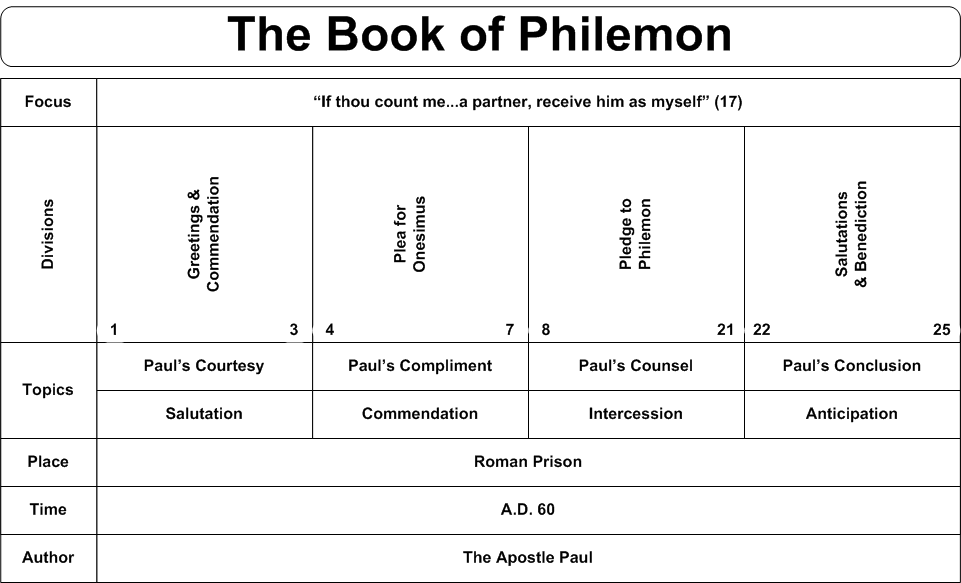


Philemon 1
1:1 Paul, a prisoner of Christ Jesus, and Timothy our brother, to Philemon, our beloved fellow worker, 2 to the beloved Apphia, to Archippus, our fellow soldier, and to the assembly in your house: 3 Grace to you and peace from God our Father and the Lord Jesus Christ.
4 I thank my God always, making mention of you in my prayers, 5 hearing of your love, and of the faith which you have with regard to (pros) the Lord Jesus, and toward (eis) all the saints; 6 that the your participation in the faith may become effective, by the knowledge of every good thing which is in us in Christ Jesus. 7 For we have much joy and comfort in your love, because the hearts of the saints have been refreshed through you, brother.
8 Therefore, though I have all boldness in Christ to command you that which is appropriate, 9 yet for love’s sake I rather beg, being such a one as Paul, the aged, but also a prisoner of Jesus Christ. 10 I beg you for my child, whom I have become the father of in my chains, Onesimus, 11 who once was useless to you, but now is useful to you and to me. 12 I am sending him back. Therefore receive him, that is, my own heart, 13 whom I desired to keep with me, that on your behalf he might serve me in my chains for the Good News. 14 But I was willing to do nothing without your consent, that your goodness would not be as of necessity, but of free will. 15 For perhaps he was therefore separated from you for a while, that you would have him forever, 16 no longer as a slave, but more than a slave, a beloved brother, especially to me, but how much rather to you, both in the flesh and in the Lord.
17 If then you count me a partner, receive him as you would receive me. 18 But if he has wronged you at all, or owes you anything, put that to my account. 19 I, Paul, write this with my own hand: I will repay it (not to mention to you that you owe to me even your own self besides).
20 Yes, brother, let me have joy from you in the Lord. Refresh my heart in the Lord. 21 Having confidence in your obedience, I write to you, knowing that you will do even beyond what I say. 22 Also, prepare a guest room for me, for I hope that through your prayers I will be restored to you. 23 Epaphras, my fellow prisoner in Christ Jesus, greets you, 24 as do Mark, Aristarchus, Demas, and Luke, my fellow workers. 25 The grace of our Lord Jesus Christ be with your spirit. Amen

Observations: 1:1-3 Paul identifies himself a prisoner of the Messiah Jesus, and writes (along with Timothy) to Philemon, and two others, as well as the entire assembly/church which meets in Philemon's house. The number of people who know about the contents of the letter adds pressure for Philemon to act in response to it. Paul wishes Philemon the covenantal blessings of grace and peace.
1:4-7 Paul thanks God for Philemon's love toward the saints and faith in the Lord Jesus (chiastic structure helps us see that faith is not towards the saints, as is further validated by the use of two different prepositions as noted in the text above). Verse 6 is crucial for understanding the letter. Paul prays that Philemon's fellowship or participation (koinonia feminine noun for “having in common” see verse 17 for the masculine form) in the faith might become effective/effectual by the experiential knowledge of every good thing which believers have in their union with Christ. Some translations have “sharing” of his faith, in an evangelistic sense, but Paul's objective is to encourage Philemon to forgive and accept Onesimus, not win others to Christ. Forgiving his runaway slave, and the debt of whatever Onesimus had taken from him when he left would require drawing on the grace that God had extended to him in Christ. Paul refers to how Philemon had used that grace to minister to others in refreshing the hearts of the saints through his generosity to those in need. And thus asks him to extend the same Christlike grace toward Onesimus.
1:8-16 Forgiving and accepting Onesimus was the right thing to do and Paul says he could command Philemon to do what was right, but instead he appeals to him, or even begs him, as the old prisoner of Christ (tugging on the heart strings) to forgive Onesimus. Paul pleads for him as his own child, whom he had led to the Lord while in prison with him. He gives Philemon more reasons to do so, saying that previously Onesimus was an unprofitable servant, but has now become a useful believing brother to both Paul and Philemon. Impressing upon Philemon that “he owes Paul favors” Paul states that Onesimus had ministered to him while in prison, doing the job that Philemon should have done in serving Paul for the furthering of the Good News of the Kingdom of Christ. Paul wanted to keep Onesimus, but didn't want to do so without Philemon's permission, so that any good deed would not be done under compulsion, but as a free will act of Philemon (so there is free-will!). Paul then gives another incentive, pointing out that Philemon would now have Onesimus forever, not as a slave but as a brother in Christ.
1:17-19 Although Paul wants Philemon to willingly accept Onesimus, he makes such a strong case that it would be impossible to refuse with any shred of honor. If Philemon considers Paul a fellow partaker (koinonos the masculine form of the feminine noun in verse 6), then he should receive Onesimus as he would Paul. If Onesimus had wronged him in anything, Philemon should put it on Paul's account. Paul says that he is writing the letter with his own hand to guarantee his pledge, and then reminds Philemon that he owes his very self to Paul, because of Paul's ministry to him. Paul's willingness to go to bat for an escaped slave is an example of the kind of love committed believers showed toward each other.
1:20-25 Paul appears pretty bold in asking Philemon to give him joy and refresh his poor old imprisoned heart by accepting back Onesimus. He says he has confidence that Philemon will not only comply (literally the word for “obey” or “listen under”) with his “request,” but go beyond it, in reinstating Onesimus without prejudice. He also asks Philemon to prepare a guest room in anticipation of God answering his prayers and bringing about Paul's release from prison (a parallel to God answering Paul's prayers to have Onesimus being released form the prison of his debt to Philemon). Speaking of parallels, one can't help but notice the allegorical parallel of the believer being restored to the Father by the work of Christ (where Onesimus is the believer, Philemon is the Father, and Paul is Christ). Paul sends greetings and prays that the grace of Christ would strengthen Philemon's spirit in doing the right thing.
Application: Believers must not harbor bitterness nor resentment towards believers who have wronged them, but extend Christlike forgiveness (regardless of whether or not they repent, to free themselves from bitterness) and acceptance to the repentant as God has done to us, so that our participation in the promises of the Gospel may make a difference in our lives, now and in the future.
Prayer: Heavenly Father, I praise You for the forgiveness and acceptance You've shown me in Christ, may I know and demonstrate similar grace toward others. Amen.


Digging Deeper


God in a nutshell: God has forgiven us by His grace and reinstated us in His graces, and expects us to do the same for others.

Build-a-Jesus: Jesus is the Lord and Master whom we must serve in order to be blessed, or face negative consequences.

Us in a nutshell: Believers need to draw upon God's grace to live so as to please Him, contending against those who teach falsely, and extending love to our fellow saints.

Where to Go for More:
Truthbase.net

Deuteronomy 30-31 Choose Life Or Die

Deuteronomy 30-31 Choose Life or Die

Psalm 31:15-24 Refuge and Reward
Ps 31:15 “(14 But I trust in you, Yahweh. I said, "You are my God.") 15 My times are in your hand. Deliver me from the hand of my enemies, and from those who persecute me. 16 Make your face to shine on your servantSave me in your hesed/loyal covenantal love. 17 Let me not be disappointed, Yahweh, for I have called on you. Let the wicked be disappointed. Let them be silent in Sheol. 18 Let the lying lips be mute, which speak against the righteous insolently, with pride and contempt.
19 Oh how great is your goodness, which you have laid up for those who fear you, which you have worked for those who take refuge in you, before the sons of men! 20 In the shelter of your presence you will hide them from the plotting of man. You will keep them secretly in a dwelling away from the strife of tongues. 21 Praise be to Yahweh, for he has shown me his marvelous hesed/loyal covenantal love in a strong city. 22 As for me, I said in my haste, "I am cut off from before your eyes." Nevertheless you heard the voice of my petitions when I cried to you. 23 Oh love Yahweh, all you his saints! Yahweh preserves the faithful, and fully recompenses him who behaves arrogantly. 24 Be strong, and let your heart take courage, all you who hope in Yahweh."

Observations: 31:1-14 See post on Leviticus 11 for vv 1-14, for how to confess and trust when you've caused your own trouble.
31:15-24 David calls upon God to save him from the oppression of his enemies, because they look like they will do him in. He appeals on the basis of God's hesed and his fear and trust of God. He praises God for the goodness He has stored up to pour out upon those who are faithful to Him, at just the right time.

Application: Take refuge in God, and trust in His goodness; He will not disappoint those who are loyal to Him.

Prayer: Great God, I praise You for being my refuge and help; for being loyal to Your promises; for providing what is good, so I can trust You completely. Thanks. Amen.

Proverbs 8:20-21 Wealth of Wisdom
Pr 8:20 “(18 With me are riches, honor, enduring wealth, and prosperity. 19 My fruit is better than fine gold...) I lead in the way of righteousness, in the midst of the paths of justice; 21 That I may give wealth to those who love me. I fill their treasuries.

Observations: 8:20-21 Wisdom not only leads to temporal wealth but also eternal righteousness. Wisdom promises to fill the treasuries of those who love her and walk with her. What's not to like? So often people forsake the ways of wisdom and righteousness in the pursuit of temporal honor and gain, winding up with neither, nor enduring righteousness. Silly people; who told you to do that?

Application: Walk in the paths of wisdom, righteousness, and justice, and they'll lead to your pot of gold.

Prayer: Lord, teach me to love your ways and walk in them, so that I may receive all the blessings You have planned for me. Thanks. Amen.


Deuteronomy 30-31 There are just two chapters today to give you time to focus and digest. They are the climax of the book, the last words of Moses. (Musical types might argue for the Song of Moses in the next chapter.) There is an extended section on getting a new heart under Digging Deeper. Be asking yourself: “What did God want and expect the people to do?”

Deuteronomy 30 Change of Heart
30:1 When all these things have come on you, the blessing and the curse, which I have set before you, and you shall call them to mind among all the nations, where Yahweh your God has driven you, 2 and shall return to Yahweh your God, and shall obey his voice according to all that I command you this day, you and your children, with all your heart, and with all your soul; 3 that then Yahweh your God will turn your captivity, and have compassion on you, and will return and gather you from all the peoples, where Yahweh your God has scattered you. 4 If your outcasts are in the uttermost parts of the heavens, from there will Yahweh your God gather you, and from there he will bring you back: 5 and Yahweh your God will bring you into the land which your fathers possessed, and you shall possess it; and he will do you good, and multiply you above your fathers. 6 Yahweh your God will circumcise your heart, and the heart of your seed, to love Yahweh your God with all your heart, and with all your soul, that you may live. 7 Yahweh your God will put all these curses on your enemies, and on those who hate you, who persecuted you. 8 You shall return and obey the voice of Yahweh, and do all his commandments which I command you this day. 9 Yahweh your God will make you abundant/plenteous in all the work of your hand, in the fruit of your body, and in the fruit of your livestock, and in the fruit of your ground, for good: for Yahweh will again rejoice over you for good, as he rejoiced over your fathers; 10 if you shall obey the voice of Yahweh your God, to keep his commandments and his statutes which are written in this book of the law; if you turn to Yahweh your God with all your heart, and with all your soul.
11 For this commandment which I command you this day, it is not too hard for you, neither is it far off. 12 It is not in heaven, that you should say, "Who shall go up for us to heaven, and bring it to us, and make us to hear it, that we may do it?" 13 Neither is it beyond the sea, that you should say, "Who shall go over the sea for us, and bring it to us, and make us to hear it, that we may do it?" 14 But the word is very near to you, in your mouth, and in your heart, that you may do it.
15 Behold, I have set before you this day life and good, and death and evil; 16 in that I command you this day to love Yahweh your God, to walk in his ways, and to keep his commandments and his statutes and his ordinances, that you may live and multiply, and that Yahweh your God may bless you in the land where you go in to possess it. 17 But if your heart turns away, and you will not hear, but shall be drawn away, and worship other gods, and serve them; 18 I denounce to you this day, that you shall surely perish; you shall not prolong your days in the land, where you pass over the Jordan to go in to possess it. 
19 I call heaven and earth to witness against you this day, that I have set before you life and death, the blessing and the curse: therefore CHOOSE LIFE, that you may live, you and your seed; 20 to love Yahweh your God, to obey his voice, and to cling to him; for he is your life, and the length of your days; that you may dwell in the land which Yahweh swore to your fathers, to Abraham, to Isaac, and to Jacob, to give them.

Observations: 30:1 Note that God expected Israel to reap both the blessings and curses based upon their obedience. When they chose to obey, they'd be blessed. When they chose to disobey, they'd be cursed. When in the process of being cursed/disciplined, they recalled what God had promised, and returned to Him, He would graciously return to them. (Read Romans 11 if you don't know it.)
30:6 After they recall these words and return to God, then He will circumcise (make sensitive) their hearts. In Dt 10:16 “Circumcise therefore the foreskin of your heart, and be no more stiff-necked.” the people had the responsibility to do this. Ditto in Jer 4:4. However in Jer 32:39, again after they repent and return, He will regather and give them a new heart. See New Covenant under Digging Deeper (below).
30:10 Just like these were the conditions for blessing before Israel was disciplined, so they are the conditions after they return from being disciplined.
30:11-14 Anyone who says God gave the law to show people they couldn't keep it must not have these verses in their Bible.
30:15-20 It should be clear to all but the most hardened of heart, that God gives people a choice, and implores them to choose correctly. Their consequences are dependent upon their actions. I implore you to understand these two chapters, the climax of the law, especially this paragraph. Life and death are covenantal terms. In covenantal terminology, “to live” is to exercise dominion under the terms of a covenant; “to die” is to be deprived of dominion under the terms of a covenant. An Ancient Near East text reads something like: “...he was an unfaithful vassal so I 'put him to death' and led him captive in chains to my capital city, where he served out the rest of his days in my dungeon.” A suzerain (greater power) deposed a vassal (lesser power) of a position or rulership, and the term used was “to slay, or put to death,” yet the guy is still alive in the dungeon. This is similar to Adam and Eve being told they would die in the day they ate the forbidden fruit, yet they are still living and playing hide 'n seek with God. What Adam and Eve and the unfaithful vassal lost was dominion, or the right to rule. Adam and Eve were deprived of glory/rulership (discovered they were naked because their glory departed. See Genesis 3 post). The unfaithful vassal was also “killed” under the terms of the covenant. Israel would not be top nation (deposed) if they were unfaithful. Unfaithful servants in the NT don't rule with Christ either. Way before Spock said “Live long and prosper” God gave Israel the choice to experience that blessing through faithful obedience.
Heaven and earth are the witnesses of God giving Israel the choice, because they would be around a long time, to testify to the words God spoke to the nation.

Question: Are the choices you're making going to result in God's blessing or discipline?

Application: In the words of God though Moses: 14 But the word is very near to you, and in your heart, that you may do it. 19 therefore CHOOSE LIFE, that you may live, 20 to love Yahweh your God, to obey his voice, and to cling to him; for he is your life,

Prayer: God, I accept your offer of life; may I live it abundantly as a result of Your blessings; may I also be careful to love, obey, and cling to You all my days. Thanks for making this possible. Amen.

Deuteronomy 31 Be Strong and Courageous
31:1 Moses went and spoke these words to all Israel. 2 He said to them, "I am one hundred twenty years old this day; I can no more go out and come in: and Yahweh has said to me, ‘You shall not go over this Jordan.’ 3 Yahweh your God, he will go over before you; he will destroy these nations from before you, and you shall dispossess them. Joshua shall go over before you, as Yahweh has spoken. 4 Yahweh will do to them as he did to Sihon and to Og, the kings of the Amorites, and to their land; whom he destroyed. 5 Yahweh will deliver them up before you, and you shall do to them according to all the commandment which I have commanded you. 6 Be strong and courageous, don’t be afraid, nor be scared of them: for Yahweh your God, he it is who does go with you; he will not fail you, nor forsake you." 7 Moses called to Joshua, and said to him in the sight of all Israel, "Be strong and courageous: for you shall go with this people into the land which Yahweh has sworn to their fathers to give them; and you shall cause them to inherit it. 8 Yahweh, he it is who does go before you; he will be with you, he will not fail you, neither forsake you: don’t be afraid, neither be dismayed."
9 Moses wrote this law, and delivered it to the priests the sons of Levi, who bore the ark of the covenant of Yahweh, and to all the elders of Israel. 10 Moses commanded them, saying, "At the end of every seven years, in the set time of the year of release, in the feast of tents, 11 when all Israel has come to appear before Yahweh your God in the place which he shall choose, you shall read this law before all Israel in their hearing. 12 Assemble the people, the men and the women and the little ones, and your foreigner who is within your gates, that they may hear, and that they may learn, and fear Yahweh your God, and observe to do all the words of this law; 13 and that their children, who have not known, may hear, and learn to fear Yahweh your God, as long as you live in the land where you go over the Jordan to possess it."
14 Yahweh said to Moses, "Behold, your days approach that you must die: call Joshua, and present yourselves in the Tent of Meeting, that I may commission him." Moses and Joshua went, and presented themselves in the Tent of Meeting. 15 Yahweh appeared in the Tent in a pillar of cloud: and the pillar of cloud stood over the door of the Tent. 16 Yahweh said to Moses, "Behold, you shall sleep with your fathers; and this people will rise up, and play the prostitute after the strange gods of the land, where they go to be among them, and will forsake me, and break my covenant which I have made with them. 17 Then my anger shall be kindled against them in that day, and I will forsake them, and I will hide my face from them, and they shall be devoured, and many evils and troubles shall come on them; so that they will say in that day, ‘Haven’t these evils come on us because our God is not among us?’ 18 I will surely hide my face in that day for all the evil which they shall have worked, in that they are turned to other gods. 19 "Now therefore write this song for yourselves, and teach it to the children of Israel: put it in their mouths, that this song may be a witness for me against the children of Israel. 20 For when I shall have brought them into the land which I swore to their fathers, flowing with milk and honey, and they shall have eaten and filled themselves, and grown fat; then will they turn to other gods, and serve them, and despise me, and break my covenant. 21 It shall happen, when many evils and troubles have come on them, that this song shall testify before them as a witness; for it shall not be forgotten out of the mouths of their seed: for I know their intentions which they frame this day, before I have brought them into the land which I swore."
22 So Moses wrote this song the same day, and taught it the children of Israel. 23 He commissioned Joshua the son of Nun, and said, "Be strong and courageous; for you shall bring the children of Israel into the land which I swore to them: and I will be with you." 24 It happened, when Moses had made an end of writing the words of this law in a book, until they were finished, 25 that Moses commanded the Levites, who bore the ark of the covenant of Yahweh, saying, 26 "Take this book of the law, and put it by the side of the ark of the covenant of Yahweh your God, that it may be there for a witness against you. 27 For I know your rebellion, and your stiff neck: behold, while I am yet alive with you this day, you have been rebellious against Yahweh; and how much more after my death? 28 Assemble to me all the elders of your tribes, and your officers, that I may speak these words in their ears, and call heaven and earth to witness against them. 29 For I know that after my death you will utterly corrupt yourselves, and turn aside from the way which I have commanded you; and evil will happen to you in the latter days; because you will do that which is evil in the sight of Yahweh, to provoke him to anger through the work of your hands." 30 Moses spoke in the ears of all the assembly of Israel the words of this song, until they were finished.

Observations: 31:1-8 Note the emphasis on God, as the basis of not fearing. God would not forsake them if they wouldn't forsake Him. However, if they forsook God (31:16-17), He would forsake them. Although God would deliver the nations to Israel, He still had a job for them to do (31:5)
31:10, 19-26 God's major means to bring about blessing (Plan A) in the lives of His people is His word. They were to read/hear it, sing it, keep in their lives and in the Ark. Plan B is disastrous consequences, evils and troubles for forsaking Him, to help folks come to the awareness that God was not in their midst. In their sin, God appeals to their reason: If God seems far away, guess who moved?
31:16-21 God's grace is so obvious in giving Israel the land and blessing them in it as a result of their initial obedience, even though He knew they would forsake Him as soon as life got comfy. His same grace disciplines them so they might turn back.
31:29 Moses is getting a little curmudgeonly in his old age. In order for someone to be blessed they had to follow and obey God. In order to rebel and corrupt themselves, and turn aside, they had to have been first following God. The evil will happen to them because of their choice to do wrong. God did not ordain their obedience nor disobedience, just the consequences that would come from exercising their will correctly or incorrectly.
Application: The key to exercising one's will correctly in choosing obedience is to simply follow what God said in 31:12 - hear, that they may learn, and fear the LORD God, and observe to do all the words of this law.” If you don't feed on the word every day, you'll fail to walk in way of life.
Prayer: Lord of my life, keep my head and heart in Your words, and my feet on the path to life. Amen.


Digging Deeper:

Getting a New Heart
30:6 After God's chosen yet cursed/disciplined people (who had experienced blessing as a group and were now experiencing cursing as a group - 30:1) recall His promises and return to God, and obey wholeheartedly (30:2) then He will circumcise their hearts. That's after they decide to do things God's way, and actually do it wholeheartedly.
A circumcised heart is one that is sensitive to God. Remember that the heart is where values reside and decisions are made. The fool has no room for God's law in the decision-making process, preferring to live independently of His revelation (independence is the essence of sin).

God's people are given the responsibility to circumcise their own hearts.
Earlier in the book they were given this command: Dt 10:12 “Now, Israel, what does Yahweh your God require of you, but to fear Yahweh your God, to walk in all his ways, and to love him, and to serve Yahweh your God with all your heart and with all your soul, 13 to keep the commandments of Yahweh, and his statutes, which I command you this day for your good?
16 “Circumcise therefore the foreskin of your heart, and be no more stiff-necked.” The people had the responsibility to do this.
Later in their history, in Jeremiah 4:4, they are told to return to God and circumcise themselves, in order to avoid God's wrath and exile: Circumcise yourselves to Yahweh, and take away the foreskins of your heart, you men of Judah and inhabitants of Jerusalem; lest my wrath go forth like fire, and burn so that none can quench it, because of the evil of your doings.”

So how does one circumcise their heart and make it tender towards God? Keep reading.

However, in the future, according to Jeremiah 31:33, again after they repent and return, He will regather and put His law in their hearts. This is part of the New Covenant that God will make with the regathered Israel.

Jer 31:31 31 "Indeed, a time is coming," says the LORD, "when I will make a new covenant with the people of Israel and Judah. 32 It will not be like the old covenant that I made with their ancestors when I delivered them from Egypt. For they violated that covenant, even though I was like a faithful husband to them," says the LORD. 33 "But I will make a new covenant with the whole nation of Israel after I plant them back in the land," says the LORD. "I will put my law within them and write it on their hearts and minds. I will be their God and they will be my people. 34 "People will no longer need to teach their neighbors and relatives to know me. For all of them, from the least important to the most important, will know me," says the LORD. "For I will forgive their sin and will no longer call to mind the wrong they have done."(NET)
Jeremiah 32 goes on to indicate that when the law is in their hearts there is no room for competing values (v39), and it results in fearing God so they won't sin (cf. Proverbs on fearing God and wisdom).
Jer 32:37 I will surely gather them from all the lands where I banish them in my furious anger and great wrath; I will bring them back to this place and let them live in safety. 38 They will be my people, and I will be their God. 39 I will give them singleness of heart and action, so that they will always fear me and that all will then go well for them and for their children after them. 40 I will make an everlasting covenant with them: I will never stop doing good to them, and I will inspire them to fear me, so that they will never turn away from me.(NIV)

The Prophet Ezekiel also speaks of the reversal of the earned curses and return to the land, with promise of a different heart. The new heart is tender toward God, rather than stony, with single intent, resulting in the kind of obedience that allows God to have an intimate relationship with them. Note the addition of a different spirit as well. Both Ezek 11:18 and 11:19 start with a “waw consecutive” in Hebrew, indicating a sequence of events, correctly translated as “and” or “then”. Some translations obscure it or omit it. After they repent (Dt 30:1) and God regathers and they remove the idols THEN God will give a new heart. God will destroy those whose hearts are devoted to the idols and who don't remove them (11:21). So God doesn't give the blessing of the covenant to everyone, only those who obey. So not every returning Israelite would have the right heart. Notice also that the giving of a new heart is dependent upon obedience, not the other way around. Again, the hallmark of having a circumcised/sensitive heart with the law written on it, is obedience.

Ezek 11:12 Then (after being judged) you will know that I am the LORD, whose statutes you have not followed and whose regulations you have not carried out. Instead you have behaved according to the standards/customs of the nations around you!'"
18 “And they will return to it (the land) and remove all its vile images and detestable idols. 19 And I will give them an undivided heart and put a new spirit in them; I will remove from them their heart of stone and give them a heart of flesh. 20 Then they will follow my decrees and be careful to keep my laws. They will be my people, and I will be their God. 21 But as for those whose hearts are devoted to their vile images and detestable idols, I will bring down on their own heads what they have done, declares the Sovereign LORD.” (NIV)

Ezek 36:26 I will also give you a new heart, and I will put a new spirit within you; and I will take away the stony heart out of your flesh, and I will give you a heart of flesh. 27 I will put my Spirit within you, and cause you to walk in my statutes, and you shall keep my ordinances, and do them.

So how do you get a new heart? You don't have to wait for God to regather Israel in the land. Write the law on it yourself, by purposefully obeying it, and ingraining it in your value system. Check out the following verses to see the do-ability of the task. See Joshua 1:7-8 (in a couple of posts) for more.
Proverbs 3:1 My son, forget not my law; but let your heart keep my commandments: 3 Let not hesed/loyal love and truth/faithfulness forsake you: bind them around your neck; write them upon the table of your heart:
Proverbs 4:1 My son, keep my words. Store up my commandments within you. 2 Keep my commandments and live! Guard my teaching as the apple of your eye. 3 Bind them on your fingers. Write them on the tablet of your heart.
Psalm 37:31 The law of his God is in his heart. None of his steps shall slide.
Psalm 40:8 I delight to do your will, my God. Yes, your law is within my heart."
Psalm 119:11 I have hidden your word in my heart, that I might not sin against you.
Isaiah 51:7 "Listen to me, you who know righteousness, the people in whose heart is my law; don’t fear the reproach of men, neither be dismayed at their insults.
Romans 7:22 For I delight in God’s law after the inward man,
2 Corinthians 3:3 being revealed that you are a letter of Christ, served by us, written not with ink, but with the Spirit of the living God; not in tablets of stone, but in tablets that are hearts of flesh.


God in a nutshell: God wants an intimate relationship with people so He can bless them and be praised and glorified. He gives them a choice to get blessed or cursed. He graciously gives good things to His people, knowing that some will choose to forsake Him. He graciously gives bad things to His disobedient people knowing that some will choose to repent and return. In the process He displays His multifaceted character. He gives His word, and incentives to keep in guiding the wills and actions of His people.

Us in a nutshell: We receive blessing or cursing entirely dependent upon our response to Truth (God's word). If we obey (good choice), life gets good, and we are tempted to ease up on our pursuit of God (bad choice). God appeals to our mind/reason through the word (30:1) to get us to repent (change mind) when sinning. If we are reaping negative consequences, we can choose to reverse them by our obedience (but scars will remain).


Where to Go for More:
Truthbase.net
Deuteronomy complete text

Deuteronomy 30
30:1 It shall happen, when all these things have come on you, the blessing and the curse, which I have set before you, and you shall call them to mind among all the nations, where Yahweh your God has driven you, 2 and shall return to Yahweh your God, and shall obey his voice according to all that I command you this day, you and your children, with all your heart, and with all your soul; 3 that then Yahweh your God will turn your captivity, and have compassion on you, and will return and gather you from all the peoples, where Yahweh your God has scattered you. 4 If your outcasts are in the uttermost parts of the heavens, from there will Yahweh your God gather you, and from there he will bring you back: 5 and Yahweh your God will bring you into the land which your fathers possessed, and you shall possess it; and he will do you good, and multiply you above your fathers. 6 Yahweh your God will circumcise your heart, and the heart of your seed, to love Yahweh your God with all your heart, and with all your soul, that you may live. 7 Yahweh your God will put all these curses on your enemies, and on those who hate you, who persecuted you. 8 You shall return and obey the voice of Yahweh, and do all his commandments which I command you this day. 9 Yahweh your God will make you plenteous in all the work of your hand, in the fruit of your body, and in the fruit of your livestock, and in the fruit of your ground, for good: for Yahweh will again rejoice over you for good, as he rejoiced over your fathers; 10 if you shall obey the voice of Yahweh your God, to keep his commandments and his statutes which are written in this book of the law; if you turn to Yahweh your God with all your heart, and with all your soul.
11 For this commandment which I command you this day, it is not too hard for you, neither is it far off. 12 It is not in heaven, that you should say, "Who shall go up for us to heaven, and bring it to us, and make us to hear it, that we may do it?" 13 Neither is it beyond the sea, that you should say, "Who shall go over the sea for us, and bring it to us, and make us to hear it, that we may do it?" 14 But the word is very near to you, in your mouth, and in your heart, that you may do it.
15 Behold, I have set before you this day life and good, and death and evil; 16 in that I command you this day to love Yahweh your God, to walk in his ways, and to keep his commandments and his statutes and his ordinances, that you may live and multiply, and that Yahweh your God may bless you in the land where you go in to possess it. 17 But if your heart turns away, and you will not hear, but shall be drawn away, and worship other gods, and serve them; 18 I denounce to you this day, that you shall surely perish; you shall not prolong your days in the land, where you pass over the Jordan to go in to possess it. 19 I call heaven and earth to witness against you this day, that I have set before you life and death, the blessing and the curse: therefore choose life, that you may live, you and your seed; 20 to love Yahweh your God, to obey his voice, and to cling to him; for he is your life, and the length of your days; that you may dwell in the land which Yahweh swore to your fathers, to Abraham, to Isaac, and to Jacob, to give them.

Deuteronomy 31
31:1 Moses went and spoke these words to all Israel. 2 He said to them, "I am one hundred twenty years old this day; I can no more go out and come in: and Yahweh has said to me, ‘You shall not go over this Jordan.’ 3 Yahweh your God, he will go over before you; he will destroy these nations from before you, and you shall dispossess them. Joshua shall go over before you, as Yahweh has spoken. 4 Yahweh will do to them as he did to Sihon and to Og, the kings of the Amorites, and to their land; whom he destroyed. 5 Yahweh will deliver them up before you, and you shall do to them according to all the commandment which I have commanded you. 6 Be strong and courageous, don’t be afraid, nor be scared of them: for Yahweh your God, he it is who does go with you; he will not fail you, nor forsake you." 7 Moses called to Joshua, and said to him in the sight of all Israel, "Be strong and courageous: for you shall go with this people into the land which Yahweh has sworn to their fathers to give them; and you shall cause them to inherit it. 8 Yahweh, he it is who does go before you; he will be with you, he will not fail you, neither forsake you: don’t be afraid, neither be dismayed."
9 Moses wrote this law, and delivered it to the priests the sons of Levi, who bore the ark of the covenant of Yahweh, and to all the elders of Israel. 10 Moses commanded them, saying, "At the end of every seven years, in the set time of the year of release, in the feast of tents, 11 when all Israel has come to appear before Yahweh your God in the place which he shall choose, you shall read this law before all Israel in their hearing. 12 Assemble the people, the men and the women and the little ones, and your foreigner who is within your gates, that they may hear, and that they may learn, and fear Yahweh your God, and observe to do all the words of this law; 13 and that their children, who have not known, may hear, and learn to fear Yahweh your God, as long as you live in the land where you go over the Jordan to possess it."
14 Yahweh said to Moses, "Behold, your days approach that you must die: call Joshua, and present yourselves in the Tent of Meeting, that I may commission him." Moses and Joshua went, and presented themselves in the Tent of Meeting. 15 Yahweh appeared in the Tent in a pillar of cloud: and the pillar of cloud stood over the door of the Tent. 16 Yahweh said to Moses, "Behold, you shall sleep with your fathers; and this people will rise up, and play the prostitute after the strange gods of the land, where they go to be among them, and will forsake me, and break my covenant which I have made with them. 17 Then my anger shall be kindled against them in that day, and I will forsake them, and I will hide my face from them, and they shall be devoured, and many evils and troubles shall come on them; so that they will say in that day, ‘Haven’t these evils come on us because our God is not among us?’ 18 I will surely hide my face in that day for all the evil which they shall have worked, in that they are turned to other gods. 19 "Now therefore write this song for yourselves, and teach it to the children of Israel: put it in their mouths, that this song may be a witness for me against the children of Israel. 20 For when I shall have brought them into the land which I swore to their fathers, flowing with milk and honey, and they shall have eaten and filled themselves, and grown fat; then will they turn to other gods, and serve them, and despise me, and break my covenant. 21 It shall happen, when many evils and troubles have come on them, that this song shall testify before them as a witness; for it shall not be forgotten out of the mouths of their seed: for I know their imagination which they frame this day, before I have brought them into the land which I swore."
22 So Moses wrote this song the same day, and taught it the children of Israel. 23 He commissioned Joshua the son of Nun, and said, "Be strong and courageous; for you shall bring the children of Israel into the land which I swore to them: and I will be with you." 24 It happened, when Moses had made an end of writing the words of this law in a book, until they were finished, 25 that Moses commanded the Levites, who bore the ark of the covenant of Yahweh, saying, 26 "Take this book of the law, and put it by the side of the ark of the covenant of Yahweh your God, that it may be there for a witness against you. 27 For I know your rebellion, and your stiff neck: behold, while I am yet alive with you this day, you have been rebellious against Yahweh; and how much more after my death? 28 Assemble to me all the elders of your tribes, and your officers, that I may speak these words in their ears, and call heaven and earth to witness against them. 29 For I know that after my death you will utterly corrupt yourselves, and turn aside from the way which I have commanded you; and evil will happen to you in the latter days; because you will do that which is evil in the sight of Yahweh, to provoke him to anger through the work of your hands." 30 Moses spoke in the ears of all the assembly of Israel the words of this song, until they were finished.