Showing posts with label forgiveness. Show all posts

Revelation 4-7 The Wrath of the Lamb Begins

TMS 1John 5:13 Assurance of Salvation
1Jn 5:11 “And this is the testimony: that God has given us eternal life, and this life is in His Son. 12 He who has the Son has life; he who does not have the Son of God does not have life.

13 These things I have written to you
who believe in the name of the Son of God,
that you may know that you have eternal life,
and that you may continue
to believe in the name of the Son of God.

Observations: 5:13 Eternal life is given to those who believe in the name of the Son of God. John 1:12 equates believing in His name with receiving or welcoming Him into one's life. Forgiveness for sin is part of the package, given on the basis God's grace, to those who exercise faith in Christ's death for their sins. That forgiveness removes the barrier between us and God so we can have a relationship with Him. Nothing else that we can do provides the relationship. Maintaining and developing the relationship, and not forfeiting the benefits, are another story. We already have the assurance of the justification/forgiveness aspect of our salvation, according to the first half of verse 13. But John writes the epistle, and the second half of verse 13 (which some versions inappropriately omit) to enable us to maintain the benefits of the relationship by continuing to believe. As Jesus said in John 10:10, He came that we “might have life, and have it abundantly.” John wrote in 20:31 that by continuing to believe we will have life in (by means of) His name/power. To “have the Son” in 1John is to have an abiding relationship with Him (see Jn 15 and comments in 1Jn 5:13). Those who continue to believe will reap the benefits of the relationship, including glory/dominion in the Messianic Age. Those who don't continue to believe what God has revealed in Christ, don't lose their forgiveness, but will forfeit the blessings God intends to give those who are loyal and faithful.
Application: Belief in Christ starts the relationship and begets life; continuing to believe brings in the abundant life Christ wants to share with us.
Prayer: Lord Jesus, thank You for wanting a relationship with me, may I believe all that You have said, and act accordingly. Amen.


Revelation 4-7 John gets invited to come up to heaven to see and record what God has planned for the future. The judgments of Revelation are the wrath of the Lamb, who pays back injustice and unrighteousness. This section describes six of the “seven seal judgments” that will occur during the Great Tribulation. In the Pre-millennial view, the Tribulation is the seven year period following the Rapture of the Church and before the Messiah returns to set up His promised Millennial Kingdom (thus the return of Christ is Pre-millennial). The term “Pre-Tribulation” refers to the Rapture of the church occurring before this time of trouble (see comments on 1Thess 4). Like a telescope, contained within the “seventh seal judgment” are “seven trumpet judgments,” and contained in the “seventh trumpet” are “seven vial or bowel judgments.” The cumulative effect of these judgments totally alters earth and life on it as we know it. It is obvious that these judgments are yet future.


Revelation 4 Worthy is the Lord
4:1 After these things I looked and saw a door opened in heaven, and the first voice that I heard, like a trumpet speaking with me, was one saying, "Come up here, and I will show you the things which must happen after this." 2 Immediately I was in the Spirit. Behold, there was a throne set in heaven, and one sitting on the throne 3 that looked like a jasper stone and a sardius. There was a rainbow around the throne, like an emerald to look at. 4 Around the throne were twenty-four thrones. On the thrones were twenty-four elders sitting, dressed in white garments, with crowns of gold on their heads. 5 Out of the throne proceed lightnings, sounds, and thunders. There were seven lamps of fire burning before his throne, which are the seven Spirits of God. 6 Before the throne was something like a sea of glass, similar to crystal. In the midst of the throne, and around the throne were four living creatures full of eyes before and behind. 7 The first creature was like a lion, and the second creature like a calf, and the third creature had a face like a man, and the fourth was like a flying eagle.
8 The four living creatures, each one of them having six wings, are full of eyes around and within. They have no rest day and night, saying, "Holy, holy, holy is the Lord God, the Almighty, who was and who is and who is to come!"
9 Whenever the living creatures give glory, honor, and thanks to him who sits on the throne, to him who lives forever and ever, 10 the twenty-four elders fall down before him who sits on the throne, and worship him who lives forever and ever, and throw their crowns before the throne, saying, 11 "Worthy are you, our Lord and God, the Holy one, to receive the glory, the honor, and the power, for you created all things, and because of your desire they existed, and were created!"

Observations: 4:1-8 After hearing the contents of the seven letters, John sees a door open in heaven and a voice calling him up there (some see this as an indication of the Rapture), to see the things which must happen according to the plan of God. Being transported in the Spirit to the presence of God like Ezekiel, he sees God on His throne, as did Ezekiel. This vision clearly links the two books, as Ezekiel is also about the establishment of the Messiah's Millennial Kingdom. Thus all that Ezekiel said should be in the back of the reader's mind as they consider Revelation. Daniel 7:9-14 has a somewhat similar vision which fits the next chapter better. The four “living/ruling” creatures are most likely angelic beings, reflective of the aspects of Christ in His roles as king (lion), servant (ox/calf), man, and God (eagle).
4:9-11 Whenever the four creatures gave glory to God, the elders also worshiped, both by their actions and words which acknowledged that all things were created by and for Him. We're not told the identity of the twenty-four elders in white garments with crowns on their heads. The crowns are golden victors' wreaths, which would designate them as rewarded overcomers, rather than angels (5:11 distinguishes them from angels as well). The next chapter (5:10) indicates that they are representative of those Christ has redeemed from all nations. The twelve apostles were promised thrones and rulership over the twelve tribes of Israel, so the additional twelve could be those who ruled over the Gentiles (rather than OT Patriarchs or prophets or priests), but most opinions are just that since we're not given more specifics.
Matthew 19:28 So Jesus said to them, "Assuredly I say to you, that in the regeneration, when the Son of Man sits on the throne of His glory, you who have followed Me will also sit on twelve thrones, judging the twelve tribes of Israel.”
The elders worship Him who lives (not just exists, but rules or exercises dominion) forever. Those who think that rewards don't matter because “we just give them back to Jesus” are deluded on multiple accounts.
Having a crown/glory is a means of honoring God. The giving of glory, honor, and thanks is different from the living creatures saying “Holy, Holy, Holy.” When they do, the elders cast (present tense) their crowns before His throne as an acknowledgment of His worthiness to receive glory and honor and power. For a ruler to put their crown under another's feet was to acknowledge not only the other's greater power, but that they ruled by the permission and pleasure of the greater power. Those who fail to overcome and be rewarded will not be able to honor God like this.
God doesn't want the area in front of His throne to be littered with pointy tipped crowns (stepping on them could be painful). Note that in order to fall down again, they have to get back up and put their crowns back on their head, and resume their duties of ruling, and carrying out God's will (which is why they have thrones in the first place).
The giving of rulership, authority, and power, means the person giving it, has it, thus when He rewards His faithful servants, God is displaying His hitherto unseen glory. Those who want God to receive the maximum amount of glory, will live so He can display it in rewarding them.
2Thessalonians 1:10 when He comes, in that Day, to be glorified in His saints and to be admired among all those who believe, because our testimony among you was believed. 12 that the name of our Lord Jesus Christ may be glorified in you, and you in Him, according to the grace of our God and the Lord Jesus Christ.
Application: God is worthy of our total worship and allegiance because He is the Creator and thus Owner of all. He is doubly worthy because He not only gave us life, He gave it back to us through His redemption of us, after we forfeited it through sin.
Prayer: God, You are holy, and worthy of all the honor I could ever give You; may I live to bring You glory. Amen.


Revelation 5 Title Deed to the Earth
5:1 I saw, in the right hand of him who sat on the throne, a book/scroll written inside and outside, sealed shut with seven seals. 2 I saw a mighty angel proclaiming with a loud voice, "Who is worthy to open the book, and to break its seals?" 3 No one in heaven above, or on the earth, or under the earth, was able to open the book, or to look in it. 4 And I wept much, because no one was found worthy to open the book, or to look in it. 5 One of the elders said to me, "Don’t weep. Behold, the Lion who is of the tribe of Judah, the Root of David, has overcome; he who opens the book and its seven seals."
6 I saw in the midst of the throne and of the four living creatures, and in the midst of the elders, a Lamb standing, as though it had been slain, having seven horns, and seven eyes, which are the seven Spirits of God, sent out into all the earth. 7 Then he came, and he took it out of the right hand of him who sat on the throne. 8 Now when he had taken the book, the four living creatures and the twenty-four elders fell down before the Lamb, each one having a harp, and golden bowls full of incense, which are the prayers of the saints.
9 They sang a new song, saying, "You are worthy to take the book, and to open its seals: for you were killed, and redeemed us for God with your blood, out of every tribe, language, people, and nation, 10 and made us kings and priests to our God, and we will reign on earth."
11 I saw, and I heard something like a voice of many angels around the throne, the living creatures, and the elders; and the number of them was ten thousands of ten thousands, and thousands of thousands; 12 saying with a loud voice, "Worthy is the Lamb who has been killed to receive the power, wealth, wisdom, strength, honor, glory, and blessing!" 13 I heard every created thing which is in heaven, on the earth, under the earth, on the sea, and everything in them, saying, "To him who sits on the throne, and to the Lamb be the blessing, the honor, the glory, and the dominion, forever and ever! Amen!" 14 The four living creatures said, "Amen!" The elders fell down and worshiped Him that lives forever.

Observations: 5:1-5 John sees the Father holding a scroll with seven seals on it. Roman law required that a “will” be authenticated by seven seals from seven witnesses. The scroll is the title deed to the earth which is inherited by Christ as a result of His obedience (Phil 2). He is worthy to open it because He is not only the legal inheritor of the promises made to David (2Sam 7; Ps 89 -Davidic Covenant) and Abraham (Gen 12), but also the faithful “overcomer” (verse 5). John was distraught perhaps because the purposes of God contained in the scroll would be thwarted if no one could open it. One of the elders encouraged John with the fact that the Lion of Judah, the Root of David, had overcome (was victorious) and therefore could open the scroll.
5:6-10 In the midst of the throne John sees the Lamb that was slain having seven horns (symbols of authority and rulership -cf Daniel's visions), and the sevenfold (abundant and omnipresent) Spirit of God. Jesus came and took the scroll and the four living creatures and the twenty-four praised Him. It's noteworthy that Jesus' reward is not given to Him, but He takes it, as a just recompense, which is highlighted in the chapter. The elders now have bowls of incense, (instead of the crowns which represented their ruling function, John sees them exercising their priestly function) representing the prayers/praises of the saints (holy believers), and harps to accompany their praise. (The less honorable ones had accordions.) They sang a new song, acknowledging the worthiness of Christ to open the scroll/will and execute its provisions. They cite the cause of His worthiness, His death, and highlight what it accomplished, the redemption of people from all nations, and the constitution of them as kings and priests (crowns and incense), to reign with the Messiah upon the earth. Note that this is a vision of the future which had not yet been implemented.
5:11-14 Then John sees and hears innumerable angels joining in with the elders and living creatures in praising the Lamb who was slain, for His worthiness. He is worthy to receive power, wealth, wisdom, strength, honor, glory, and blessing (did they miss anything?). Every created thing joins in the praise of God the Father on the throne, and the Lamb, ascribing blessing, honor, glory, and dominion/power to them. The elders fall down (again) and worship Him that lives (exercises dominion) forever (to the Age of Ages).
Application: Jesus was worthy to be blessed because of His victorious obedience to the Father's will. The same goes for us; we are worthy by virtue of our faithful behavior (Mt 10:38; Eph 4:1).
Prayer: Lord, I praise You for redeeming me; You are worthy of all I could possibly give You; please guide me in being worthy to share in Your kingdom. Amen.

Revelation 6 Six Seals of the Wrath of the Lamb
6:1 I saw that the Lamb opened one of the seven seals, and I heard one of the four living creatures saying, as with a voice of thunder, "Come and see!" 2 And behold, a white horse, and he who sat on it had a bow. A crown was given to him, and he came forth conquering, and to conquer.
3 When he opened the second seal, I heard the second living creature saying, "Come!" 4 Another came forth, a red horse. To him who sat on it was given power to take peace from the earth, and that they should kill one another. There was given to him a great sword.
5 When he opened the third seal, I heard the third living creature saying, "Come and see!" And behold, a black horse, and he who sat on it had a balance in his hand. 6 I heard a voice in the midst of the four living creatures saying, "A quart of wheat for a denarius, and three quarts of barley for a denarius! Don’t damage the oil and the wine!"
7 When he opened the fourth seal, I heard the fourth living creature saying, "Come and see!" 8 And behold, a pale horse, and he who sat on it, his name was Death. Hades followed with him. Authority over one fourth of the earth, to kill with the sword, with famine, with death, and by the wild animals of the earth was given to him.
9 When he opened the fifth seal, I saw underneath the altar the souls of those who had been killed for the Word of God, and for the testimony of the Lamb which they had. 10 They cried with a loud voice, saying, "How long, Master, the holy and true, until you judge and avenge our blood on those who dwell on the earth?" 11 A long white robe was given to each of them. They were told that they should rest yet for a while, until their fellow servants and their brothers, who would also be killed even as they were, should complete their course.
12 I saw when he opened the sixth seal, and there was a great earthquake. The sun became black as sackcloth made of hair, and the whole moon became as blood. 13 The stars of the sky fell to the earth, like a fig tree dropping its unripe figs when it is shaken by a great wind. 14 The sky was removed like a scroll when it is rolled up. Every mountain and island were moved out of their places. 15 The kings of the earth, the princes, the commanding officers, the rich, the strong, and every slave and free person, hid themselves in the caves and in the rocks of the mountains. 16 They told the mountains and the rocks, "Fall on us, and hide us from the face of him who sits on the throne, and from the wrath of the Lamb, 17 for the great day of his wrath has come; and who is able to stand?"

Observations: 6:1 John sees the Lamb undo the seals on the scroll. As each of the first four is opened, a judgment is unleashed upon the earth, commented upon by one of the four living (ruling?) creatures. The four horsemen of the Apocalypse come from this passage, and are an outpouring of the wrath of the Lamb (see verse 17). It should be obvious to any literary or literal interpreter that these have not yet occurred, as well as those who pay attention to the clues in the context (ie, how long until...?).
6:2 The first is a white horse, a symbol of power, as is the bow, and crown. White implies but doesn't guarantee righteousness. The rider is given authority/permission to conquer, but no more is said about him here. No arrows are mentioned, nor the effect on earth, possibly pointing to a peaceful conquest (cf. Dan 9:27; 1Thess 5:3).
6:3-4 The second is a red horse, whose rider was given a sword, and power to take peace from the earth, which resulted in people killing each other. Red usually symbolizes blood.
6:5-6 The third is a black horse, who has a balance scale, used in buying and selling (the word is also for a “yoke” to harness farm animals). Through destruction or manipulation of markets, famine conditions are reached. The prices of wheat and barley are about twenty times the normal price, consuming an entire day's wages. Oil and wine, consumed more by the rich, are not to be touched.
6:7-8 The fourth is a pale horse ridden by Death, followed by Hades (the grave) who killed a quarter of the earth's population with war, famine, death, and wild animals. There is no record of anything like this in history (see another clearly yet future terror in the sixth seal).
6:9-11 The fifth seal reveals what should be vengeance and justice, but instead it reveals under the altar (before the throne cf. Ezekiel) the martyrs who had been killed for their faithfulness to the work of God, and the Lamb. They ask how long it will be until they are avenged. Their holy and true Master gives each of them a white robe (glory? cf. 19:8 where it is put for the righteous acts of the saints), and they are told to “rest” for a while until their fellow saints should join them (cf Heb 11:39-40 comments about the future glorification of the NT saints). There will come a time when they are avenged, but it is still future.
6:12-17 The sixth seal is unprecedented apocalypse of Biblical proportions. It's a global earthquake that moves every mountain, and every island out of its original placement, and which turns the sun black and the moon blood-red. Bunches of stars fall out of the sky to strike the earth like figs shaken from a tree. The sky is rolled back like a scroll (wonder what's under it). Everyone on earth heads for the hills to hide in terror from the face of the God who judges and the wrath of the Lamb. It's payback time and the great day of Christ's wrath has come. Only those rightly related to him can stand.
Malachi 3:1...Behold, He is coming," Says the LORD of hosts. 2 " But who can endure the day of His coming? And who can stand when He appears? For He is like a refiner's fire And like launderers' soap. 3 He will sit as a refiner and a purifier of silver; He will purify the sons of Levi, And purge them as gold and silver, That they may offer to the LORD An offering in righteousness. 4 " Then the offering of Judah and Jerusalem Will be pleasant to the LORD, As in the days of old, As in former years. 5 And I will come near you for judgment; I will be a swift witness Against sorcerers, Against adulterers, Against perjurers, Against those who exploit wage earners and widows and orphans, And against those who turn away an alien --- Because they do not fear Me," Says the LORD of hosts.
Application: God will avenge the injustices His servants experience at the proper time. While waiting, we can rest in confidence that His holiness demands justice.
Prayer: Lord Jesus, thanks for dying for me, and enabling me to live so as to be spared from the wrath to come. Amen.


Revelation 7 144,000 and a Whole Lot More
7:1 After this, I saw four angels standing at the four corners of the earth, holding the four winds of the earth, so that no wind would blow on the earth, or on the sea, or on any tree. 2 I saw another angel ascend from the sunrise, having the seal of the living God. He cried with a loud voice to the four angels to whom it was given to harm the earth and the sea, 3 saying, "Don’t harm the earth, neither the sea, nor the trees, until we have sealed the bondservants of our God on their foreheads!" 4 I heard the number of those who were sealed, one hundred forty-four thousand, sealed out of every tribe of the children of Israel: 5 of the tribe of Judah were sealed twelve thousand, of the tribe of Reuben twelve thousand, of the tribe of Gad twelve thousand, 6 of the tribe of Asher twelve thousand, of the tribe of Naphtali twelve thousand, of the tribe of Manasseh twelve thousand, 7 of the tribe of Simeon twelve thousand, of the tribe of Levi twelve thousand, of the tribe of Issachar twelve thousand, 8 of the tribe of Zebulun twelve thousand, of the tribe of Joseph twelve thousand, of the tribe of Benjamin were sealed twelve thousand.
9 After these things I looked, and behold, a great multitude, which no man could number, out of every nation and of all tribes, peoples, and languages, standing before the throne and before the Lamb, dressed in white robes, with palm branches in their hands. 10 They cried with a loud voice, saying, "Salvation be to our God, who sits on the throne, and to the Lamb!" 11 All the angels were standing around the throne, the elders, and the four living creatures; and they fell on their faces before his throne, and worshiped God, 12 saying, "Amen! Blessing, glory, wisdom, thanksgiving, honor, power, and might, be to our God forever and ever! Amen."
13 One of the elders answered, saying to me, "These who are arrayed in white robes, who are they, and from where did they come?" 14 I told him, "My lord, you know." He said to me, "These are those who came out of the great tribulation. They washed their robes, and made them white in the Lamb’s blood. 15 Therefore they are before the throne of God, they serve him day and night in his temple. He who sits on the throne will spread his tabernacle over them. 16 They will never be hungry, neither thirsty any more; neither will the sun beat on them, nor any heat; 17 for the Lamb who is in the midst of the throne shepherds them, and leads them to springs of waters of life. And God will wipe away every tear from their eyes."

Observations: 7:1-8 Four angels stand ready to unleash four winds upon the earth to destroy, but another angle ascending from the sunrise (where God's glory shines) has the seal of the living God to make secure the servants of God, first. He seals 144,000 Jewish believers, specified as coming equally from each of the twelve tribes. Sealing was done to identify and protect. No Gentiles are mentioned.
7:9-17 After the sealing of the 144,000 Jews, John sees an innumerable multitude of people from all nations standing before the throne to serve God and the Lamb. They have white robes (righteousness) and palm branches (cf Jn 12:13; Lev 23:40). The refrain of their praise is similar to that in chapter 5. They are those who came out of the Great Tribulation (of the preceding judgments -Mt 24:21; Jer 30:7; Dan 9:24) and washed their robes in the blood of the Lamb (note they are the active agents). They will no longer suffer, but the Lamb will shepherd them, and God will wipe away every tear (giving them joy instead).
Application: Those who suffer and serve, even to the point of tears and death, won't regret the sacrifices they have made for Christ.
Prayer: Lord Jesus, thanks that You shepherd Your servants, and lead them to springs of living water, where lack is a forgotten memory. Amen.


Digging Deeper

God in a nutshell: God is the Creator and Sustainer of all, and worthy of all glory and honor.

Build-a-Jesus: Jesus is worthy to rule and receive all glory and honor with the Father because of His faithful obedience. In His rule He will pour out His wrath on the unjust and ungodly, yet still shepherd those who are loyal to Him.

Us in a nutshell: We have the responsibility to praise and worship God our entire lives, which isn't just singing songs, but dying for Him daily.

Where to Go for More:
Truthbase.net

Jude and Philemon - Truth and Love

TMS John 13:34-35 True Love
Jn 13:34 ”A new commandment I give to you,
that you love one another;
as I have loved you,
that you also love one another.
35 By this all will know that you are My disciples,
if you have love for one another."

Observations: 13:34-35 This is the major teaching of Jesus during the Last Supper as recorded by John (and elaborated upon in John's epistles as well). The hallmark of a disciple is the loyal love they have for their brothers and sisters in Christ. The OT taught that believers should love their neighbor (Lev 19:18) and Paul said such love summed up the law (Gal 5:14). Jesus' audience considered it the second greatest commandment upon which hung all the others. So what's new? The standard to which we are to measure our love is new. If we wish to obey this command, we must love others as Jesus modeled. His was a self-sacrificial love (yet at the time, He had not yet gone to the cross, but had spoken of laying down His life for others). In the earlier half of John 13, the only thing about the Lord's Supper which John recorded was the laying aside of Jesus' outer garments to wash the disciples' feet. Paul gives more insight on this in Philippians 2. Jesus modeled humbling oneself to meet the needs of others (for cleansing, but that might be pushing the analogy too far). In any event, in His life, Jesus loved others in teaching them truth that would benefit them eternally, and then gave the ultimate self-sacrifice on the cross.
Application: Our love must be like Christ's in sacrificially serving others if we wish to obey God.
Prayer: Jesus, thanks for loving me, dying for me, and giving me Your commandments; may I love others as I follow Your purposes for my life on this planet. Amen.


Jude and Philemon These two little letters pack powerful punches. The one to Philemon is the last and shortest of Paul's epistles (which are arranged by length). It addresses the forgiveness and reception of a runaway slave whom Paul led to Christ in prison, and was now sending back to his original master. It provides an allegorical picture of God's dealings with us, as well as a application of relationships characterized by love and forgiveness.
The last epistle of the NT, Jude was written by one of Jesus' half-brothers, and warns believers against abusing grace, denying the Lordship of Christ in their lives, and indulging their desires. The judgment awaiting such erring believers should motivate us to build ourselves up in our faith (whatever that means) and strive for future glory.


Jude 1 Faultless Faith
1:1 Jude, a servant of Jesus Christ, and brother of James, to those who are sanctified/loved by God the Father, and kept/guarded by/in Jesus Christ, the called: 2 Mercy to you and peace and love be multiplied.
3 Beloved, while I was very eager to write to you about our common salvation, I was constrained to write to you exhorting you to contend earnestly for the faith which was once for all delivered to the saints. 4 For there are certain men who crept in secretly, even those who were long ago marked out for this condemnation: ungodly men, turning the grace of our God into indecency, and denying our only Master, God, and Lord, Jesus Christ.
5 Now I desire to remind you, though you already know this, that the Lord, having saved a people out of the land of Egypt, afterward destroyed those who did not believe. 6 Angels who didn’t keep their first domain, but deserted their own dwelling place, he has kept in everlasting bonds under darkness for the judgment of the great day. 7 Even as Sodom and Gomorrah, and the cities around them, having, in the same way as these, given themselves over to sexual immorality and gone after strange flesh, are set forth as an example, suffering the punishment/justice of the fire of the age.
8 Yet in the same way, these dreamers defile the flesh, despise dominion/authority, and speak evil of glory/celestial beings. 9 But Michael, the archangel, when contending with the devil and arguing about the body of Moses, dared not bring against him an abusive condemnation, but said, "May the Lord rebuke you!" 10 But these speak evil of whatever things they don’t know. What they understand naturally, like the creatures without reason; by these things they corrupt/defile themselves. 11 Woe to them! For they went in the way of Cain, and ran riotously in the error of Balaam for hire, and perished in Korah’s rebellion.
12 These are hidden rocky reefs in your love feasts when they feast with you, shepherds who without fear feed themselves; clouds without water, carried along by winds; autumn leaves without fruit, twice dead, plucked up by the roots; 13 wild waves of the sea, foaming out their own shame; wandering stars, for whom the blackness of darkness has been reserved forever. 14 About these also Enoch, the seventh from Adam, prophesied, saying, "Behold, the Lord came with ten thousands of his holy ones,15 to execute judgment on all, and to convict all the ungodly of all their works of ungodliness which they have done in an ungodly way, and of all the hard things which ungodly sinners have spoken against him." 16 These are murmurers and complainers, walking after their lusts (and their mouth speaks proud things), showing respect of persons to gain advantage.
17 But you, beloved, remember the words which have been spoken before by the apostles of our Lord Jesus Christ. 18 They said to you that "In the last time there will be mockers, walking after their own ungodly lusts." 19 These are they who cause divisions, and are sensual, not having the Spirit. 20 But you, beloved, keep building up yourselves on your most holy faith, praying in the Holy Spirit. 21 Keep yourselves in the love of God, looking for the mercy of our Lord Jesus Christ to eternal life.
22 And [have mercy, who are doubting] [reprove, who are contending] 23 and/but de some save, snatching them out of the fire with fear, hating even the clothing stained by the flesh.
24 Now to him who is able to keep you from stumbling, and to present you faultless before the presence of his glory in great joy, 25 to God our Savior, who alone is wise, be glory and majesty, dominion and power, both now and forever. Amen.

Observations: 1:1-2 Jude, as the brother of James would have been the half-brother of Jesus (see comments on James 1), yet refers to himself as the servant of Jesus the Messiah. He writes to believers who are loved or sanctified by the Father (a textual variant yields the two different translations), and kept by the power of Jesus the Messiah, who thus can be called “the called/invited.” This last word occurs at the end of the Greek text for emphasis (as in the KJV), although many translations put it at the beginning of the sentence. Believers who are sanctified and preserved or guarded in their relationship with Christ are the ones who are invited to the wedding feast of the Lamb. Jude wishes that three blessings be multiplied to them, which many erroneously think of as static forces in the past, rather than dynamic forces in the present and future, which can be had in varying degrees. Mercy is the usual LXX translation of hesed or loyal covenantal love which can be experienced differentially based upon our loyalty. The same goes for peace and love.
1:3 Jude wanted to write about the common salvation they share, probably not telling them about the fact that Jesus died for their sins, since unless they were complete morons, they wouldn't need constant reminders about the justification aspects of their salvation, since they didn't become believers without embracing the truth that Jesus died in their place. It's more likely that he intended to emphasize the glorification rather than sanctification aspect of their salvation since he ends the letter on that in verses 24-25. But instead of talking about glory and the means to attaining it, he was forced by the infestation of false teachers to exhort them to contend/fight (epi-agonizomai an intensive agonized fight, struggle or labor) for the faith once and for all delivered to the saints. This is not just the belief that Jesus died for their sins, but the expectation that He would be returning to set up His kingdom and reward those who diligently sought to please Him, which is what would bring their hope of glory into the reality of their experience (see comments on Heb 11:6). Jude tells them to build themselves up in the faith in verse 20 (which again is not somehow building the belief in the atonement, but is used in the NT of building on the foundation of Christ by ministering to others with the expectation of judgment and reward -1Cor 3:10,12,14; Acts 20:32). The fact that the content of the faith that holy ones (saints) need to believe and obey was once and for all delivered to them, precludes the need for any other revelation or prophet or prophetess getting or giving “revelation” to God's people. Any such “additional” revelation would not have its source in God. Faithful believers must fight against false teaching.
1:4 The reason for Jude's change of subject matter is the infiltration of the creepy crawly false teachers whom Paul (Acts 20:29-30; 1Tim 4:1) and Peter (2Pt 2:1) warned about (cf Jude 17-18). They sneak into the church unnoticed, which would be a pretty impressive feat of legerdemain, or an incredible indictment of the gullibility of believers, if no one noticed that the teachers were denying that Jesus existed or died for their sins (although in modern times they could get away with such brazen lies -2Tim 4:3-4). Jude tells us exactly what they were doing, they were turning the grace of God, which every believer had embraced and experienced in being regenerated (born-again) into a license for sin. They were denying the Lordship of Christ, and the right of God to rule or be Master in their lives. We are saved/justified by grace (Eph 2:8-9) through exercising faith, but that doesn't mean we should continue to sin (as Paul emphatically states in Romans 6). These folks aren't denying the deity of Christ, nor the efficacy of His atonement (the Saviorship of Christ) but that God is their Master, and Jesus the Messiah is their Lord (see comments on 2Pt 2:1 where the same word Master/despot is used). Long ago (Dt 28) God had sovereignly attached condemnation/cursing rather than blessing to such ungodly behavior (not knowing and doing what he wanted -see Titus 1). Those who are not concerned about knowing and doing God's will, who live for their pleasure and glory rather than God's, are engaging in ungodly behavior. “It's all under the blood” or “Grace has got it covered” is true with respect to an individual going into the lake of fire for their sins, because Jesus did die for all their sins, but that does not spare them the judgment and condemnation of those who disobey God, as Jude will now illustrate (see comments on Mt 5-7; and the warning passages in Hebrews, more warning pasages in Hebrewsanother warning passage in Hebrewsfinal warning passage).
1:5-7 Jude reminds those who have bought into the lie that there are no negative consequences for those who are born again of some things that carnal Christians (those who live for their temporal desires -1Cor 2; Rm 8) delight in being ignorant about. The parallel between the nation of Israel and NT believers is clearly spelled out in 1Corinthians 10, even down to having the Spirit and Christ as well as in other places (Rm 15:4). God saved/redeemed the Jews out of Egypt but then destroyed those who were not faithful to obey Him and enter the Promised Land. Jude uses the aorist participle, “those who were not believing.” What did they not believe? The promises of God to bless and curse (Exodus 20; Num 14:27-37; Heb 3:17-19). It's not that they didn't believe God redeemed them in the past, but that they had an obligation to serve and obey Him to enjoy the future. Angels who rebelled in following Satan, or perhaps those referred to in Genesis 6 who didn't follow God's order for them, suffered a similar discipline, losing their glorified status, and being kept in everlasting (not the word for “age,” but the word for “always”) chains in darkness awaiting greater judgment on the great Day of the Lord. Similarly Sodom and Gomorrah gave themselves over to their unrestrained passions, particularly immorality and homosexuality, and serve as an example of those who please themselves rather than God, and are suffering (present tense) the punishment of the age (not the eternal one of the angels, nor the past one of the Israelites). All three of those who failed to do what God desired are cited as an example of those who suffer punishment and loss for their unwise and unfaithful choices. All three judgments are different, and it could be argued are mutually exclusive, so Jude is not saying unfaithful believers who follow the false teachings will experience the same judgments, just that they will experience similar unpleasantness.
1:8-11 Returning to the false teachers, Jude calls them dreamers (out of touch with reality) who like those above defile the flesh, despise dominion/authority, and speak evil of glory (literally as in 2Pt 2:10, but translated as beings in light of the next verse). Even Michael the archangel, when contending with the devil about the body of Moses (who knew?), didn't speak evil (same word root as the previous verse) but asked the Lord to rebuke him. This account isn't in the Scripture, but was present in Jewish tradition. Jude appeals to it to make his case as did Paul to the Cretan poet in Titus 1. The false teachers speak evil about whatever they don't understand, a trait common among those who just parrot party lines without knowing the Scriptures in their context. What the false teachers do say are understood naturally, like brute beasts (as opposed to learned by the Spirit of Truth), and these things they teach result in their corruption (and eventual destruction). Jude pronounces a warning of woe upon them because they are following the ways of Cain (Gen 4) Balaam (Num 22) and Korah (Num 16), who all ended poorly.
1:12-16 Some consider the references to the love feast (Lord's Supper) to be the chiastic center of the book. Others argue for verse 9 which fits the theme of contending. What is clear to Jude (and us) is that the false teachers were dangerous, like hidden reefs waiting to shipwreck believers' faith (1Tim 1:19) which prevents one from reaching the intended safe harbor of peace. The false teachers will say they love Jesus, and commemorate Him, but lack fear of God (as do most who parrot lies -Mt 12:36). They pose as shepherds/pastors or teachers who only feed themselves. They don't provide words by which others can live, but are like clouds without rain, and fruitless leaves, without roots in the truth. There's a lot of emotion and froth, but no truth. They are like wandering stars (the word for heresy is from the same root as planet, which looked like wandering stars which had deviated from the right path), for whom was reserved the punishment of the darkness of the Age (2Pt 2:17).
The Book of Enoch is considered to be from first century BC, but is allegedly, based upon tradition, a preservation of what Enoch prophesied. It was also known to the church fathers in the second century AD, and a few fragments had been found, but an entire copy was found in AD 1773. Enoch, known to the NT audience, was the seventh person in the Genesis genealogy, perhaps a reference to the Millennial Age. Jude quotes him to illustrate the judgment that will come upon the ungodly ones in the Day of Judgment. Failure to be godly in one's words and ways sets one up for judgment. Jude describes the ungodly as those who grumble and complain, and walk/live for whatever pleases their temporal desires. They are proud (usually unteachable), and will show hypocritical deference to those who can profit them.
1:17-21 Jude reminds his readers of the words spoken by the apostles (2Pt 3:2-3; 1Tim 4:1; 2Tim 3:1), that in the end times people would mock the way of truth and walk in the way of temporal lust. These folks are not submitted to the Lord Jesus, so there is no basis for unity, and therefore they cause divisions, following their sensual or natural instincts as opposed to the Spirit. They don't have the Spirit indwelling, as in controlling them. See comments on Romans 8:9 where not having the Spirit is contrasted with the Spirit dwelling in those who please God. To make the equation that “not having Spirit” means unregenerate pagans misses the ellipsis, and the contexts of both texts. But some will manage to miss it, since they don't know how to trace an argument in context. These are the same false teachers that Jude has been warning his readers against. They are shepherds and teachers participating in the love feast of the Lord's Supper, the problem is not that they are unregenerate pagans who need to be evangelized but bad believers who need to repent and submit themselves to their Lord and Master. In contrast to them, the good believers need to build themselves up in their most holy faith (the expectation that the Lord would return to reward and rule -1Pt 1; Heb 11:6), and be praying in the Spirit (which is not babbling meaningless sounds) but seeking the mind and will of God as one expresses dependence upon Him to do His will. Such building and praying would be developing the traits that would result in God's reward (2Pt 1 “add to your faith...abundant entrance”). They need to keep/guard themselves so they will remain in the loyal love of God (owing allegiance only to Him), and be eagerly expecting the mercy (hesed - covenantal promise fulfillment) of God, with a view toward receiving dominion of the Messianic Age (eternal life).
1:22-23 Verse 22 has a textual variant (mercy/reprove) and word that has multiple meanings (judge/contend/doubt). The translation most in harmony with the context is the second one in brackets. In addition to following verse 21, believers should “reprove those who are contending (same meaning as the word when used in verse 9) against the faith”. Verse 23 opens with a “de” which joins two different or sequential concepts, rather than a “kai” which joins coordinate concepts. “Having mercy on some and saving others” doesn't take into account the “de” nor make a lot of sense. On the other hand the point of the letter is to have believers contend for the faith, and here in the conclusion, one would expect that to be emphasized. So Jude commands believers to reprove some and to save others, snatching them out of the fiery judgment that awaits them, while fearing God and hating even the clothing (outward trappings, or practices) that is defied by the defiled flesh of those following falsehood.
1:24-25 The letter ends with a great benediction, ascribing praise to our God who is able to keep us from stumbling (and falling short of the glory) and present believers faultless before the presence of His glory with great joy. To our God and Savior, who alone is wise, be glory, majesty, dominion, and power/authority, both now and in the Messianic Age.
Application: Believers must learn to identify and refute false teachers who don't live under the Lordship of Christ; and build themselves up in the faith by drawing on the grace of God to live so as to be faultless when He returns.
Prayer: God, thanks for saving me by Your grace, and giving me the power to live faultless before You; may I live in tune with Your truth and Spirit, under Your Lordship every day, so that You will be glorified by my life. Amen.

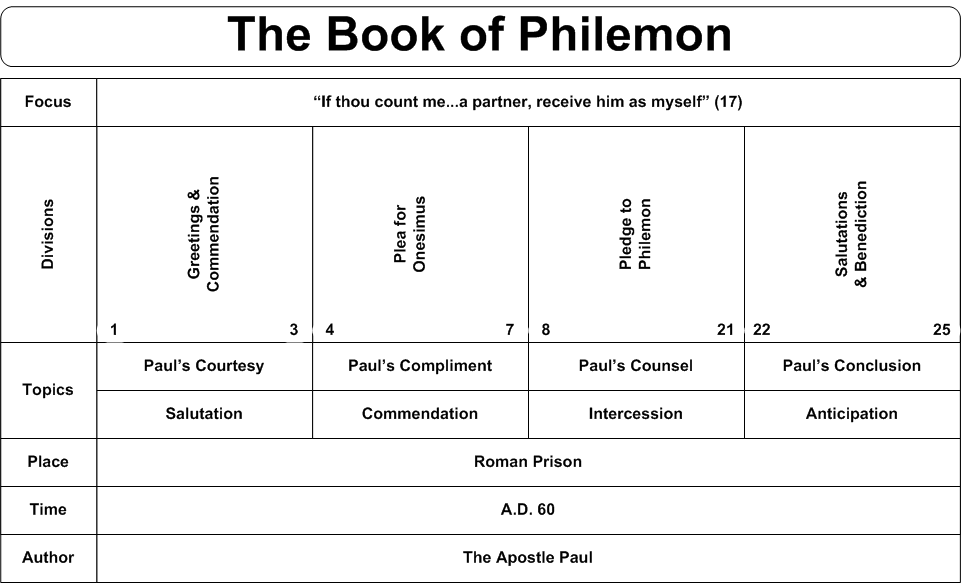
Philemon This is Paul's most personal and persuasive letter, written primarily to Philemon in order to induce him to accept back Onesimus, his runaway slave. Paul had met Onesimus in prison and led him to the Lord. Paul gives a number of compelling (almost manipulative) reasons why Philemon should freely and willingly decide to do what is best, The letter also provides insights into relationships among believers in the early church which have modern applications as well.


Philemon 1
1:1 Paul, a prisoner of Christ Jesus, and Timothy our brother, to Philemon, our beloved fellow worker, 2 to the beloved Apphia, to Archippus, our fellow soldier, and to the assembly in your house: 3 Grace to you and peace from God our Father and the Lord Jesus Christ.
4 I thank my God always, making mention of you in my prayers, 5 hearing of your love, and of the faith which you have with regard to (pros) the Lord Jesus, and toward (eis) all the saints; 6 that the your participation in the faith may become effective, by the knowledge of every good thing which is in us in Christ Jesus. 7 For we have much joy and comfort in your love, because the hearts of the saints have been refreshed through you, brother.
8 Therefore, though I have all boldness in Christ to command you that which is appropriate, 9 yet for love’s sake I rather beg, being such a one as Paul, the aged, but also a prisoner of Jesus Christ. 10 I beg you for my child, whom I have become the father of in my chains, Onesimus, 11 who once was useless to you, but now is useful to you and to me. 12 I am sending him back. Therefore receive him, that is, my own heart, 13 whom I desired to keep with me, that on your behalf he might serve me in my chains for the Good News. 14 But I was willing to do nothing without your consent, that your goodness would not be as of necessity, but of free will. 15 For perhaps he was therefore separated from you for a while, that you would have him forever, 16 no longer as a slave, but more than a slave, a beloved brother, especially to me, but how much rather to you, both in the flesh and in the Lord.
17 If then you count me a partner, receive him as you would receive me. 18 But if he has wronged you at all, or owes you anything, put that to my account. 19 I, Paul, write this with my own hand: I will repay it (not to mention to you that you owe to me even your own self besides).
20 Yes, brother, let me have joy from you in the Lord. Refresh my heart in the Lord. 21 Having confidence in your obedience, I write to you, knowing that you will do even beyond what I say. 22 Also, prepare a guest room for me, for I hope that through your prayers I will be restored to you. 23 Epaphras, my fellow prisoner in Christ Jesus, greets you, 24 as do Mark, Aristarchus, Demas, and Luke, my fellow workers. 25 The grace of our Lord Jesus Christ be with your spirit. Amen

Observations: 1:1-3 Paul identifies himself a prisoner of the Messiah Jesus, and writes (along with Timothy) to Philemon, and two others, as well as the entire assembly/church which meets in Philemon's house. The number of people who know about the contents of the letter adds pressure for Philemon to act in response to it. Paul wishes Philemon the covenantal blessings of grace and peace.
1:4-7 Paul thanks God for Philemon's love toward the saints and faith in the Lord Jesus (chiastic structure helps us see that faith is not towards the saints, as is further validated by the use of two different prepositions as noted in the text above). Verse 6 is crucial for understanding the letter. Paul prays that Philemon's fellowship or participation (koinonia feminine noun for “having in common” see verse 17 for the masculine form) in the faith might become effective/effectual by the experiential knowledge of every good thing which believers have in their union with Christ. Some translations have “sharing” of his faith, in an evangelistic sense, but Paul's objective is to encourage Philemon to forgive and accept Onesimus, not win others to Christ. Forgiving his runaway slave, and the debt of whatever Onesimus had taken from him when he left would require drawing on the grace that God had extended to him in Christ. Paul refers to how Philemon had used that grace to minister to others in refreshing the hearts of the saints through his generosity to those in need. And thus asks him to extend the same Christlike grace toward Onesimus.
1:8-16 Forgiving and accepting Onesimus was the right thing to do and Paul says he could command Philemon to do what was right, but instead he appeals to him, or even begs him, as the old prisoner of Christ (tugging on the heart strings) to forgive Onesimus. Paul pleads for him as his own child, whom he had led to the Lord while in prison with him. He gives Philemon more reasons to do so, saying that previously Onesimus was an unprofitable servant, but has now become a useful believing brother to both Paul and Philemon. Impressing upon Philemon that “he owes Paul favors” Paul states that Onesimus had ministered to him while in prison, doing the job that Philemon should have done in serving Paul for the furthering of the Good News of the Kingdom of Christ. Paul wanted to keep Onesimus, but didn't want to do so without Philemon's permission, so that any good deed would not be done under compulsion, but as a free will act of Philemon (so there is free-will!). Paul then gives another incentive, pointing out that Philemon would now have Onesimus forever, not as a slave but as a brother in Christ.
1:17-19 Although Paul wants Philemon to willingly accept Onesimus, he makes such a strong case that it would be impossible to refuse with any shred of honor. If Philemon considers Paul a fellow partaker (koinonos the masculine form of the feminine noun in verse 6), then he should receive Onesimus as he would Paul. If Onesimus had wronged him in anything, Philemon should put it on Paul's account. Paul says that he is writing the letter with his own hand to guarantee his pledge, and then reminds Philemon that he owes his very self to Paul, because of Paul's ministry to him. Paul's willingness to go to bat for an escaped slave is an example of the kind of love committed believers showed toward each other.
1:20-25 Paul appears pretty bold in asking Philemon to give him joy and refresh his poor old imprisoned heart by accepting back Onesimus. He says he has confidence that Philemon will not only comply (literally the word for “obey” or “listen under”) with his “request,” but go beyond it, in reinstating Onesimus without prejudice. He also asks Philemon to prepare a guest room in anticipation of God answering his prayers and bringing about Paul's release from prison (a parallel to God answering Paul's prayers to have Onesimus being released form the prison of his debt to Philemon). Speaking of parallels, one can't help but notice the allegorical parallel of the believer being restored to the Father by the work of Christ (where Onesimus is the believer, Philemon is the Father, and Paul is Christ). Paul sends greetings and prays that the grace of Christ would strengthen Philemon's spirit in doing the right thing.
Application: Believers must not harbor bitterness nor resentment towards believers who have wronged them, but extend Christlike forgiveness (regardless of whether or not they repent, to free themselves from bitterness) and acceptance to the repentant as God has done to us, so that our participation in the promises of the Gospel may make a difference in our lives, now and in the future.
Prayer: Heavenly Father, I praise You for the forgiveness and acceptance You've shown me in Christ, may I know and demonstrate similar grace toward others. Amen.


Digging Deeper


God in a nutshell: God has forgiven us by His grace and reinstated us in His graces, and expects us to do the same for others.

Build-a-Jesus: Jesus is the Lord and Master whom we must serve in order to be blessed, or face negative consequences.

Us in a nutshell: Believers need to draw upon God's grace to live so as to please Him, contending against those who teach falsely, and extending love to our fellow saints.

Where to Go for More:
Truthbase.net

1 John 1-2 Fellowship with God and Man

TMS 2 Corinthians 9:6-7 Reaping What You Sow
2 Corinthians 9:6 “But this I say:
he who sows sparingly will also reap sparingly,
and he who sows bountifully will also reap bountifully.
7 So let each one give
as he purposes in his heart,
not grudgingly or of necessity;
for God loves a cheerful giver.

8 And God is able to make all grace abound toward you, that you, always having all sufficiency in all things, may have an abundance for every good work.”

Observations: 9:6-7 God doesn't need our money, but we need to give. God actually provides us with the means of giving, and we are just being stewards of His stuff when we give. So we want to determine what He wants us to do with His stuff. God wants us to give of our own free will (as He wants us to live all our lives), choosing to do what pleases Him, and benefits us. So we should determine God's will for our giving, and then give, knowing we will benefit in return. We can't out-give God, and He is totally just in recompensing those who honor Him. See the context in 2 Corinthians 9 for a better understanding of giving, and the series of being faithful with God's treasure at the end of the TOYL book on Truthbase.net.
Application: Know that God gives you what you need, and will give you back more than you give or willingly “sacrifice.” (see Malachi 3:10 comments).
Prayer: Heavenly Father, thanks that You have so graciously given of Yourself in providing my salvation in Christ, and in meeting all my needs; may I mirror Your grace and generosity in my giving. Amen.


1 John 1-2 The first epistle of John is considered the most difficult to outline in the New Testament, but it is fairly easy to understand and apply the individual verses without a thorough knowledge of the literary structure (like Proverbs). One commentator declared that the book made as much sense reading each sentence beginning at the last verse of chapter 5, as it did beginning in 1:1. However, there are discernible blocks of text (lots of structure in triads, etc,) and a logic flow, but the argument isn't as smooth due to our insufficient understanding, not John's writing. The apostle John writes to born-again believers so they may have fellowship with God and each other, and continue to abide in Christ (John 15)  so they can reap the abundant life God offers. The epistle addresses a number of errors and false teaching that could keep believers from being blessed. Just like in the end of his gospel, John reveals his purpose in writing at the end.

1 John 5:11 And this is the testimony: that God has given us eternal life, and this life is in His Son. 12 He who has the Son has life; he who does not have the Son of God does not have life. 13 These things I have written to you who believe in the name of the Son of God, that you may know that you have eternal life, and that you may continue to believe in the name of the Son of God.


1 John 1 Fellowship with God and Man
1:1 That which was from the beginning,
that which we have heard,
that which we have seen with our eyes,
that which we saw,
and our hands touched,
concerning the Word of life

2 and the life was revealed,
and we have seen,
and bear witness,
and declare to you
that eternal life,
which was with the Father,
and was revealed to us;
3 that which we have seen and heard
we declare to you,

that you also may have fellowship with us.
Yes, and our fellowship is with the Father,
and with His Son, Jesus Christ.
4 And we write these things to you, that our joy may be fulfilled.

5 This is the message which we have heard from Him and announce to you,
that God is light, and in Him is no darkness at all.

6 If we say that we have fellowship with Him
and walk in the darkness,
we lie, and don’t tell the truth.

7 But if we walk in the light, as He is in the light,
we have fellowship with one another,
and the blood of Jesus Christ, his Son,
cleanses us from all sin.

8 If we say that we have no sin,
we deceive ourselves,
and the truth is not in us.

9 If we confess our sins,
He is faithful
and just
to forgive us the sins,
and to cleanse us from all unrighteousness.

10 If we say that we haven’t sinned,
we make Him a liar,
and His word is not in us.

Observations: 1:1-4 John opens the epistle with words very similar to the prologue of his gospel: “in the beginning,” “the word”, and “life.” He testifies to Jesus (the word of life) so that the born-again readers may have fellowship/participation with the apostles in the life of God, so that their mutual joy might be full (because his children walk in the truth - 3 John 1:4). It might be worth making sure you understand what fellowship is: its root is “to have in common” and by extension “to share” or “participate in.” We share or participate in the life of Christ, both as the animating force of our spiritual existence, and the rule or practice of our lives. If Christ is not living in and through us, we won't have Biblical fellowship with each other. Unity is achieved, not by compromise, but by all parties moving to the truth.
1:5-7 Since God is light (another concept from John's prologue), and in Him is no darkness, then those who share His life (fellowship) can't walk in darkness, but must walk in the light (not live in sin). This general principle is stated in verse 5, and then elaborated in verses 6-10. Those who say they have fellowship with God, yet are sinning, are liars. But those who walk in the light, not only do have fellowship with God, but also have fellowship (as shared life) with other believers. This is not about sinless perfection, but about being forgiven through the sacrifice of Christ so that one can be cleansed from sin (see comments on Heb 9:14, where the blood of Christ cleanses our conscience from dead works so we can serve the living God).
1:8-10 Those who say they have no sin are deceived (psychologists say we're blind to most of our faults), and the truth is not in them. However, the corrective to sin, the Christian bar of soap, is to “name it and claim it.” Name the sin, and claim forgiveness. “Confess” means to “say the same thing” as God does about our behavior, that it is wrong, and leads to death. Acknowledging what is wrong is tantamount to forsaking it, for why would someone want to continue in what is wrong and deadly? Confession opens the door to cleansing. If we confess, God is faithful and just. The structure is chiastic, with God's justice being the basis of our forgiveness (Christ paid the penalty so we don't have to -Rom 3:23-26), and His faithfulness to His promises is the basis of our cleansing (1:7), so we can walk in the light of His truth. This is not justification, but the sanctification or holiness necessary for living in unity with a holy God (see comments on Mt 6:15).
Verse 10 essentially restates verse 8, forming an inclusio; those who would deny their sin are not only liars, but make God a liar as well. Such folks don't have the light of the truth in them, and are not in fellowship with God.
Application: God wants us to walk in the light so we can share His life; if we find ourselves slipping into the dark, use 1 John 1:9 to get back into the light.
Prayer: God, I praise You for wanting to share Your life with me; may I walk in the light and enjoy fellowship with You and my fellow forgiven believers. Amen.


1 John 2 Confidence at His Appearing
2:1 My little children, I write these things to you so that you may not sin.
If anyone sins, we have a Counselor with the Father, Jesus Christ, the righteous.
2 And He is the atoning sacrifice for our sins,
and not for ours only, but also for the whole world.

3 This is how we know that we know Him:
if we keep His commandments.
4 One who says, "I know Him,"
and doesn’t keep His commandments,
is a liar,
and the truth isn’t in him.

5 But whoever keeps His word,
the love of God has most certainly been perfected in him.

This is how we know that we are in Him:
6 he who says he abides in Him
ought himself also to walk just like He walked.

7 Brothers, I write no new commandment to you,
but an old commandment
which you had from the beginning.
The old commandment is the word which you heard
from the beginning.

8 Again, I write a new commandment to you,
which is true in Him and in you;
because the darkness is passing away,
and the true light already shines.

9 He who says he is in the light
and hates his brother,
is in the darkness even until now.

10 He who loves his brother abides in the light,
and there is no occasion for stumbling in him.
11 But he who hates his brother
is in the darkness,
and walks in the darkness,
and doesn’t know where he is going,
because the darkness has blinded his eyes.

12 I write to you, little children,
because your sins are forgiven you for His name’s sake.
13 I write to you, fathers,
because you know Him who is from the beginning.
I write to you, young men,
because you have overcome the evil one.

I write to you, little children,
because you know the Father.
14 I have written to you, fathers,
because you know Him who is from the beginning.
I have written to you, young men,
because you are strong,
and the word of God abides in you,
and you have overcome the evil one.

15 Don’t love the world,
neither the things that are in the world.
If anyone loves the world,
the Father’s love isn’t in him.

16 For all that is in the world,
the lust of the flesh,
the lust of the eyes,
and the pride of life,
isn’t the Father’s,
but is the world’s.
17 The world is passing away with its lusts,
but he who does God’s will abides forever.

18 Little children, these are the end times,
and as you heard that the Antichrist is coming,
even now many antichrists have arisen.
By this we know that it is the final hour.
19 They went out from us,
but they weren't of (ek) us;
for if they were of us,
they would have continued with us.
But they left, that they might be revealed that none of them were of us.

20 You have an anointing from the Holy One, and you all have knowledge.

21 I have not written to you because you don’t know the truth,
but because you know it,
and because no lie is of the truth.
22 Who is the liar but he who denies that Jesus is the Christ?

This is the Antichrist, he who denies the Father and the Son.
23 Whoever denies the Son,
the same doesn’t have the Father.
He who confesses the Son has the Father also.

24 Therefore, as for you,
let that abide in you
which you heard from the beginning.
If that which you heard from the beginning
abides in you,
you also will abide
in the Son,
and in the Father.
25 This is the promise which He promised us, the eternal life.

26 These things I have written to you concerning those who would lead you astray.
27 As for you, the anointing which you received from Him abides in you,
and you don’t need for anyone to teach you.
But as His anointing teaches you concerning all things,
and is true, and is no lie,
and even as it taught you, you will abide in Him.

28 Now, little children, abide in Him,
that when He appears,
we may have confidence, and not be ashamed before Him at his coming.
29 If you know that He is righteous,
you know that everyone who practices righteousness
is born of Him.

Observations: 2:1-2 John said in chapter 1 that he wants his readers to walk in the light and not sin. He reiterates that intent, and adds that if we do sin, we have an Advocate or Counselor with the Father, Jesus the Messiah, the Righteous. He is the atoning/covering sacrifice for our sins. But wait, there's more! Jesus died for the whole world (John 3:16) so He is the sacrifice for all people who put their faith in Him.
2:3-4 John gives a number of benchmarks throughout the book, so we don't deceive ourselves into believing what isn't true. We can have confidence that we know God if we keep His commandments. As Jesus said: “If you love me, obey me” and “Why do you call me Lord and don't do what I say?” (John 14:15; Luke 6:46). So if we are intimately acquainted with God, we will be keeping His commands. Those who don't obey are lying when they say they have a good relationship with God. The truth isn't abiding in them and there will be no fruit either (John 15).
2:5-11 Those who keep (abide in) God's word, have the love of/for God (objective genitive) brought to completion in living loyally for Him. This is how a believer knows they are living “in union with Him” (a major concept in the epistle); they who abide in Him, walk/live, as Jesus did, particularly in relationships with other believers that reflect self-sacrificial love (agape). This is in accord with the summation of the law (love - Galatians 5:14), the old command which Jesus spoke in the Sermon on the Mount (Matthew 5:43), and the “new” major command Jesus gave his disciples at the Last Supper (John 13:34-45), expressing the higher standard to love self-sacrificially as Jesus loved them. The basis of the command is that the old dark order was passing away, and the new true light (of God's requirements) was already shining, for them to walk by. The one who hates his brother/sister is walking in the dark. The one who loves, abides in the light. One could argue that the old commandment was to believe and follow Christ (cf 3:23) but that command doesn't match the parallelism, nor the emphasis on loving others in the epistle. . 
2:12-15 It would have been the better division of the chapters, to begin chapter 2 here, since the earlier section relates to the theme of fellowship with God and others by walking in the light, and now John turns his attention to overcoming satanic obstacles to fellowship with God. There is a stylistic change of “I am writing to you” and the naming of three groups, possibly related to stages of spiritual development (young believers, mature believers, and those in the middle).
In verse 12 he writes to the “little children” whose sins are forgiven for the sake of God's glory or name. In verse 13 John addresses the same group, who have progressed from being forgiven to knowing God.
John writes to the “fathers” who have had a mature relationship with God, from the beginning, and are abiding in it, so the same content in is both verses.
John writes to the “young men” who initially have overcome the evil one, and then progressed to maintaining their strength by having the word of God abide in them (an ongoing necessity for fellowship -John 15).
2:15-16 Next John addresses their desires and values, which could trip them up. Unsanctified desires, derived from Satan's world, are the major reason believers continue to sin, and don't live in victory. See comments on Eve's temptation Genesis 3 and Jesus' temptation in Matthew 3. The desire for temporal power (pride-security/significance), pleasure (flesh), and possessions (eyes) motivate us to seek those things in the world, rather than the delights of the Father. The world, with its temporal trinkets will pass away, but the one who does God's will (which is knowable and doable) will abide forever. See series on Deadly Desires on Truthbase.net.
2:18-19 John warns them of the chief agent of Satan, the Antichrist, and the lesser minions, the false teachers who would seek to dissuade them from following Christ in the light. These false teachers went out from the the apostles, but they were not of (literally “ek” denoting source or origin, as in sharing the same source of teaching and doctrine) them. If the false teachers were from the apostles, they would have continued in the apostolic teaching. Their departure from the apostolic doctrine proved they were not based in them, and thus should be ignored. This indicates that the problem facing the readers is the same as that of the rest of the NT, Judaizers, who were denying the validity of the believer's experience in Jesus the Messiah, and teaching the OT as the basis of righteousness, rather than the words of Jesus. In fact they would go on to deny that Jesus was the Messiah (same word as Christ) of the OT, come in the flesh. Those who posit some sort of Gnostic teaching are ignorant of the fact that Gnosticism didn't become a coherent philosophy until the second century after Christ.
2:20-23 John reminds his readers that they have an “anointing” from the Holy One, so they have the correct knowledge, and don't need the Judaizing teaching. Apparently they still need John's instruction, and were in danger of being led astray, so they didn't know everything. The fact that they had an “anointing,” a reference to the Holy Spirit which the Messiah was to give, validated the Messiahship of Christ, and their accurate/true belief in Him. That was all they needed, not the false teaching of the antichrists. John isn't writing because they don't know the truth, but because they do know it (and don't need anything additional). No lie comes out of the truth; the liar is the one who denies that Jesus is the Messiah. Note they are not denying what He did, but that He is the promised Messiah of Isaiah 40-66 fame (as well as other places in Isaiah and the rest of the OT).
Satan is the one who denies the Father (as he did in Isaiah 14) and the Son (as he was doing through his agents, the false teachers. Whoever denies the Messiahship of the Son, doesn't have the Father either (so don't pay attention to them). Whoever confesses/acknowledges the Son (as the believers did) have the Father also (and don't need anything else).
2:24-27 Therefore (conclusion of the above), the believers should abide/remain in the teaching they heard from the real apostles, and have it abide in them (John 15). If they abide/remain in the truth, they will abide in the Son and Father, and have the fellowship John promised in the beginning of the epistle, and the eternal life Jesus promised in the gospels (cf John 3:16, 36). So the recipients of the letter don't need anyone to teach them anything else. The anointing they received (the fact of receiving the Holy Spirit) teaches them all they need to know to ignore the false teaching. This is not a blanket statement to all believers that they don't need teaching, but is context specific to the audience, with regard to the error of the antichrists. Jesus gave the responsibility to teach people to obey (Mt 28:20); Paul instructed Timothy to teach people who could teach others also (2 Timothy 2:2); the Holy Spirit gave gifted men to teach (Ephesians 4); and the gift of teaching to the early church (1 Corinthians 12). The author of Hebrews outlined the Christian career path of progressing to be able to teach others (Heb 5), so obviously believers need teaching, just not the false teaching of the antichrists (those opposed to Christ as Messiah, and probably advocated Judaism as the means to getting blessed). John closes the chapter, and opens the next one with the instruction to abide in what they had been taught, so they would abide in union with Christ.
2:28-29 John exhorts the believers to abide/remain in union with Christ so that when He appears to judge and set up His Millennial Kingdom, they would have confidence to stand before His judgment seat (2 Corinthians 5:9-10). Those who were not loyal to Him, or who spent their time stumbling around in the dark, would be ashamed at His coming.
Knowing that Jesus is righteous (and requires righteousness for blessing) they know that everyone who is born of Him would also have/practice righteousness.
Application: If we abide in the truth and aren't deceived by the world or false teachers, we will live in love and righteousness, and thus have confidence to stand before the Messiah when He returns.
Prayer: Lord Jesus, I pray You would guide me in understanding and applying Your truth, so I will abide in You,and will not be ashamed to stand before You when You return. Amen.


Digging Deeper

God in a nutshell: God wants us to share in His life, and have proper relationships with others. He provides the means of doing that with His truth (light), and forgiveness, and wants to cleanse us from all our sin.

Build-a-Jesus: Jesus is the word of life and the coming Messiah, regardless of what anyone says. One day all will stand before Him and acknowledge that truth, even the Antichrist.

Us in a nutshell: We need to walk in the light and love each other if we are to share in the life of Christ.

Where to Go for More: