Showing posts with label law. Show all posts

Jude and Philemon - Truth and Love

TMS John 13:34-35 True Love
Jn 13:34 ”A new commandment I give to you,
that you love one another;
as I have loved you,
that you also love one another.
35 By this all will know that you are My disciples,
if you have love for one another."

Observations: 13:34-35 This is the major teaching of Jesus during the Last Supper as recorded by John (and elaborated upon in John's epistles as well). The hallmark of a disciple is the loyal love they have for their brothers and sisters in Christ. The OT taught that believers should love their neighbor (Lev 19:18) and Paul said such love summed up the law (Gal 5:14). Jesus' audience considered it the second greatest commandment upon which hung all the others. So what's new? The standard to which we are to measure our love is new. If we wish to obey this command, we must love others as Jesus modeled. His was a self-sacrificial love (yet at the time, He had not yet gone to the cross, but had spoken of laying down His life for others). In the earlier half of John 13, the only thing about the Lord's Supper which John recorded was the laying aside of Jesus' outer garments to wash the disciples' feet. Paul gives more insight on this in Philippians 2. Jesus modeled humbling oneself to meet the needs of others (for cleansing, but that might be pushing the analogy too far). In any event, in His life, Jesus loved others in teaching them truth that would benefit them eternally, and then gave the ultimate self-sacrifice on the cross.
Application: Our love must be like Christ's in sacrificially serving others if we wish to obey God.
Prayer: Jesus, thanks for loving me, dying for me, and giving me Your commandments; may I love others as I follow Your purposes for my life on this planet. Amen.


Jude and Philemon These two little letters pack powerful punches. The one to Philemon is the last and shortest of Paul's epistles (which are arranged by length). It addresses the forgiveness and reception of a runaway slave whom Paul led to Christ in prison, and was now sending back to his original master. It provides an allegorical picture of God's dealings with us, as well as a application of relationships characterized by love and forgiveness.
The last epistle of the NT, Jude was written by one of Jesus' half-brothers, and warns believers against abusing grace, denying the Lordship of Christ in their lives, and indulging their desires. The judgment awaiting such erring believers should motivate us to build ourselves up in our faith (whatever that means) and strive for future glory.


Jude 1 Faultless Faith
1:1 Jude, a servant of Jesus Christ, and brother of James, to those who are sanctified/loved by God the Father, and kept/guarded by/in Jesus Christ, the called: 2 Mercy to you and peace and love be multiplied.
3 Beloved, while I was very eager to write to you about our common salvation, I was constrained to write to you exhorting you to contend earnestly for the faith which was once for all delivered to the saints. 4 For there are certain men who crept in secretly, even those who were long ago marked out for this condemnation: ungodly men, turning the grace of our God into indecency, and denying our only Master, God, and Lord, Jesus Christ.
5 Now I desire to remind you, though you already know this, that the Lord, having saved a people out of the land of Egypt, afterward destroyed those who did not believe. 6 Angels who didn’t keep their first domain, but deserted their own dwelling place, he has kept in everlasting bonds under darkness for the judgment of the great day. 7 Even as Sodom and Gomorrah, and the cities around them, having, in the same way as these, given themselves over to sexual immorality and gone after strange flesh, are set forth as an example, suffering the punishment/justice of the fire of the age.
8 Yet in the same way, these dreamers defile the flesh, despise dominion/authority, and speak evil of glory/celestial beings. 9 But Michael, the archangel, when contending with the devil and arguing about the body of Moses, dared not bring against him an abusive condemnation, but said, "May the Lord rebuke you!" 10 But these speak evil of whatever things they don’t know. What they understand naturally, like the creatures without reason; by these things they corrupt/defile themselves. 11 Woe to them! For they went in the way of Cain, and ran riotously in the error of Balaam for hire, and perished in Korah’s rebellion.
12 These are hidden rocky reefs in your love feasts when they feast with you, shepherds who without fear feed themselves; clouds without water, carried along by winds; autumn leaves without fruit, twice dead, plucked up by the roots; 13 wild waves of the sea, foaming out their own shame; wandering stars, for whom the blackness of darkness has been reserved forever. 14 About these also Enoch, the seventh from Adam, prophesied, saying, "Behold, the Lord came with ten thousands of his holy ones,15 to execute judgment on all, and to convict all the ungodly of all their works of ungodliness which they have done in an ungodly way, and of all the hard things which ungodly sinners have spoken against him." 16 These are murmurers and complainers, walking after their lusts (and their mouth speaks proud things), showing respect of persons to gain advantage.
17 But you, beloved, remember the words which have been spoken before by the apostles of our Lord Jesus Christ. 18 They said to you that "In the last time there will be mockers, walking after their own ungodly lusts." 19 These are they who cause divisions, and are sensual, not having the Spirit. 20 But you, beloved, keep building up yourselves on your most holy faith, praying in the Holy Spirit. 21 Keep yourselves in the love of God, looking for the mercy of our Lord Jesus Christ to eternal life.
22 And [have mercy, who are doubting] [reprove, who are contending] 23 and/but de some save, snatching them out of the fire with fear, hating even the clothing stained by the flesh.
24 Now to him who is able to keep you from stumbling, and to present you faultless before the presence of his glory in great joy, 25 to God our Savior, who alone is wise, be glory and majesty, dominion and power, both now and forever. Amen.

Observations: 1:1-2 Jude, as the brother of James would have been the half-brother of Jesus (see comments on James 1), yet refers to himself as the servant of Jesus the Messiah. He writes to believers who are loved or sanctified by the Father (a textual variant yields the two different translations), and kept by the power of Jesus the Messiah, who thus can be called “the called/invited.” This last word occurs at the end of the Greek text for emphasis (as in the KJV), although many translations put it at the beginning of the sentence. Believers who are sanctified and preserved or guarded in their relationship with Christ are the ones who are invited to the wedding feast of the Lamb. Jude wishes that three blessings be multiplied to them, which many erroneously think of as static forces in the past, rather than dynamic forces in the present and future, which can be had in varying degrees. Mercy is the usual LXX translation of hesed or loyal covenantal love which can be experienced differentially based upon our loyalty. The same goes for peace and love.
1:3 Jude wanted to write about the common salvation they share, probably not telling them about the fact that Jesus died for their sins, since unless they were complete morons, they wouldn't need constant reminders about the justification aspects of their salvation, since they didn't become believers without embracing the truth that Jesus died in their place. It's more likely that he intended to emphasize the glorification rather than sanctification aspect of their salvation since he ends the letter on that in verses 24-25. But instead of talking about glory and the means to attaining it, he was forced by the infestation of false teachers to exhort them to contend/fight (epi-agonizomai an intensive agonized fight, struggle or labor) for the faith once and for all delivered to the saints. This is not just the belief that Jesus died for their sins, but the expectation that He would be returning to set up His kingdom and reward those who diligently sought to please Him, which is what would bring their hope of glory into the reality of their experience (see comments on Heb 11:6). Jude tells them to build themselves up in the faith in verse 20 (which again is not somehow building the belief in the atonement, but is used in the NT of building on the foundation of Christ by ministering to others with the expectation of judgment and reward -1Cor 3:10,12,14; Acts 20:32). The fact that the content of the faith that holy ones (saints) need to believe and obey was once and for all delivered to them, precludes the need for any other revelation or prophet or prophetess getting or giving “revelation” to God's people. Any such “additional” revelation would not have its source in God. Faithful believers must fight against false teaching.
1:4 The reason for Jude's change of subject matter is the infiltration of the creepy crawly false teachers whom Paul (Acts 20:29-30; 1Tim 4:1) and Peter (2Pt 2:1) warned about (cf Jude 17-18). They sneak into the church unnoticed, which would be a pretty impressive feat of legerdemain, or an incredible indictment of the gullibility of believers, if no one noticed that the teachers were denying that Jesus existed or died for their sins (although in modern times they could get away with such brazen lies -2Tim 4:3-4). Jude tells us exactly what they were doing, they were turning the grace of God, which every believer had embraced and experienced in being regenerated (born-again) into a license for sin. They were denying the Lordship of Christ, and the right of God to rule or be Master in their lives. We are saved/justified by grace (Eph 2:8-9) through exercising faith, but that doesn't mean we should continue to sin (as Paul emphatically states in Romans 6). These folks aren't denying the deity of Christ, nor the efficacy of His atonement (the Saviorship of Christ) but that God is their Master, and Jesus the Messiah is their Lord (see comments on 2Pt 2:1 where the same word Master/despot is used). Long ago (Dt 28) God had sovereignly attached condemnation/cursing rather than blessing to such ungodly behavior (not knowing and doing what he wanted -see Titus 1). Those who are not concerned about knowing and doing God's will, who live for their pleasure and glory rather than God's, are engaging in ungodly behavior. “It's all under the blood” or “Grace has got it covered” is true with respect to an individual going into the lake of fire for their sins, because Jesus did die for all their sins, but that does not spare them the judgment and condemnation of those who disobey God, as Jude will now illustrate (see comments on Mt 5-7; and the warning passages in Hebrews, more warning pasages in Hebrewsanother warning passage in Hebrewsfinal warning passage).
1:5-7 Jude reminds those who have bought into the lie that there are no negative consequences for those who are born again of some things that carnal Christians (those who live for their temporal desires -1Cor 2; Rm 8) delight in being ignorant about. The parallel between the nation of Israel and NT believers is clearly spelled out in 1Corinthians 10, even down to having the Spirit and Christ as well as in other places (Rm 15:4). God saved/redeemed the Jews out of Egypt but then destroyed those who were not faithful to obey Him and enter the Promised Land. Jude uses the aorist participle, “those who were not believing.” What did they not believe? The promises of God to bless and curse (Exodus 20; Num 14:27-37; Heb 3:17-19). It's not that they didn't believe God redeemed them in the past, but that they had an obligation to serve and obey Him to enjoy the future. Angels who rebelled in following Satan, or perhaps those referred to in Genesis 6 who didn't follow God's order for them, suffered a similar discipline, losing their glorified status, and being kept in everlasting (not the word for “age,” but the word for “always”) chains in darkness awaiting greater judgment on the great Day of the Lord. Similarly Sodom and Gomorrah gave themselves over to their unrestrained passions, particularly immorality and homosexuality, and serve as an example of those who please themselves rather than God, and are suffering (present tense) the punishment of the age (not the eternal one of the angels, nor the past one of the Israelites). All three of those who failed to do what God desired are cited as an example of those who suffer punishment and loss for their unwise and unfaithful choices. All three judgments are different, and it could be argued are mutually exclusive, so Jude is not saying unfaithful believers who follow the false teachings will experience the same judgments, just that they will experience similar unpleasantness.
1:8-11 Returning to the false teachers, Jude calls them dreamers (out of touch with reality) who like those above defile the flesh, despise dominion/authority, and speak evil of glory (literally as in 2Pt 2:10, but translated as beings in light of the next verse). Even Michael the archangel, when contending with the devil about the body of Moses (who knew?), didn't speak evil (same word root as the previous verse) but asked the Lord to rebuke him. This account isn't in the Scripture, but was present in Jewish tradition. Jude appeals to it to make his case as did Paul to the Cretan poet in Titus 1. The false teachers speak evil about whatever they don't understand, a trait common among those who just parrot party lines without knowing the Scriptures in their context. What the false teachers do say are understood naturally, like brute beasts (as opposed to learned by the Spirit of Truth), and these things they teach result in their corruption (and eventual destruction). Jude pronounces a warning of woe upon them because they are following the ways of Cain (Gen 4) Balaam (Num 22) and Korah (Num 16), who all ended poorly.
1:12-16 Some consider the references to the love feast (Lord's Supper) to be the chiastic center of the book. Others argue for verse 9 which fits the theme of contending. What is clear to Jude (and us) is that the false teachers were dangerous, like hidden reefs waiting to shipwreck believers' faith (1Tim 1:19) which prevents one from reaching the intended safe harbor of peace. The false teachers will say they love Jesus, and commemorate Him, but lack fear of God (as do most who parrot lies -Mt 12:36). They pose as shepherds/pastors or teachers who only feed themselves. They don't provide words by which others can live, but are like clouds without rain, and fruitless leaves, without roots in the truth. There's a lot of emotion and froth, but no truth. They are like wandering stars (the word for heresy is from the same root as planet, which looked like wandering stars which had deviated from the right path), for whom was reserved the punishment of the darkness of the Age (2Pt 2:17).
The Book of Enoch is considered to be from first century BC, but is allegedly, based upon tradition, a preservation of what Enoch prophesied. It was also known to the church fathers in the second century AD, and a few fragments had been found, but an entire copy was found in AD 1773. Enoch, known to the NT audience, was the seventh person in the Genesis genealogy, perhaps a reference to the Millennial Age. Jude quotes him to illustrate the judgment that will come upon the ungodly ones in the Day of Judgment. Failure to be godly in one's words and ways sets one up for judgment. Jude describes the ungodly as those who grumble and complain, and walk/live for whatever pleases their temporal desires. They are proud (usually unteachable), and will show hypocritical deference to those who can profit them.
1:17-21 Jude reminds his readers of the words spoken by the apostles (2Pt 3:2-3; 1Tim 4:1; 2Tim 3:1), that in the end times people would mock the way of truth and walk in the way of temporal lust. These folks are not submitted to the Lord Jesus, so there is no basis for unity, and therefore they cause divisions, following their sensual or natural instincts as opposed to the Spirit. They don't have the Spirit indwelling, as in controlling them. See comments on Romans 8:9 where not having the Spirit is contrasted with the Spirit dwelling in those who please God. To make the equation that “not having Spirit” means unregenerate pagans misses the ellipsis, and the contexts of both texts. But some will manage to miss it, since they don't know how to trace an argument in context. These are the same false teachers that Jude has been warning his readers against. They are shepherds and teachers participating in the love feast of the Lord's Supper, the problem is not that they are unregenerate pagans who need to be evangelized but bad believers who need to repent and submit themselves to their Lord and Master. In contrast to them, the good believers need to build themselves up in their most holy faith (the expectation that the Lord would return to reward and rule -1Pt 1; Heb 11:6), and be praying in the Spirit (which is not babbling meaningless sounds) but seeking the mind and will of God as one expresses dependence upon Him to do His will. Such building and praying would be developing the traits that would result in God's reward (2Pt 1 “add to your faith...abundant entrance”). They need to keep/guard themselves so they will remain in the loyal love of God (owing allegiance only to Him), and be eagerly expecting the mercy (hesed - covenantal promise fulfillment) of God, with a view toward receiving dominion of the Messianic Age (eternal life).
1:22-23 Verse 22 has a textual variant (mercy/reprove) and word that has multiple meanings (judge/contend/doubt). The translation most in harmony with the context is the second one in brackets. In addition to following verse 21, believers should “reprove those who are contending (same meaning as the word when used in verse 9) against the faith”. Verse 23 opens with a “de” which joins two different or sequential concepts, rather than a “kai” which joins coordinate concepts. “Having mercy on some and saving others” doesn't take into account the “de” nor make a lot of sense. On the other hand the point of the letter is to have believers contend for the faith, and here in the conclusion, one would expect that to be emphasized. So Jude commands believers to reprove some and to save others, snatching them out of the fiery judgment that awaits them, while fearing God and hating even the clothing (outward trappings, or practices) that is defied by the defiled flesh of those following falsehood.
1:24-25 The letter ends with a great benediction, ascribing praise to our God who is able to keep us from stumbling (and falling short of the glory) and present believers faultless before the presence of His glory with great joy. To our God and Savior, who alone is wise, be glory, majesty, dominion, and power/authority, both now and in the Messianic Age.
Application: Believers must learn to identify and refute false teachers who don't live under the Lordship of Christ; and build themselves up in the faith by drawing on the grace of God to live so as to be faultless when He returns.
Prayer: God, thanks for saving me by Your grace, and giving me the power to live faultless before You; may I live in tune with Your truth and Spirit, under Your Lordship every day, so that You will be glorified by my life. Amen.

Philemon This is Paul's most personal and persuasive letter, written primarily to Philemon in order to induce him to accept back Onesimus, his runaway slave. Paul had met Onesimus in prison and led him to the Lord. Paul gives a number of compelling (almost manipulative) reasons why Philemon should freely and willingly decide to do what is best, The letter also provides insights into relationships among believers in the early church which have modern applications as well.
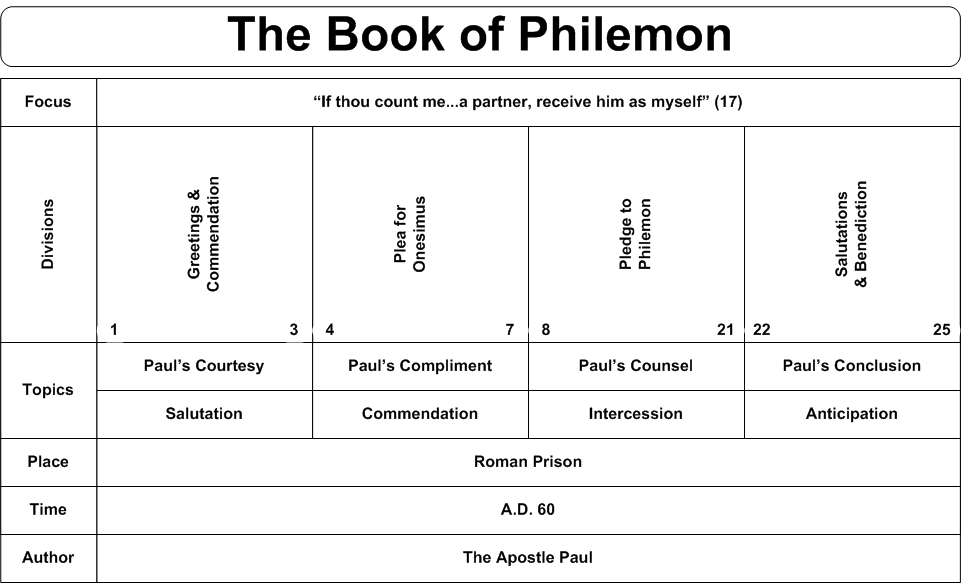


Philemon 1
1:1 Paul, a prisoner of Christ Jesus, and Timothy our brother, to Philemon, our beloved fellow worker, 2 to the beloved Apphia, to Archippus, our fellow soldier, and to the assembly in your house: 3 Grace to you and peace from God our Father and the Lord Jesus Christ.
4 I thank my God always, making mention of you in my prayers, 5 hearing of your love, and of the faith which you have with regard to (pros) the Lord Jesus, and toward (eis) all the saints; 6 that the your participation in the faith may become effective, by the knowledge of every good thing which is in us in Christ Jesus. 7 For we have much joy and comfort in your love, because the hearts of the saints have been refreshed through you, brother.
8 Therefore, though I have all boldness in Christ to command you that which is appropriate, 9 yet for love’s sake I rather beg, being such a one as Paul, the aged, but also a prisoner of Jesus Christ. 10 I beg you for my child, whom I have become the father of in my chains, Onesimus, 11 who once was useless to you, but now is useful to you and to me. 12 I am sending him back. Therefore receive him, that is, my own heart, 13 whom I desired to keep with me, that on your behalf he might serve me in my chains for the Good News. 14 But I was willing to do nothing without your consent, that your goodness would not be as of necessity, but of free will. 15 For perhaps he was therefore separated from you for a while, that you would have him forever, 16 no longer as a slave, but more than a slave, a beloved brother, especially to me, but how much rather to you, both in the flesh and in the Lord.
17 If then you count me a partner, receive him as you would receive me. 18 But if he has wronged you at all, or owes you anything, put that to my account. 19 I, Paul, write this with my own hand: I will repay it (not to mention to you that you owe to me even your own self besides).
20 Yes, brother, let me have joy from you in the Lord. Refresh my heart in the Lord. 21 Having confidence in your obedience, I write to you, knowing that you will do even beyond what I say. 22 Also, prepare a guest room for me, for I hope that through your prayers I will be restored to you. 23 Epaphras, my fellow prisoner in Christ Jesus, greets you, 24 as do Mark, Aristarchus, Demas, and Luke, my fellow workers. 25 The grace of our Lord Jesus Christ be with your spirit. Amen

Observations: 1:1-3 Paul identifies himself a prisoner of the Messiah Jesus, and writes (along with Timothy) to Philemon, and two others, as well as the entire assembly/church which meets in Philemon's house. The number of people who know about the contents of the letter adds pressure for Philemon to act in response to it. Paul wishes Philemon the covenantal blessings of grace and peace.
1:4-7 Paul thanks God for Philemon's love toward the saints and faith in the Lord Jesus (chiastic structure helps us see that faith is not towards the saints, as is further validated by the use of two different prepositions as noted in the text above). Verse 6 is crucial for understanding the letter. Paul prays that Philemon's fellowship or participation (koinonia feminine noun for “having in common” see verse 17 for the masculine form) in the faith might become effective/effectual by the experiential knowledge of every good thing which believers have in their union with Christ. Some translations have “sharing” of his faith, in an evangelistic sense, but Paul's objective is to encourage Philemon to forgive and accept Onesimus, not win others to Christ. Forgiving his runaway slave, and the debt of whatever Onesimus had taken from him when he left would require drawing on the grace that God had extended to him in Christ. Paul refers to how Philemon had used that grace to minister to others in refreshing the hearts of the saints through his generosity to those in need. And thus asks him to extend the same Christlike grace toward Onesimus.
1:8-16 Forgiving and accepting Onesimus was the right thing to do and Paul says he could command Philemon to do what was right, but instead he appeals to him, or even begs him, as the old prisoner of Christ (tugging on the heart strings) to forgive Onesimus. Paul pleads for him as his own child, whom he had led to the Lord while in prison with him. He gives Philemon more reasons to do so, saying that previously Onesimus was an unprofitable servant, but has now become a useful believing brother to both Paul and Philemon. Impressing upon Philemon that “he owes Paul favors” Paul states that Onesimus had ministered to him while in prison, doing the job that Philemon should have done in serving Paul for the furthering of the Good News of the Kingdom of Christ. Paul wanted to keep Onesimus, but didn't want to do so without Philemon's permission, so that any good deed would not be done under compulsion, but as a free will act of Philemon (so there is free-will!). Paul then gives another incentive, pointing out that Philemon would now have Onesimus forever, not as a slave but as a brother in Christ.
1:17-19 Although Paul wants Philemon to willingly accept Onesimus, he makes such a strong case that it would be impossible to refuse with any shred of honor. If Philemon considers Paul a fellow partaker (koinonos the masculine form of the feminine noun in verse 6), then he should receive Onesimus as he would Paul. If Onesimus had wronged him in anything, Philemon should put it on Paul's account. Paul says that he is writing the letter with his own hand to guarantee his pledge, and then reminds Philemon that he owes his very self to Paul, because of Paul's ministry to him. Paul's willingness to go to bat for an escaped slave is an example of the kind of love committed believers showed toward each other.
1:20-25 Paul appears pretty bold in asking Philemon to give him joy and refresh his poor old imprisoned heart by accepting back Onesimus. He says he has confidence that Philemon will not only comply (literally the word for “obey” or “listen under”) with his “request,” but go beyond it, in reinstating Onesimus without prejudice. He also asks Philemon to prepare a guest room in anticipation of God answering his prayers and bringing about Paul's release from prison (a parallel to God answering Paul's prayers to have Onesimus being released form the prison of his debt to Philemon). Speaking of parallels, one can't help but notice the allegorical parallel of the believer being restored to the Father by the work of Christ (where Onesimus is the believer, Philemon is the Father, and Paul is Christ). Paul sends greetings and prays that the grace of Christ would strengthen Philemon's spirit in doing the right thing.
Application: Believers must not harbor bitterness nor resentment towards believers who have wronged them, but extend Christlike forgiveness (regardless of whether or not they repent, to free themselves from bitterness) and acceptance to the repentant as God has done to us, so that our participation in the promises of the Gospel may make a difference in our lives, now and in the future.
Prayer: Heavenly Father, I praise You for the forgiveness and acceptance You've shown me in Christ, may I know and demonstrate similar grace toward others. Amen.


Digging Deeper


God in a nutshell: God has forgiven us by His grace and reinstated us in His graces, and expects us to do the same for others.

Build-a-Jesus: Jesus is the Lord and Master whom we must serve in order to be blessed, or face negative consequences.

Us in a nutshell: Believers need to draw upon God's grace to live so as to please Him, contending against those who teach falsely, and extending love to our fellow saints.

Where to Go for More:
Truthbase.net

Romans 10 sermon Good News

Romans 10 Good News © 2012 WF Cobb Truthbase.net DailyTruthbase.Blogspot.com

I. Heritage is not Holiness; Election is corporate and to Blessing (not individual forgiveness). Hardening is in our choices.
9:6 it is not that the word of God has taken no effect. For they are not all ek Israel who are of Israel (Gal 3:7-9), 12 "The older shall serve the younger." 13 As it is written, "Jacob I have loved, but Esau I have hated." 17 For the Scripture says to the Pharaoh, "For this very purpose I have exalted/raised you up, that I may show My power in you, and that My name may be declared in all the earth." 18 Therefore He has mercy on whom He wills, and whom He wills He hardens. Ex 9:27 “I have sinned this time, the Lord is righteous?

APP: God can harden/fix people in their bad choices to display His glory/power in justly judging them; so be quick to obey (Rm 11:20).
harden
II. Those who want righteousness from God must be careful to do what is right in His sight
10: 1 Brethren, my heart's desire and prayer to God for Israel is that they may be saved. 2 For I bear them witness that they have a zeal for God, but not according to knowledge. 3 For they being ignorant of God's righteousness, and seeking to establish their own righteousness, have not submitted to the righteousness of God. 4 For Christ is the end of the law for righteousness to everyone who believes. 5 For Moses writes about the righteousness which is of the law, "The man who does those things shall live by them."

APP: The righteousness required for blessing is being careful to do what is right in God's sight, from initial reception to obedient receptivity.

III. We all have faith to believe that God is who He said He is, and will do what He said He'll do (Heb 11:6)
6 the righteousness of faith speaks 8 "The word is near you, in your mouth and in your heart" (the word of faith which we preach):
9 if you confess with your mouth the Lord Jesus and believe in your heart that God has raised Him from the dead, you will be saved.
10 For with the heart one believes unto righteousness, and with the mouth confession is made unto salvation/glorification.

APP:Wholehearted belief and acknowledgment of Christ's Lordship is necessary for glorification. How is He your Lord?

IV. Faith relies on the Revelation of God about what has occurred, and will or won't happen in the future, and calls upon Him
11 For the Scripture says, "Whoever believes on Him will not be put to shame." 12 For there is no distinction between Jew and Greek, for the same Lord over all is rich to all who call upon Him 13 "whoever calls on the name of the LORD shall be saved." (Joel 2:32)
14 How then shall they call on Him in whom they have not believed? And how shall they believe in Him of whom they have not heard? And how shall they hear without a preacher? 15 And how shall they preach unless they are sent? As it is written: " How beautiful are the feet of those who preach the gospel of peace, Who bring glad tidings of good things!" (Isa 52:7 Our God reigns)
16 But they have not all obeyed the gospel. For Isaiah says, "LORD, who has believed our report?" (Isa 53:1)
17 So then faith is ek hearing, and hearing by/dia the word of God.

APP: Our faith/belief must be based upon the Revelation of God, and our behavior based upon our belief, if we're to reap the benefits.

V. God repeatedly reaches out to those who disobey and reject Him in an effort to get them to repent so it's totally their choice.
18 ...have they not heard? Yes indeed: "Their sound has gone out to all the earth, and their words to the ends of the world." 19 But I say, did Israel not know? First Moses says: " I will provoke you to jealousy by those who are not a nation, I will move you to anger by a foolish nation." 20 But Isaiah is very bold and says: " I was found by those who did not seek Me; I was made manifest to those who did not ask for Me." 21 But to Israel He says: "All day long I have stretched out My hands to a disobedient and contrary people."

APP: Failure to submit to God's will is sourced in our willing ignorance and satanically influenced self-will, which we can change.

VI. God always keeps His sovereign promises, especially that of Blessing the whole world through the descendents of Abraham (Gen 12)
11:1 has God cast away His people? Certainly not! For I also am an Israelite...2 God has not cast away His people whom He foreknew. 11..have they stumbled that they should fall? Certainly not! But thru their fall, to provoke them to jealousy, salvation has come to the Gentiles.

20 Because of unbelief they were broken off, and you stand by faith. Do not be haughty, but fear. 21 For if God did not spare the natural branches, He may not spare you either. 22 Therefore consider the goodness and severity of God: on those who fell, severity; but toward you, goodness, if you continue in goodness/virtue. Otherwise you also will be cut off. 23 And they also, if they do not continue in unbelief, will be grafted in, for God is able to graft them in again. 29 For the gifts and the calling of God are irrevocable.

APP: Justified believers will be cut off from blessing if they don't continue in goodness; those who repent and return will be blessed.

Questions for Reflection/Discussion/Response:
1. Why would someone think that their ideas about what's right in God's sight are correct? How can a finite being know infinite truth?
2. Does praying for someone's salvation make a difference? How would God answer that prayer if the person/nation is uncooperative?
3. If we don't believe and act upon God's promises, nor deny ourselves daily to follow the Lord Jesus, what kind of “salvation” can we expect?
4. When and how do you call upon the Lord? What happens? For what benefits are you believing Him?
5. What can you do to experience the benefits of the good news and share them with others?

Romans 9 God's Got a Plan to Bless Believers

Romans 9  God's Got a Plan to Bless Believers © 2014 WF Cobb Truthbase.net DailyTruthbase.Blogspot.com

I. Heritage does not equal Blessable Holiness; Election is corporate and to Blessing (not individual forgiveness).
9:3 For I could wish that I myself were accursed from Christ for my brethren, my countrymen according to the flesh, 4 who are Israelites, to whom pertain the adoption, the glory, the covenants, the giving of the law, the service of God, and the promises; 5 of whom are the fathers and from whom, according to the flesh, Christ came, who is over all, the eternally blessed God. Amen.

6 But it is not that the word of God has taken no effect. For they are not all ek Israel who are of Israel (Gal 3:7-9). 7 nor are they all children because they are the seed of Abraham (Jn 8:39); but, "In Isaac (vs Ishmael) your seed shall be called." 8 That is, those who are the children of the flesh, these are not the children of God; but the children of the promise are counted as the seed. 9 For this is the word of promise: "At this time I will come and Sarah shall have a son." 10 Rebecca also had conceived 11 (for the children not yet being born, nor having done any good or evil, that the purpose of God according to election might stand, not of works but of Him who calls), 12 it was said to her, "The older shall serve the younger." 13 As it is written, "Jacob I have loved, but Esau I have hated." (Mal 1:2-3; Gen 26:27)

APP: Most of Israel missed the blessings and promises of God, despite God's choice of them. Not all children of Abraham obey.

II. God has mercy/hesed (loyal covenantal relations) with whomever He chooses and confirms the sinful choices of others.
14 What shall we say then? Is there unrighteousness with God? Certainly not! 15 For He says to Moses (Ex 33:19), "I will have mercy/hesed on whomever I will have mercy, and I will have compassion on whomever I will have compassion." 16 So then it is not of him who wills, nor of him who runs, but of God who shows mercy. 17 For the Scripture says to the Pharaoh, "For this very purpose I have exalted/raised you up, that I may show My power in you, and that My name may be declared in all the earth." 18 Therefore He has mercy on whom He wills, and whom He wills He hardens. (sets up for judgment as a result of their choices {cf 1:28} -Ex 7:3,13; 22; 8:19; 9:12, 35; 10:20,27;11:10,14,4, 8,17; Acts 19:9; Heb 3:8,13, 15; 4:7) Ex 9:27 “I have sinned this time, the Lord is righteous?

APP: God can harden/fix people in their bad choices to display His glory/power in justly judging them; so be quick to obey (Rm 11:20).
III. God will Honor those who do His will, and Dishonor those who don't. He patiently endures sinners to show mercy to all.
19 You will say to me then, "Why does He still find fault? For who has resisted His will?" 20..."Why have you made me like this?" (Isa 45:9; 29:16) 21 Does not the potter have power over the clay, from the same lump to make one vessel for honor and another for dishonor? 22 What if God, wanting to show His wrath and to make His power known, endured with much longsuffering the vessels of wrath fitted for destruction, 23 and that He might make known the riches of His glory on the vessels of mercy, which He had prepared beforehand (Eph 2:10) for glory, 24 even us whom He called, not of the Jews only, but also of the Gentiles? 25 "I will call them My people/beloved, who were not My people, 26 "in the place where it was said to them, 'You are not My people,' There they shall be called sons of the living God." 27 "Though the number of the children of Israel be as the sand of the sea, the remnant will be saved.

APP: The fact that God does find fault with those who resist His will should cause us to strive to enter life at the narrow gate (Mt 7:13-14)

IV. Righteousness (careful to do what is right in God's sight) must be sought by faith in God's revelation, not ritual/tradition.
30 What shall we say then? Gentiles, who did not pursue righteousness, have attained to righteousness...righteousness of faith; 31 but Israel, pursuing the law of righteousness, has not attained to the law of righteousness. 32 Why? Because they did not seek it by faith, but as it were, by the works of the law. For they stumbled at that stumbling stone. 33 whoever believes on Him will not be put to shame."

10:1 Brethren, my heart's desire and prayer to God for Israel is that they may be saved. 2 For I bear them witness that they have a zeal for God, but not according to knowledge. 3 For they being ignorant of God's righteousness, and seeking to establish their own righteousness, have not submitted to the righteousness of God. 4 For Christ is the end of the law for righteousness to everyone who believes.

APP: We need to know and do what God requires, submitting ourselves wholeheartedly to God's plan, to be righteous and rewarded.

V. God always keeps His sovereign promises, especially that of Blessing the whole world through the descendents of Abe (Gen 12)
11:1 has God cast away His people? Certainly not! For I also am an Israelite...2 God has not cast away His people whom He foreknew. 11..have they stumbled that they should fall? Certainly not! But thru their fall, to provoke them to jealousy, salvation has come to the Gentiles.

20 Because of unbelief they were broken off, and you stand by faith. Do not be haughty, but fear. 21 For if God did not spare the natural branches, He may not spare you either. 22 Therefore consider the goodness and severity of God: on those who fell, severity; but toward you, goodness, if you continue in goodness/virtue. Otherwise you also will be cut off. 23 And they also, if they do not continue in unbelief, will be grafted in, for God is able to graft them in again. 29 For the gifts and the calling of God are irrevocable.

APP: Justified believers will be cut off from blessing if they don't continue in goodness; those who repent and return will be blessed.

Questions for Reflection/Discussion/Response:
1. How and why did the majority of Jews miss the promises of God in the OT? In the NT? Was it their choice or God's?
2. Since it's possible to resist God's will, persist in unbelief, and refuse to be His people, how do we make sure we are not cut off from blessing?
3. What makes you think you're on the difficult narrow path, rather than the broad road to judgement and loss of blessing?
4. If God has plans to bring Israel back into the Vine and save them (fulness 11:12; 26), what do you think of those who say Israel is the church?
5. How are you continuing goodness/virtue (Rm 3:12; Gal 5:22; Col 3:12)? Are you fitted for honor or dishonor?

Romans 8 Holy Spirit Sanctification

Romans 8 Holy Spirit Sanctification © 2012 WF Cobb Truthbase.net DailyTruthbase.Blogspot.com
See sermon on Truthbase.net 
I. Righteous requirements must be fulfilled 8:1 There is therefore now no condemnation to those who are in Christ Jesus,
who do not walk according to the flesh, but according to the Spirit.
2 For the law of the Spirit of life in Christ Jesus has made me free from the law of sin and death.
3 For what the law could not do in that it was weak through the flesh, God did by sending His own Son in the likeness of sinful flesh, on account of sin: He condemned/deposed sin in the flesh,
4 that the righteous requirement of the law might be fulfilled in us who do not walk according to the flesh but according to the Spirit.

II. Pleasing God 5 For those who live according to the flesh set their minds on the things of the flesh, but those who live according to the Spirit, the things of the Spirit. 6 For to be carnally minded is death, but to be spiritually minded is life and peace. 7 Because the carnal mind is enmity against God; for it is not subject to the law of God, nor indeed can be. 8 So then, those who are in the flesh cannot please God.

III. The Indwelling Spirit 9 But you are not in the flesh but in the Spirit, if indeed the Spirit of God dwells in you. Now if anyone does not have the Spirit of Christ, he is not His/of Him. 10 And if Christ is in you, the body is dead because of sin, but the Spirit is life because of righteousness. 11 But if the Spirit of Him who raised Jesus from the dead dwells in you, He who raised Christ from the dead will also give life to your mortal bodies through His Spirit who dwells in you. (2Cor 4-5)

IV. Put to death the deeds of the flesh 12 Therefore, brethren, we are debtors --- not to the flesh, to live according to the flesh. 13 For if you live according to the flesh you will die; but if by the Spirit you put to death the deeds of the body (cf Gal 5 vs fruits of the HS), you will live. 14 For as many as are led by the Spirit of God, these are sons of God.

V. Dual Heirship 15 For you did not receive the spirit of bondage again to fear, but you received the Spirit of adoption by whom we cry out, "Abba, Father." 16 The Spirit Himself bears witness with our spirit that we are children of God, 17 and if children, then heirs --- heirs of God but joint heirs with Christ, if indeed we co-suffer with Him, that we may also be co-glorified together.

VI. Suffering for glory 18 For I consider that the sufferings of this present time are not worthy to be compared with the glory which shall be revealed in us. 19 For the earnest expectation of the creation eagerly waits for the revealing of the sons of God. 20 For the creation was subjected to futility, not willingly, but because of Him who subjected it in hope; 21 because the creation itself also will be delivered from the bondage of corruption into the glorious liberty of the children of God. 22 For we know that the whole creation groans and labors with birth pangs together until now. 23 Not only that, but we also who have the firstfruits of the Spirit, even we ourselves groan within ourselves, eagerly waiting for the adoption, the redemption of our body.

VII. Hope of Glory 24 For we were saved in this hope, but hope that is seen is not hope; for why does one still hope for what he sees? 25 But if we hope for what we do not see, we eagerly wait for it with perseverance. 26 Likewise the Spirit also helps in our weaknesses. For we do not know what we should pray for as we ought, but the Spirit Himself makes intercession for us with groanings which cannot be uttered. 27 Now He who searches the hearts knows what the mind of the Spirit is, because He makes intercession for the saints according to the will of God. 28 And we know that all things work together for good to those who love God, to those who are the called according to His purpose. 29 For whom He foreknew, He also predestined to be conformed to the image of His Son, that He might be the firstborn among many brethren. 30 Moreover whom He predestined, these He also called; whom He called, these He also justified; and whom He justified, these He also glorified.

VIII. Love of God 31 What then shall we say to these things? If God is for us, who can be against us? 32 He who did not spare His own Son, but delivered Him up for us all, how shall He not with Him also freely give us all things? 33 Who shall bring a charge against God's elect? It is God who justifies. 34 Who is he who condemns? It is Christ who died, and furthermore is also risen, who is even at the right hand of God, who also makes intercession for us.35 Who shall separate us from the love of Christ? Shall tribulation, or distress, or persecution, or famine, or nakedness, or peril, or sword? 36 As it is written: " For Your sake we are killed all day long; We are accounted as sheep for the slaughter." 37 Yet in all these things we are more than conquerors through Him who loved us. 38 For I am persuaded that neither death nor life, nor angels nor principalities nor powers, nor things present nor things to come, 39 nor height nor depth, nor any other created thing, shall be able to separate us from the love of God which is in Christ Jesus our Lord.


Questions for Reflection/Discussion/Response:
1. Why do some think that all one has to do is believe in Jesus' atonement for them, and there is nothing more to the Christian life?
2. Why would God want the righteous requirements of the law fulfilled in believers? Didn't Christ's death do this?
3. What is the believer's hope and how does one get it? How does someone put to death the deeds of the flesh? What's the role of the HS?
4. What should be the proper faith response to suffering? Why are we tempted to doubt God's love and sovereignty?
5. How will you walk according to the Spirit this week? How will you know if you're doing it or deceiving yourself?

Job 1,2,13,19 The Righteous Suffer

Job 1,2,13,19 The Righteous Suffer


Bill Blurb: Now that we've finished the Historical books of the OT, we come upon the five books of Poetry, which will be followed by the Major, then Minor Prophets. Since we've been slicing and dicing Psalms and Proverbs, we won't be covering them in the sequential text portion of the blog (like Genesis to Esther). The hallmark of Hebrew poetry is not rhyming like a Hallmark card, but repetition and parallelism of ideas and concepts, expressed in scintillating symbolism. Job, Ecclesiastes, and the Song of Solomon will be given a brief overview in the next posts, and then we will savor them a sip at a time in future posts, after we exhaust Psalms and Proverbs. We'll also portion out Psalm 119 in more bite sized (ok, meal sized) portions so we can appreciate the unique flavor of each taste, rather than choke on the huge amount of Truth in the psalm. Bon Appétit!

For those of you who like categorization (and alliteration):
  • Job teaches how to have the our (w)right place in life;
  • Psalms teach how to have worshipful praise in our life;
  • Proverbs teach how to have wise practices in our life;
  • Ecclesiastes teaches how to have worthwhile purpose in our life;
  • Song of Songs teaches how to have wondrous passion in our life.
OK, I'll stop now.


­Psalm 69:16-36 Praise is More Pleasing
Ps 69:22 “(13 But as for me, my prayer is to you, Yahweh, in an acceptable time. God, in the abundance of your hesed/loyal love, answer me in the faithfulness of your salvation.) Let their table before them become a snare. May it become a retribution and a trap. 23 Let their eyes be darkened, so that they can’t see. Let their backs be continually bent. 24 Pour out your indignation on them. Let the fierceness of your anger overtake them. 25 Let their habitation be desolate. Let no one dwell in their tents. 26 For they persecute him whom you have wounded. They tell of the sorrow of those whom you have hurt. 27 Charge them with crime upon crime. Don’t let them come into your righteousness. 28 Let them be blotted out of the book of life, and not be written with the righteous. 29 But I am in pain and distress. Let your salvation, God, protect me.
30 I will praise the name of God with a song, and will magnify him with thanksgiving. 31 It will please Yahweh better than an ox, or a bull that has horns and hoofs. 32 The humble have seen it, and are glad. You who seek after God, let your heart live. 33 For Yahweh hears the needy, and doesn’t despise his captive people. 34 Let heaven and earth praise him; the seas, and everything that moves therein! 35 For God will save Zion, and build the cities of Judah. They shall settle there, and own it. 36 The children also of his servants shall inherit it. Those who love his name shall dwell therein."

Observations: 69:1-21 See post on Judges 19 for vv 1-21, in which David asks God for deliverance from his enemies, and acknowledges that he isn't entirely blameless (69:5). However, his persecution isn't because of his sin, but his zeal for God.
69:22-36 In the last half of the psalm David expresses confidence in God's hesed to not only deliver him, but pay back his enemies. His calling down curses upon them might look a little severe, but then he is only asking God to act justly. Blotting out their name from the book of life might be a reference to the removal of them from the register of those who participation in the rule or blessings of the kingdom. The wicked will not inherit blessing.
David vows to praise God with thanksgiving, which He likes more than burnt offerings. The humble who depend on God will rejoice in the testimony of God's deliverance of His people. David looks forward to God saving Zion, regathering the people and fulfilling His promises in the Kingdom.

Application: Trust and resultant praise to God for deliverance is more pleasing to Him than a bunch of burnt animals, or any material thing we could give Him.

Prayer: God, thanks that You are the God who saves, and sets things right; I will be faithful to trust and praise You so You can be exalted in the eyes of others. Amen.

Proverbs 18:9 Sluggards Are Sinners
Pr 18:9 “One who is slack in his work is brother to him who is a master of destruction.“

Observations: 18:9 Sluggards are lower life forms that cause damage and destruction by not doing what should be done, when it should be done. It sounds like they lack wisdom (choosing the right objectives and the means of attaining them), and thus fear of the Lord. That would pretty much put them in the fool category. They waste the hours of their days by not heartily using them for the Lord's purposes, failing to build a legacy or a witness. They waste the precious minutes of others by being unfaithful and unreliable, contributing to nothing except the selfish pursuit of their temporal ease. Time is the interval during which we get blessed or cursed. Guess the destiny of the sluggard as a result of how they used their allotment of time. See Faithfulness with our Time. to get a grip on stewardship of the 10080 minutes God entrust to you each week. The outline is also at the end of the TOYL Booklet.
Application: If you happen to catch sight of a sluggard in the mirror, spend a little time cleansing yourself from the deadly sin of sloth by studying the Saga of the Sorry Sluggard.
Prayer: Lord, help me invest every precious minute You've given me for Your purposes, be it work or play, so You'll be glorified. Amen.


Job 1,2,13,19 This is considered the oldest book of the Bible, almost a prelude or “porch” to the “temple” of Genesis to Deuteronomy. It describes life in patriarchal times, before the Law was given. The postscript of the Septuagint version is worth noting (under Digging Deeper). There are some plausible arguments for Mosaic authorship there as well. In this and the next post, we'll look at some key chapters from the beginning, middle, and end of Job, and then explore the individual chapters as “Psalms” later in the blog.
A frequent hang-up to a correct understanding of God as revealed in the Scriptures is: “Why do the righteous suffer if God is all loving and powerful? He should be willing and able to do something about the evil we see and experience in our world." This is answered under the 7QUESTIONS and in sermons on suffering on Truthbase.net, but for now, the Book of Job shows us that we don't have the entire story, just like the main character and his “friends.”


Job 1 God Gives and Takes Away, Blessed Be His Name
1:1 There was a man in the land of Uz, whose name was Job. That man was blameless and upright, and one who feared God, and turned away from/eschewed evil. 2 There were born to him seven sons and three daughters. 3 His possessions also were seven thousand sheep, three thousand camels, five hundred yoke of oxen, five hundred female donkeys, and a very great household; so that this man was the greatest of all the children of the east. 4 His sons went and held a feast in the house of each one on his birthday; and they sent and called for their three sisters to eat and to drink with them. 5 It was so, when the days of their feasting had run their course, that Job sent and sanctified/purified them, and rose up early in the morning, and offered burnt offerings according to the number of them all. For Job said, "It may be that my sons have sinned, and renounced God in their hearts." Job did so continually.
6 Now it happened on the day when the sons of God came to present themselves before Yahweh, that Satan also came among them. 7 Yahweh said to Satan, "Where have you come from?" Then Satan answered Yahweh, and said, "From going back and forth in the earth, and from walking up and down in it." 8 Yahweh said to Satan, "Have you considered my servant, Job? For there is none like him in the earth, a blameless and an upright man, one who fears God, and turns away from/eschews evil." 9 Then Satan answered Yahweh, and said, "Does Job fear God for nothing? 10 Haven’t you made a hedge around him, and around his house, and around all that he has, on every side? You have blessed the work of his hands, and his substance is increased in the land. 11 But put forth your hand now, and touch all that he has, and he will renounce you to your face." 12 Yahweh said to Satan, "Behold, all that he has is in your power. Only on himself don’t put forth your hand." So Satan went forth from the presence of Yahweh.
13 It fell on a day when his sons and his daughters were eating and drinking wine in their eldest brother’s house, 14 that there came a messenger to Job, and said, "The oxen were plowing, and the donkeys feeding beside them, 15 and the Sabeans attacked, and took them away. Yes, they have killed the servants with the edge of the sword, and I alone have escaped to tell you." 16 While he was still speaking, there also came another, and said, "The fire of God has fallen from the sky, and has burned up the sheep and the servants, and consumed them, and I alone have escaped to tell you." 17 While he was still speaking, there came also another, and said, "The Chaldeans made three bands, and swept down on the camels, and have taken them away, yes, and killed the servants with the edge of the sword; and I alone have escaped to tell you." 18 While he was still speaking, there came also another, and said, "Your sons and your daughters were eating and drinking wine in their eldest brother’s house, 19 and behold, there came a great wind from the wilderness, and struck the four corners of the house, and it fell on the young men, and they are dead. I alone have escaped to tell you."
20 Then Job arose, and tore his robe, and shaved his head, and fell down on the ground, and worshiped. 21 He said, "Naked I came out of my mother’s womb, and naked shall I return there. Yahweh gave, and Yahweh has taken away. Blessed be the name of Yahweh." 22 In all this, Job did not sin, nor charge God with wrongdoing.

Observations: 1:1-5 Job is described as blameless, upright, fearing God and eschewing evil, by both the author and God himself. To deny this was true is to follow Satan's tactic of denying truth. Job is great, and blessed, and scrupulous in even offering sacrifices for his children, so they don't come under God's wrath. A real God-fearer.
1:6-12 Satan stops by to have tea with God (so much for the idea that God can't look upon evil, a total perversion of Hab 1:13 perpetrated by those oblivious to context). Only a divinely inspired author could have insight into this heavenly conversation (just like divine inspiration was necessary to listen in on Genesis 1). God brags to Satan about His super servant Job. Satan says Job only serves for the benefits, making God look like a bribing parent who can only get their kids to behave by buying them a candy bar or a BMW. God gives Satan permission to take all that God had given Job.
1:13-22 Note the forces that Satan commands, lightning, wind, and the usual bad guy.
Job responds blamelessly, mourning the loss of his children, but recognizing that all he had was the blessing of God, on loan to Him.
Application: Do you view your possessions and relationships as a blessing entrusted to you by God as a stewardship? Or do you think it's your stuff to do with as you please? If the former, you can bless God when you no longer have it.
Prayer: God, thanks that You bless your servants who fear and obey You; may I hold all Your blessings with an open hand, knowing You may require them back at any moment. Amen.

Job 2 Blameless and Upright, Fearing God, Eschewing Evil
2:1 Again it happened on the day when the sons of God came to present themselves before Yahweh, that Satan came also among them to present himself before Yahweh. 2 Yahweh said to Satan, "Where have you come from?" Satan answered Yahweh, and said, "From going back and forth in the earth, and from walking up and down in it." 3 Yahweh said to Satan, "Have you considered my servant Job? For there is none like him in the earth, a blameless and an upright man, one who fears God, and turns away from/eschews evil. He still maintains his integrity, although you incited me against him, to ruin him without cause." 4 Satan answered Yahweh, and said, "Skin for skin. Yes, all that a man has he will give for his life. 5 But put forth your hand now, and touch his bone and his flesh, and he will renounce you to your face." 6 Yahweh said to Satan, "Behold, he is in your hand. Only spare his life."
7 So Satan went forth from the presence of Yahweh, and struck Job with painful sores from the sole of his foot to his head. 8 He took for himself a potsherd to scrape himself with, and he sat among the ashes. 9 Then his wife said to him, "Do you still maintain your integrity? Renounce God, and die." 10 But he said to her, "You speak as one of the foolish women would speak. What? Shall we receive good at the hand of God, and shall we not receive evil?" In all this Job didn’t sin with his lips.
11 Now when Job’s three friends heard of all this evil that had come on him, they each came from his own place: Eliphaz the Temanite, Bildad the Shuhite, and Zophar the Naamathite, and they made an appointment together to come to sympathize with him and to comfort him. 12 When they lifted up their eyes from a distance, and didn’t recognize him, they raised their voices, and wept; and they each tore his robe, and sprinkled dust on their heads toward the sky. 13 So they sat down with him on the ground seven days and seven nights, and none spoke a word to him, for they saw that his grief was very great.

Observations: 2:1-6 Satan loses round one, and comes back for more. This time God allows him to physically afflict Job, noting again, that there is no cause in Job for the evil that befalls him.
2:7-10 Job lost power, pleasure, and possessions, now the physical pain starts. Never helpful nagging wife was not killed in chapter one so she could add to his affliction here. Job maintains his blamelessness by recognizing God is in the heavens and can do as He pleases, sending good to evil guys or evil to good guys, according to His purposes.
2:11-13 Job's “friends” come on the scene, sitting with him to share his grief. They will be used in the rest of the book to make arguments that Job's afflictions are consequences of his sinful actions. In doing so, they say much that is generally true, but not the truth about Job's situation. In responding to them, Job maintains his innocence and gives a great picture of blameless righteousness.
Application: If we know we're walking righteously, we can trust that the hand of God is upon us for good, even when bad things happen.
Prayer: God, may my response to the “bad” things in my life be a reaffirmation of Your infinite goodness, justice, and sovereignty. Amen.


Job 13 If God Slays Me, I'll Still Trust Him
13:1 "Behold, my eye has seen all this. My ear has heard and understood it. 2 What you know, I know also. I am not inferior to you. 3 "Surely I would speak to the Almighty. I desire to reason with God. 4 But you are forgers of lies. You are all physicians of no value. 5 Oh that you would be completely silent! Then you would be wise. 6 Hear now my reasoning. Listen to the pleadings of my lips. 7 Will you speak unrighteously for God, and talk deceitfully for him? 12 Your memorable sayings are proverbs of ashes, your defenses are defenses of clay. 13 "Be silent, leave me alone, that I may speak. Let come on me what will.
14 Why should I take my life in my teeth, and put my life in my hand? 15 Though, he slay me, even so, I will trust Him (KJV) Nevertheless, I will maintain my ways before him. 16 This also shall be my salvation, that a godless man shall not come before him. 17 Hear diligently my speech. Let my declaration be in your ears. 18 See now, I have set my cause in order. I know that I am righteous. 19 Who is he who will contend with me? For then would I hold my peace and give up the spirit.
20 "Only don’t do two things to me; then I will not hide myself from your face: 21 withdraw your hand far from me; and don’t let your terror make me afraid. 22 Then call, and I will answer; or let me speak, and you answer me. 23 How many are my iniquities and sins? Make me know my disobedience and my sin. 24 Why hide you your face, and hold me for your enemy? 25 Will you harass a driven leaf? Will you pursue the dry stubble? 26 For you write bitter things against me, and make me inherit the iniquities of my youth: 27 You also put my feet in the stocks, and mark all my paths. You set a bound to the soles of my feet, 28 though I am decaying like a rotten thing, like a garment that is moth-eaten.

Observations: 13:1-13 Job berates his “friends” for their foolish and irrelevant “insights.” Those who understand the parallelism of Hebrew poetry will appreciate the humor of verse 4 (unless you're a doctor). He asks them to keep silent, and then asks God to speak in the last section (13:20-27).
13:14-19 Job laments the extreme deprivation to which he has been brought, and then makes the martyr's confession: Even if God kills me, I will trust Him. This affirmation of the goodness and trustworthiness of God is the ultimate answer to Satan's provocation of 2:5. Then Job rightfully maintains his innocence of wrongdoing, knowing that it will turn out for his salvation and vindication, because he is indeed, innocent.
13:20-27 It's a good idea to ask God to reveal our sin if we want to get rid of it. Job asks God to tell him what He wants him to do, and he'll do it; or to answer Job's request and tell him what he's doing wrong. The silent treatment is torment.
Application: If God allows us to live or die, we can always trust in His goodness, righteous, and justice. He will make it up to us.
Matthew 5:11 "Blessed are you when they revile and persecute you, and say all kinds of evil against you falsely for My sake.12 Rejoice and be exceedingly glad, for great is your reward in heaven, for so they persecuted the prophets who were before you.”
Prayer: God, You have revealed Yourself to be infinitely good and just and powerful, so I can always trust that You are doing what is in my best interest, even if I'm martyred. Amen.


Job 19 I Know That My Redeemer Lives
19:1 Then Job answered, 2 "How long will you torment me, and crush me with words? 3 You have reproached me ten times. You aren’t ashamed that you attack me. 4 If it is true that I have erred, my error remains with myself. 5 If indeed you will magnify yourselves against me, and plead against me my reproach; 6 know now that God has subverted me, and has surrounded me with his net. 7 "Behold, I cry out of wrong, but I am not heard. I cry for help, but there is no justice.
8 He has walled up my way so that I can’t pass, and has set darkness in my paths. 9 He has stripped me of my glory, and taken the crown from my head. 10 He has broken me down on every side, and I am gone. My hope he has plucked up like a tree. 11 He has also kindled his wrath against me. He counts me among his adversaries. 12 His troops come on together, build a siege ramp against me, and encamp around my tent. 13 "He has put my brothers far from me. My acquaintances are wholly estranged from me. 14 My relatives have gone away. My familiar friends have forgotten me. 15 Those who dwell in my house, and my maids, count me for a stranger. I am an alien in their sight. 16 I call to my servant, and he gives me no answer. I beg him with my mouth. 17 My breath is offensive to my wife. I am loathsome to the children of my own mother. 18 Even young children despise me. If I arise, they speak against me. 19 All my familiar friends abhor me. They whom I loved have turned against me. 20 My bones stick to my skin and to my flesh. I have escaped by the skin of my teeth. 21 "Have pity on me, have pity on me, you my friends; for the hand of God has touched me. 22 Why do you persecute me as God, and are not satisfied with my flesh?
23 "Oh that my words were now written! Oh that they were inscribed in a book! 24 That with an iron pen and lead they were engraved in the rock forever! 25 But as for me, I know that my Redeemer lives. In the end, he will stand upon the earth. 26 After my skin is destroyed, then in my flesh shall I see God, 27 Whom I, even I, shall see on my side. My eyes shall see, and not as a stranger. "My heart yearns within me. 28 If you say, ‘How we will persecute him!’ because the root of the matter is found in me, 29 be afraid of the sword, for wrath brings the punishments of the sword, that you may know there is a judgment."

Observations: 19:1-7 Job tries to shame his “friends” for they attack him unjustly. The consequences he's experiencing are not his own doing, they are God's doing (good insight Job!).
19:8-22 These are some of the most pitiful verses of anguish in the Bible, which make Job's following confident expression of faith astonishing.
19:23-29 Job wishes his words could be recorded so every matter could be established (they were). He then makes one of the greatest confessions of the Bible, especially in light of 19:8-22; He knows that his redeemer/rescuer live/exists, and will vindicate him, upon the earth, which implies Job is around, on the earth for a final vindication. Job makes the case for life/resurrection after death in verses 26-27; after his skin is destroyed, he will, in his flesh, see God, who will be on his side. Job warns his “friends” that while he will do well in the judgment, they might not.
Application: Know that God will vindicate the righteousness of His servants and cause them to stand in triumph on the earth. It's not over, until the day after the last trumpet sounds.
Prayer: My Redeemer and Sustainer of my soul, I know that You live, and will act in my best interest at the time that best suits Your purposes, whenever that may be. (It's OK with me.) Amen.


Digging Deeper:

The Septuagint Ending Of The Book Of Job.
Appendix 62 Bullinger's Companion Bible

In the Septuagint translation of the Old Testament into Greek, there is a long subscription.  A similar subscription is found in the Arabic Version. It professes to be taken out of "the Syriac book"; but there is nothing to be found of it in the Syriac Version as published in Walton's Polyglot. It was doubtless written B.C. It is interesting, especially when compared with the notes on p. 666/7 (in the Companion Bible, where you'll find a decent case for Mosaic authorship), but what authority there is for it is not stated.
The last verse of Job (42:17), "And Job died, an old man, and full of days," reads on as follows:
"And it is written that he will rise up again with those whom the Lord raises up.
"This man is described in the Syriac book as dwelling in the land of Ausis, on the borders of Idumea and Arabia; and his name before was Jobab; and having taken an Arabian wife, he begat a son whose name was Ennon.  He himself was the son of his father Zara, a son of the sons of Esau, and of his mother Bosorrha, so that he was the fifth from Abraham.  And these were the kings who reigned in Edom, which country he also ruled over.  First Balak the son of Beor, and the name of his city was Dennaba.  After Balak, Jobab, who is called Job:  and after him, Asom, who was governor out of the country of Thaeman; and after him Adad, the son of Barad, that destroyed Madiam in the plain of Moab; and the name of his city was Gethaim.  And the friends that came to him were Eliphaz of the sons of Esau, king of the Thaemanites, Baldad sovereign of the Sauchaens, Sophar, king of the Minaeans".


God in a nutshell: God is working out a bigger purpose on earth than our comfort and salvation. Creation and the human race exist for His glory. God is infinite, with purposes which are beyond our cursory understanding, but are revealed in Scripture if we seek for them. He is worthy of our trust regardless of our circumstances because His character is totally trustworthy. He lets His servants suffer, using them for His glory, in ways they don't always initially comprehend. He can look upon evil, and has tea with Satan on Monday and Wednesday afternoon. They play bridge on Friday :)
Point to Ponder: Satan fell because he underestimated the infinite nature of God. A third of the angels, who are pretty smart critters, placed their bets on Satan, because, as far as they could see, Satan, the highest created being, looked like he could defeat God. Satan and the angels grasped at the glory and lost, because there was more to God than met their eyes.

Us in a nutshell: Sin always results in suffering, but suffering is not always a result of sin, but is used by God to purify and reward us, and glorify Himself. It's not about us. We're just pawns, but richly rewarded pawns, in the chess match between God and Satan, to teach Satan that he should have obeyed (more in next post; Ephesians 3:8-11). We need to respond to the difficulties of our existence with the awareness that all we have is a gift of God, entrusted into our stewardship, which can be recalled without warning. It is possible to live a blameless and upright life in the sight of God if we fear Him and eschew (a great word to know and do) evil.


Where to Go for More:
Truthbase.net
Job complete text

Job 1
1:1 There was a man in the land of Uz, whose name was Job. That man was blameless and upright, and one who feared God, and turned away from/eschewed evil. 2 There were born to him seven sons and three daughters. 3 His possessions also were seven thousand sheep, three thousand camels, five hundred yoke of oxen, five hundred female donkeys, and a very great household; so that this man was the greatest of all the children of the east.
4 His sons went and held a feast in the house of each one on his birthday; and they sent and called for their three sisters to eat and to drink with them. 5 It was so, when the days of their feasting had run their course, that Job sent and sanctified them, and rose up early in the morning, and offered burnt offerings according to the number of them all. For Job said, "It may be that my sons have sinned, and renounced God in their hearts." Job did so continually.
6 Now it happened on the day when God’s sons came to present themselves before Yahweh, that Satan also came among them. 7 Yahweh said to Satan, "Where have you come from?" Then Satan answered Yahweh, and said, "From going back and forth in the earth, and from walking up and down in it." 8 Yahweh said to Satan, "Have you considered my servant, Job? For there is none like him in the earth, a blameless and an upright man, one who fears God, and turns away from evil." 9 Then Satan answered Yahweh, and said, "Does Job fear God for nothing? 10 Haven’t you made a hedge around him, and around his house, and around all that he has, on every side? You have blessed the work of his hands, and his substance is increased in the land. 11 But put forth your hand now, and touch all that he has, and he will renounce you to your face." 12 Yahweh said to Satan, "Behold, all that he has is in your power. Only on himself don’t put forth your hand." So Satan went forth from the presence of Yahweh.
13 It fell on a day when his sons and his daughters were eating and drinking wine in their eldest brother’s house, 14 that there came a messenger to Job, and said, "The oxen were plowing, and the donkeys feeding beside them, 15 and the Sabeans attacked, and took them away. Yes, they have killed the servants with the edge of the sword, and I alone have escaped to tell you." 16 While he was still speaking, there also came another, and said, "The fire of God has fallen from the sky, and has burned up the sheep and the servants, and consumed them, and I alone have escaped to tell you." 17 While he was still speaking, there came also another, and said, "The Chaldeans made three bands, and swept down on the camels, and have taken them away, yes, and killed the servants with the edge of the sword; and I alone have escaped to tell you." 18 While he was still speaking, there came also another, and said, "Your sons and your daughters were eating and drinking wine in their eldest brother’s house, 19 and behold, there came a great wind from the wilderness, and struck the four corners of the house, and it fell on the young men, and they are dead. I alone have escaped to tell you."
20 Then Job arose, and tore his robe, and shaved his head, and fell down on the ground, and worshipped. 21 He said, "Naked I came out of my mother’s womb, and naked shall I return there. Yahweh gave, and Yahweh has taken away. Blessed be the name of Yahweh." 22 In all this, Job did not sin, nor charge God with wrongdoing.

Job 2
2:1 Again it happened on the day when the God’s sons came to present themselves before Yahweh, that Satan came also among them to present himself before Yahweh. 2 Yahweh said to Satan, "Where have you come from?" Satan answered Yahweh, and said, "From going back and forth in the earth, and from walking up and down in it." 3 Yahweh said to Satan, "Have you considered my servant Job? For there is none like him in the earth, a blameless and an upright man, one who fears God, and turns away from evil. He still maintains his integrity, although you incited me against him, to ruin him without cause." 4 Satan answered Yahweh, and said, "Skin for skin. Yes, all that a man has he will give for his life. 5 But put forth your hand now, and touch his bone and his flesh, and he will renounce you to your face." 6 Yahweh said to Satan, "Behold, he is in your hand. Only spare his life."
7 So Satan went forth from the presence of Yahweh, and struck Job with painful sores from the sole of his foot to his head. 8 He took for himself a potsherd to scrape himself with, and he sat among the ashes. 9 Then his wife said to him, "Do you still maintain your integrity? Renounce God, and die." 10 But he said to her, "You speak as one of the foolish women would speak. What? Shall we receive good at the hand of God, and shall we not receive evil?" In all this Job didn’t sin with his lips.
11 Now when Job’s three friends heard of all this evil that had come on him, they each came from his own place: Eliphaz the Temanite, Bildad the Shuhite, and Zophar the Naamathite, and they made an appointment together to come to sympathize with him and to comfort him. 12 When they lifted up their eyes from a distance, and didn’t recognize him, they raised their voices, and wept; and they each tore his robe, and sprinkled dust on their heads toward the sky. 13 So they sat down with him on the ground seven days and seven nights, and none spoke a word to him, for they saw that his grief was very great.


Job 13
13:1 "Behold, my eye has seen all this. My ear has heard and understood it. 2 What you know, I know also. I am not inferior to you. 3 "Surely I would speak to the Almighty. I desire to reason with God. 4 But you are forgers of lies. You are all physicians of no value. 5 Oh that you would be completely silent! Then you would be wise. 6 Hear now my reasoning. Listen to the pleadings of my lips. 7 Will you speak unrighteously for God, and talk deceitfully for him? 8 Will you show partiality to him? Will you contend for God? 9 Is it good that he should search you out? Or as one deceives a man, will you deceive him? 10 He will surely reprove you if you secretly show partiality. 11 Shall not his majesty make you afraid, And his dread fall on you? 12 Your memorable sayings are proverbs of ashes, your defences are defences of clay.
13 "Be silent, leave me alone, that I may speak. Let come on me what will. 14 Why should I take my flesh in my teeth, and put my life in my hand? 15 Behold, he will kill me. I have no hope. Nevertheless, I will maintain my ways before him. 16 This also shall be my salvation, that a godless man shall not come before him. 17 Hear diligently my speech. Let my declaration be in your ears. 18 See now, I have set my cause in order. I know that I am righteous. 19 Who is he who will contend with me? For then would I hold my peace and give up the spirit. 20 "Only don’t do two things to me; then I will not hide myself from your face: 21 withdraw your hand far from me; and don’t let your terror make me afraid. 22 Then call, and I will answer; or let me speak, and you answer me.
23 How many are my iniquities and sins? Make me know my disobedience and my sin. 24 Why hide you your face, and hold me for your enemy? 25 Will you harass a driven leaf? Will you pursue the dry stubble? 26 For you write bitter things against me, and make me inherit the iniquities of my youth: 27 You also put my feet in the stocks, and mark all my paths. You set a bound to the soles of my feet, 28 though I am decaying like a rotten thing, like a garment that is moth-eaten.


Job 19
19:1 Then Job answered, 2 "How long will you torment me, and crush me with words? 3 You have reproached me ten times. You aren’t ashamed that you attack me. 4 If it is true that I have erred, my error remains with myself. 5 If indeed you will magnify yourselves against me, and plead against me my reproach; 6 know now that God has subverted me, and has surrounded me with his net. 7 "Behold, I cry out of wrong, but I am not heard. I cry for help, but there is no justice.
8 He has walled up my way so that I can’t pass, and has set darkness in my paths. 9 He has stripped me of my glory, and taken the crown from my head. 10 He has broken me down on every side, and I am gone. My hope he has plucked up like a tree. 11 He has also kindled his wrath against me. He counts me among his adversaries. 12 His troops come on together, build a siege ramp against me, and encamp around my tent. 13 "He has put my brothers far from me. My acquaintances are wholly estranged from me. 14 My relatives have gone away. My familiar friends have forgotten me. 15 Those who dwell in my house, and my maids, count me for a stranger. I am an alien in their sight. 16 I call to my servant, and he gives me no answer. I beg him with my mouth. 17 My breath is offensive to my wife. I am loathsome to the children of my own mother. 18 Even young children despise me. If I arise, they speak against me. 19 All my familiar friends abhor me. They whom I loved have turned against me. 20 My bones stick to my skin and to my flesh. I have escaped by the skin of my teeth. 21 "Have pity on me, have pity on me, you my friends; for the hand of God has touched me. 22 Why do you persecute me as God, and are not satisfied with my flesh?
23 "Oh that my words were now written! Oh that they were inscribed in a book! 24 That with an iron pen and lead they were engraved in the rock forever! 25 But as for me, I know that my Redeemer lives. In the end, he will stand upon the earth. 26 After my skin is destroyed, then in my flesh shall I see God, 27 Whom I, even I, shall see on my side. My eyes shall see, and not as a stranger. "My heart is consumed within me. 28 If you say, ‘How we will persecute him!’ because the root of the matter is found in me, 29 be afraid of the sword, for wrath brings the punishments of the sword, that you may know there is a judgment."