Showing posts with label love. Show all posts

Revelation 1-3 A Peek into Heaven

TMS 1 John 3:18 True Love Loves Truly
1 John 3:18 “My little children,
let us not love in word or in tongue,
but in deed and in truth.”

Observations: 3:18 It's easy to say “I love you” but following through on those words is a lot more difficult. Many say they love Jesus, but how many are actually loyal to Him, and exclusively His? Our love toward others must not be lip service to the concept, but demonstrated in our deeds as well. When was the last time you sacrificed something you wanted to do in order to serve someone else spiritually or materially? When did you last step out of your comfort zone and risk rejection and ridicule to reprove or rebuke a sinning believer? How about sharing your faith or witnessing to your Lord Jesus so they wouldn't spend an eternity separated from Him?
Application: True love loves truly (according to the truth), whether convenient, comfortable, or welcome.
Prayer: Lord, thanks for loving me, and modeling the love You desire me to have towards others; please help me draw on Your strength and grace to love as You've loved me. Amen.


Revelation 1-3 John gets a trip outside of time to see God's purposes for the earth and believers. He writes of what he saw and heard, and what will be, to encourage believers to be loyal to Christ. This post focuses on the message Jesus revealed to John to give to seven churches in Asia. The accompanying charts under Digging Deeper provide some interesting ways of interpreting the communication to the literal churches.

Revelation 1 A Peek into Heaven
1:1 This is the Revelation of Jesus Christ, which God gave Him to show to His servants the things which must happen soon, which He sent and made known by His angel to His servant, John, 2 who testified to God’s word, and of the testimony of Jesus Christ, about everything that he saw. 3 Blessed is he who reads and those who hear the words of the prophecy, and keep the things that are written in it, for the time is at hand.
4 John, to the seven assemblies that are in Asia: Grace to you and peace, from God, who is and who was and who is to come; and from the seven Spirits who are before His throne; 5 and from Jesus Christ, the faithful witness, the firstborn of the dead, and the ruler of the kings of the earth. To Him who loves us, and washed us from our sins by His blood; 6 and He made us to be a Kingdom, priests to His God and Father; to Him be the glory and the dominion forever and ever. Amen. 7 Behold, He is coming with the clouds, and every eye will see Him, including those who pierced Him. All the tribes of the earth will mourn over Him. Even so, Amen. 8 "I am the Alpha and the Omega, the Beginning and the End," says the Lord God, "who is and who was and who is to come, the Almighty."
9 I John, your brother and partner with you in oppression, the Kingdom, and steadfastness in Christ Jesus, was on the isle that is called Patmos because of God’s Word and the testimony of Jesus Christ. 10 I was in the Spirit on the Lord’s day, and I heard behind me a loud voice, like a trumpet... 11 saying, "What you see, write in a book and send to the seven assemblies: to Ephesus, Smyrna, Pergamum, Thyatira, Sardis, Philadelphia, and to Laodicea." 12 I turned to see the voice that spoke with me. Having turned, I saw seven golden lampstands. 13 And among the lampstands was One like a Son of Man, clothed with a robe reaching down to His feet, and with a golden sash around His chest. 14 His head and His hair were white as white wool, like snow. His eyes were like a flame of fire. 15 His feet were like burnished brass, as if it had been refined in a furnace. His voice was like the voice of many waters. 16 He had seven stars in His right hand. Out of His mouth proceeded a sharp two-edged sword. His face was like the sun shining at its brightest.
17 When I saw Him, I fell at His feet like a dead man. He laid His right hand on me, saying, "Don’t be afraid. I am the First and the Last, 18 and the Living One. I was dead, and behold, I am alive forevermore. Amen. I have the keys of Death and of Hades. 19 Write therefore the things which you have seen, and the things which are, and the things which will happen hereafter; 20 the mystery of the seven stars which you saw in My right hand, and the seven golden lampstands. The seven stars are the angels of the seven assemblies. The seven lampstands are seven assemblies.

Observations: 1:1-3 John introduces the book with a statement of its contents and origin. It is revelation of what must take place (because it is God's plan) concerning Jesus Christ. John sees these things happening. Envision the events of time as occurring linearly on a table, from one end to the other. God is outside of time, seeing the end from the beginning, and everything in between, all at once. As an infinite, transcendent being, He is outside of time. Most questions about what God knows and does are raised by time-bound humans who can't see (or think) beyond their own finite perspective. John gets to view aspects of our reality from God's perspective, as they unfold sequentially from the human perspective. At the end of the book he sees the heavenly Jerusalem descending on a new earth. Obviously this is yet future from our time-bound perspective, but is already a reality from God's point of view.
Blessing is promised to the ones who read or hear, and keep or hold on to the words of this book. That means there will be things to do or obey, which if followed will result in blessing, and which, if ignored, will result in lack of blessing. The certainty of the return of the Lord Jesus the Messiah, to reward His faithful servants, and set up the rule of His Millennial Kingdom, should serve as motivation to be faithful until He returns. The Judgment is certain, John has already seen it.
1:4-8 John writes the seven assemblies/churches in Asia, wishing them the covenantal blessings of grace and peace from God, who is described in past, present, and future aspects, and from the seven Spirits before His throne, and from Jesus the Messiah, who is, among other things: the faithful witness (to God's will/revelation), the firstborn from the dead (which means there are more to come), and the ruler of the kings of the earth (these three descriptions might match the time designations of the Father). John ascribes glory to Jesus, who loves the readers, and washed them from their sins by His own blood, so that they could be priests to God. Jesus is coming with clouds (as promised in Matthew 24:30; 26:64) and every eye will see Him (which obviously hasn't happened yet, nor has the mourning). He is the Alpha and Omega (beginning of the alphabet and the end, encompassing all that is in between). He was, is, and is to come, matching the description of the Father (1:4), and sharing the title of the Almighty. Trinitarianism anyone?
1:9-16 John describes himself as a fellow-sharer/partaker with his readers in the affliction (he was exiled to Patmos), Kingdom (used 7 times in the book), and steadfast endurance (used 7 times in the book). His exile was due to his adherence to God's word and proclaiming the testimony/witness about Jesus the Messiah. He was the only apostle to not be martyred. He was “in the Spirit” probably as in praying in the Spirit on the Lord's Day, and heard a voice telling him to write what he sees and send it to the churches noted. They are in Asia, listed in a clockwise order (see map). When John looked, he saw seven golden lampstands, which stood for the seven churches (1:20). In the midst of the lampstands was One like the Son of Man in His glory. The seven stars in His hand are messengers or angels (same word since angels frequently delivered messages) of the churches. Considering this is a scene in heaven, the likely interpretation is that these are angelic beings, like guardian angels for the churches. Although because of the symbolism, of the lampstands being churches (that give God's light to those around them as Israel was supposed to do in the OT as symbolized by the lampstand in the Tabernacle and Temple), the stars might be emblematic or a symbolic “personification” of the message. They will show up again in the next two chapters.
Out of the mouth of Jesus proceeded a two-edged sword (the judging word of God - Hebrews 4:12; Revelation 2:12).
1:17-20 John does what any of us would do when confronted with the glory of God, and Jesus touched him (to revive and strengthen him), and elaborates on His identity and John's task. Jesus affirms that He is the Beginning and End (for whom all exists - Colossians 1:16), who was alive, dead, and alive again, permanently. He has the keys (power over) to Death and Hades (and all contained therein). He gives John the outline for what he is to write:
  • what he has seen (this chapter);
  • what is (the letters to the seven churches in the next two chapters);
  • what will be (in the future).
Jesus then provides the interpretation of the stars and lampstands as noted above.
Application: Jesus is in His glory, but has yet to come back to set up His kingdom and rule, but He will. In the meantime, He has expectations for those who believe in Him, that they would persevere and serve God as priests, offering Him what is pleasing in His sight.
Prayer: Lord Jesus, You are the Exalted One, who died to cleanse me from my sin, and enable me to serve You; may I be faithful to accomplish the tasks for which You have me on earth. Amen.


Revelation 2-3 Each of the letters follows a pattern of evaluation, and commendation or condemnation of the church and those in it. Jesus says (through the Spirit) that He knows the works of the believers, and evaluates them. He knows the conditions under which they live, and takes everything into account. Those sinning are urged to repent and a promise of blessing is held out to those who become overcomers. A promise of judgment is held out to those who don't repent. This judgment of believers is for rewards or punishment. It is not about faith in Jesus' death for them (the justification aspect of salvation), but their sanctification and glorification. Jesus issued His calls to discipleship to those who had ears to hear, meaning those who were willing to listen. Each message ends with the same call. See the Chart here, and under Digging Deeper.
When a king in the Ancient Near East would return from conquering new territories, he could reward his faithful servants with rulership (power), priesthood (pleasure - the best food, music, and architecture), and riches, land, or possessions. These are similar to the basic motivations of power, pleasure and possessions, with which we are created and by which we are tempted (compare the temptation of Eve with that of Christ - see comments on 1 John 2:16). When our Lord returns and sets up His Kingdom, He will reward faithful saints in a similar manner.


Revelation 2 Overcome for Glory and Blessing
2:1 To the angel of the assembly in Ephesus write: "He who holds the seven stars in His right hand, He who walks among the seven golden lampstands says these things": 2 "I know your works, and your toil and perseverance, and that you can’t tolerate evil men, and have tested those who call themselves apostles, and they are not, and found them false. 3 You have perseverance and have endured for My name’s sake, and have not grown weary. 4 But I have this against you, that you left your first love. 5 Remember therefore from where you have fallen, and repent and do the first works; or else I am coming to you swiftly, and will remove your lampstand out of its place, unless you repent. 6 But this you have, that you hate the works of the Nicolaitans, which I also hate. 7 He who has an ear, let him hear what the Spirit says to the assemblies. To him who overcomes I will give to eat of the tree of life, which is in the Paradise of my God."
8 To the angel of the assembly in Smyrna write: "The First and the Last, who was dead, and has come to life says these things": 9 "I know your works, oppression, and your poverty (but you are rich), and the blasphemy of those who say they are Jews, and they are not, but are a synagogue of Satan. 10 Don’t be afraid of the things which you are about to suffer. Behold, the devil is about to throw some of you into prison, that you may be tested; and you will have oppression for ten days. Be faithful to death, and I will give you the crown of life. 11 He who has an ear, let him hear what the Spirit says to the assemblies. He who overcomes won’t be harmed by the second death."
12 To the angel of the assembly in Pergamum write: "He who has the sharp two-edged sword says these things": 13 "I know your works and where you dwell, where Satan’s throne is. You hold firmly to My name, and didn’t deny My faith in the days of Antipas My witness, My faithful one, who was killed among you, where Satan dwells. 14 But I have a few things against you, because you have there some who hold the teaching of Balaam, who taught Balak to throw a stumbling block before the children of Israel, to eat things sacrificed to idols, and to commit sexual immorality. 15 So you also have some who hold to the teaching of the Nicolaitans likewise. 16 Repent therefore, or else I am coming to you quickly, and I will make war against them with the sword of My mouth. 17 He who has an ear, let him hear what the Spirit says to the assemblies. To him who overcomes, to him I will give of the hidden manna, and I will give him a white stone, and on the stone a new name written, which no one knows but he who receives it."
18 To the angel of the assembly in Thyatira write: "The Son of God, who has His eyes like a flame of fire, and His feet are like burnished brass, says these things": 19 "I know your works, your love, faith, service, patient endurance, and that your last works are more than the first. 20 But I have this against you, that you tolerate your woman, Jezebel, who calls herself a prophetess. She teaches and seduces My servants to commit sexual immorality, and to eat things sacrificed to idols. 21 I gave her time to repent, but she refuses to repent of her sexual immorality. 22 Behold, I will throw her into a sickbed, and those who commit adultery with her into great affliction, unless they repent of her works. 23 I will kill her children with Death, and all the assemblies will know that I am He who searches the minds and hearts. I will give to each one of you according to your deeds. 24 But to you I say, to the rest who are in Thyatira, as many as don’t have this teaching, who don’t know what some call ‘the deep things of Satan,’ to you I say, I am not putting any other burden on you. 25 Nevertheless, hold that which you have firmly until I come. 26 He who overcomes, and he who keeps My works to the end, to him I will give authority over the nations. 27 He will rule them with a rod of iron, shattering them like clay pots; as I also have received of My Father: 28 and I will give him the morning star. 29 He who has an ear, let him hear what the Spirit says to the assemblies."

Observations: 2:1-7 The church at Ephesus had a lot going for it. It was the best taught church in the New Testament (see introduction to Ephesians). Both Paul and John ministered there. As a result they knew the truth, and repulsed the onslaught of false teachers seeking to undermine it. They persevered and endured persecution for the name/glory of the Lord, and didn't give up. Yet there was a fault Christ found in them, which would result in loss of their light/glory if they didn't repent and overcome it. The condemnation was that they left or abandoned their first or priority love. Too many preachers/pastors who have been busy doing “ministry” at the expense of abiding in the Vine, have erroneously taught that this passage means the Ephesians had stopped loving Jesus. This is classic projectionism (thinking everyone has your problem). In Ephesians 1 Paul writes that the believers are to be blameless in their love for each other, and then throughout the book (at least eight times) exhorts them to love each other (not the Lord; cf John 13:34-35). If the believers at Ephesus did not repent and love each other as Jesus wanted, they would lose their witness/light. Notice that the corrective is to repent and do works, not believe, to gain forgiveness, so the issue is not justification by faith, but rather sanctification (as is the case in most NT admonitions).
An additional commendation (sandwich rebuke) is given for their hatred of the works of the Nicolaitans. No one knows with certainty who these are or what were their deeds (they show up again in 2:15 as distinct from, not similar to, the doctrine of Balaam), but the etymology or derivation of the word yields two options. Nikao means “victory” or “to conquer” and laos means “people” or “laity.” So it could mean “victory of the people” or “conquer the people or laity.” The former would refer to some anti-authoritarian anti-nominalism (anti-law), which would result in recognizing no Biblical authority or restraints on a believer's behavior. The latter would result in just the opposite, the imposition of a leadership hierarchy on the people as would surface as a distinction between the laity and “clergy,” with abuses of authority. Both were real problems then, and today, as people have trouble submitting to others, and power corrupts. Either flaw should be avoided, but neither might be the issue Christ addressed. A third option is that they were followers of Nicolas, a deacon in Acts 6:5, of whom nothing else is known. Those who overcame or were victorious (same word as “niko”) over the flaw of failing to love their brothers and sisters in Christ, and became blameless in love (Ephesians 1:4 KJV/NKJV) would be rewarded with the right to eat/partake of the tree of life, which is in the Paradise of God. Christ's desire is that believers be victorious overcomers, and only those are rewarded. Eating of the tree of life cannot be equivalent to getting one's sins forgiven, since it is a reward based upon works. The tree first appeared in Genesis 1:26, sin deprived man from eating of it (Genesis 3:22) so they would not eat of it and live (in a glorified state) forever; and only glorified saints will have access to it again in Revelation 22:14, to use the leaves for the healing of the nations over which they rule. The understanding of “live” in Genesis 3:22 and “life” is not mere continuous existence (for that is the destiny of all human and angelic life forms) but that of having glory and exercising dominion (as discussed in comments on Genesis 3 and Deuteronomy 30:19 “choose life that you may live”). To equate “life” with forgiveness of sins, or to say that all believers are “overcomers” is to twist, torture, maim, and kill the context of the passages where the words are found (as well as doing similar harm to justification by faith).
2:8-11 Smyrna was about 40 miles north of Ephesus, the seat of Roman Emperor worship in Asia. Christ knows their works, affliction and poverty (although in His eyes they are rich). They apparently had much opposition from the Jews who really belong to the synagogue of Satan. Jesus has no words of reproof for them, but instead warns them not to be afraid of the persecution which they'll suffer. Satan will use his agents to throw them in prison, and afflict them, even to martyrdom. “Ten days” is probably a symbol for completeness, which would result in death. Those who remain faithful and not deny their loyalty to Christ will receive the crown of life. Crown is a reward (1 Corinthians 9:25; Philippians 4:1; 1 Thessalonians 2:19; 2 Timothy 4:8); life is dominion. They would rule in Christ's kingdom. Those who overcome and are victorious through the trials would not be harmed by the second death (see comments on Revelation 20). The second death is the lake of fire (Revelation 20:14). The portion (inheritance) of the unfaithful is burned up in the lake of fire (see Revelation 21:8). Interpreting this any other traditional way necessitates being victorious and overcoming all sin in order to have one's sins forgiven, an impossible position to defend Biblically. Equally impossible is the common but erroneous view that only those who are victorious are those who are born again, which negates faith and grace. These are passages about rewards or inheritance for the holy and victorious. The lack of harm from the second death counterbalances the physical death the martyrs would experience.

James 1:12 "Blessed is the man who endures temptation, for when he has been approved, he will receive the crown of life, which the Lord promised to those who love Him."
Revelation 20:6Blessed and holy is he that has his portion in the first resurrection: on such the second death has no power, but they shall be priests of God and of Christ, and shall reign with Him a thousand years.”

2:12-17 Pergamum, about fifty five miles from Smyrna was where Satan kept his summer palace, and had more pagan temples than Jesus had disciples. Being a believer there must have been difficult not just because of the persecution, but because of the pervasive pressure to compromise. Christ commends their works and loyalty to the faith and His name, even when Antipas was martyred (we know nothing else about him). However, Jesus did have a few things against them. They had some who held to the teaching of Balaam, who when unable to curse the Israelites, taught Balak to derail God's people by enticing them into sensual pagan worship (see Genesis 22 for the difference between Yahweh and pagan worship). Participation in pagan idol worship usually involved feasting and sex, as one acted out the request for fertility. Many temples have excavated large numbers of chambers designed to house temple prostitutes of both sexes. In addition, there were some who held to the teaching of the Nicolaitans (see comments above, and in this context the meaning of “no restraints” would be a close fit). Jesus warns that if they don't repent, He will judge them with the “sword of His mouth” which was the word that said the immoral wouldn't have an inheritance in the kingdom (see comments on 1Cor 6:9-10; Eph 5:5, etc.). Instead of food offered to idols (the eating of which would give the strength of the God), the Messiah would give the hidden/secret manna (the miracle food which sustained Israel in the wilderness), and a white stone with a secret name on it. There are lots of conjectures about the meaning of the stone, many revolving around a white stone used for acquittal in a vote, but that view doesn't take into account the “name having been written on it" (perfect tense). An interpretation which comes close to fitting the context is the use of a stone with a special mark used to admit the possessor to an entertainment event like a play or concert. The counterpoint to pleasure of pagan sex would be the pleasure of entrance into the courts of the God in whose presence is fullness of joy (cx the unfaithful priests in Ezek 44, a key chapter to know in order to understand Revelation, see comments there).
2:18-29 Thyatira was forty miles south-east of Pergamum, and a center of commerce. Christ knows their works: their love, faith, service, and endurance. They had grown in usefulness to their Master, and were doing more as they matured than at the beginning (a great pattern that isn't always true today). Unfortunately, Jesus finds fault with their toleration (Gasp! Isn't open-mindedness a virtue? Not when sin is involved). It isn't enough to be busy serving the Lord and others, Christ demands purity of His Bride, the church. The assembly was allowing a woman, Jezebel, a false prophetess, probably energized by Satan to gain a following, to lead others astray. She taught and seduced Christ's servants to participate in sensual pagan worship just like at Pergamum above. God graciously gave time for repentance but because of her refusal, will afflict her and those who join with her with disease or sickness (cf 1Cor 11:30-31). When those who are the fruit of her evil are smitten and die, then all the churches will fear, and know that the Lord Jesus evaluates their minds and hearts and will give to each believer according to their deeds (cf 2Cor 5:10 comments). Those who haven't indulged in the “deep things of Satan” (probably the false esoteric knowledge the prophetess promoted as a means to power and success in life) have no other burden except to hold fast to the position they had achieved by their good works listed above, until Jesus returns to set up His kingdom. Those who remain victorious and keep doing Christ's works until the end will be given authority over the nations, to rule as the Messiah does (Ps 2). They will also get the morning star, a reference to partaking in the glory of the Messiah (Malachi 4:2; 2Pt 1:19; Rev 22:16).
Application: Those who desire the blessing and glory that comes from being faithful to Christ, must overcome the challenges and temptations of sin, to live victoriously now, and in the future.
Prayer: Lord Jesus, search my heart and thoughts, and expose my sin, so I can repent of it now, and not miss out on the eternal delights of Your blessings in the future. Thanks. Amen.


Revelation 3 Losers and Winners
3:1 "And to the angel of the assembly in Sardis write: "He who has the seven Spirits of God, and the seven stars says these things: "I know your works, that you have a reputation of being alive, but you are dead. 2 Wake up, and strengthen the things that remain, which you were about to throw away, for I have found no works of yours perfected before my God. 3 Remember therefore how you have received and heard. Keep it, and repent. If therefore you won’t pay attention, I will come as a thief, and you won’t know what hour I will come upon you. 4 Nevertheless you have a few names in Sardis that did not defile their garments. They will walk with me in white, for they are worthy. 5 He who overcomes will be arrayed in white garments, and I will in no way blot his name out of the book of life, and I will confess his name before my Father, and before his angels. 6 He who has an ear, let him hear what the Spirit says to the assemblies.
7 To the angel of the assembly in Philadelphia write: He who is holy, he who is true, he who has the key of David, he who opens and no one can shut, and who shuts and no one opens, says these things: 8 I know your works (behold, I have set before you an open door, which no one can shut), that you have a little power, and kept my word, and didn’t deny my name. 9 Behold, I give of the synagogue of Satan, of those who say they are Jews, and they are not, but lie. Behold, I will make them to come and bow before your feet, and to know that I have loved you. 10 Because you kept my command to endure, I also will keep you from the hour of testing, which is to come on the whole world, to test those who dwell on the earth. 11 I am coming quickly! Hold firmly that which you have, so that no one takes your crown. 12 He who overcomes, I will make him a pillar in the temple of my God, and he will go out from there no more. I will write on him the name of my God, and the name of the city of my God, the new Jerusalem, which comes down out of heaven from my God, and my own new name. 13 He who has an ear, let him hear what the Spirit says to the assemblies.
14 To the angel of the assembly in Laodicea write: The Amen, the Faithful and True Witness, the Head of God’s creation, says these things: 15 I know your works, that you are neither cold nor hot. I wish you were cold or hot. 16 So, because you are lukewarm, and neither hot nor cold, I will vomit you out of my mouth. 17 Because you say, ‘I am rich, and have gotten riches, and have need of nothing’; and don’t know that you are the wretched one, miserable, poor, blind, and naked; 18 I counsel you to buy from me gold refined by fire, that you may become rich; and white garments, that you may clothe yourself, and that the shame of your nakedness may not be revealed; and eye salve to anoint your eyes, that you may see. 19 As many as I love, I reprove and chasten. Be zealous therefore, and repent. 20 Behold, I stand at the door and knock. If anyone hears my voice and opens the door, then I will come in to him, and will dine with him, and he with me. 21 He who overcomes, I will give to him to sit down with me on my throne, as I also overcame, and sat down with my Father on his throne. 22 He who has an ear, let him hear what the Spirit says to the assemblies."

Observations: 3:1-6 Drawing on another aspect of the portrait in chapter 1, Christ instructs John to write to the angel or messenger of the church at Sardis, thirty miles south-east of Thyatira, and about a hundred miles inland from Ephesus. Sardis had a reputation for rich and luxuriant living (home of Croesus, the proverbial uber rich man). Christ knows their works and they stink. They have a reputation for being alive, but are in fact dead (like many “big name” churches today resting on their former glories). Jesus tells them to wake up out of their stupor (cf Eph 5:14) and strengthen whatever vestiges they have of the faith, because He has found no works perfected or brought to completion. They need revival, being brought back to life, by remembering the truth they had heard and discarded rather than applied. There are no words of commendation (even Jesus who knows all, couldn't find anything positive to say about the church). They need to go back to the word of God and obey it, changing their thinking about life and their deeds (repentance). If they don't pay attention He will come like a thief, and they will suffer loss. There were a few at Sardis, who did not defile themselves as the rest of the church did (and were probably the fodder for much gossip). The holy ones will walk with Christ in His future Kingdom clothed in white (cf Rev 19:8), for they are worthy. Unsanctified believers are not worthy of blessing and reward. However, those who listen, repent, obey and overcome, will be also arrayed in white, and will not have their name blotted out of the book of life, but Jesus will acknowledge them before the Father when the glory is distributed. The Book of Life was a register of all those citizens who could vote or participate in the rulership of a city-state (see how life is used for ruling or glory). The names of all believers are entered in the Book of Life (Rev 20:15) but those whose names are crossed out lose the right to rule. This is the fate toward which the spiritual sluggards of Sardis were headed, unless they repented and became victorious in overcoming defiling sin.
3:7-13 Philadelphia was about 27 miles south-east of Sardis and receives commendation from Christ, who is holy and true, and holds the key of David (see Isaiah 22:22 and the Davidic Covenant 2Sam 7), the right to rule on the David throne in the Messianic Kingdom. He has set before them an open door (entrance to possession in the Kingdom) which no one could shut (prevent them from entering as the Jews sought to do). Even though the believers had little strength or power, they had kept Christ's word, and didn't deny His name (weren't unfaithful), despite the persecution of the Jews who really belonged to the synagogue of Satan. Christ will make them bow before the faithful believers (which might imply the bad guys are around in the future). Jesus has loved the faithful because they were loyal to Him, keeping His command to endure. Therefore, He will keep them from (ek = “out of” or “away from”) the hour of testing/trial that will come upon all those that dwell on the earth. This means that some believers will escape this universal trial. Some see in this a reference to the Rapture, which does explain the words, but raises a difficulty summarized in the question “why just these believers?” An answer can seen in the chart under Digging Deeper, where each church is thought to represent an type of church, or successive church periods (one problem with this last view is that it could make the last church exist when all believers had been removed from the earth, which isn't an insurmountable problem). Anyway, the certain application for the initial readers is for them to hold fast to what they have so they don't lose their crown/reward, a distinct possibility, otherwise they wouldn't be warned against it. The one who is victorious and overcomes the difficulties of being faithful to Christ will become a pillar (permanent fixture) in the house of God (see the faithful and blessed priests in Ezek 44). Christ will write on the faithful the name of God, just like the High Priest had Yahweh's name on him (Ex 28:36-38). There is no condemnation of this church which was totally pleasing in Christ's sight.
3:14-22 Laodicea, forty miles south-east of Philadelphia and forty miles east of Ephesus, is the lukewarm church. They think they have no needs because their wealth insulates them from dependence upon God. Christ know their works, and they are totally lacking. They think they're rich, but are wretched and poor. He counsels them to pay the cost to buy from Christ, by their effort and obedience, what will remedy their situation. They don't perceive accurately, and are naked (no glory suits for these bad believers - 2 Corinthians 5). Yet Christ still loves them, even though he reproves and disciplines them. He exhorts them to be zealous and repent of their self-sufficiency and sin, and enter into fellowship with Him. Verse 20 is an invitation for intimacy, based upon them heeding His voice and opening their lives to Him. Then He will dine with them (a metaphor for not just fellowship but empowerment). Those who respond and are victorious, he will grant to sit on His throne (rule with Him), just as His right to rule was a function of overcoming the obstacles to do the Father's will, and as a result He sits/rules with the Father. Those who have ears to hear and obey should do so. It's eternally worth it.
Application: Our participation in the blessings of Christ are dependence upon our dependent obedience, otherwise we lose.
Prayer: Jesus, thanks for coming into my life and having a relationship with me; may I be zealous to maintain it, and enjoy Your company now and forevermore. Amen.


Digging Deeper

God in a nutshell: God shares His glory with Jesus so He can share it with us.

Build-a-Jesus: Jesus evaluates the works of all believers and rewards them accordingly or disciplines those who are unfaithful.

Us in a nutshell: Believers must overcome the trials of persecution and temptations of their flesh, so they live in victory, and will share in Christ's victory in the future. Losers will continue to lose.


Where to Go for More:

Jude and Philemon - Truth and Love

TMS John 13:34-35 True Love
Jn 13:34 ”A new commandment I give to you,
that you love one another;
as I have loved you,
that you also love one another.
35 By this all will know that you are My disciples,
if you have love for one another."

Observations: 13:34-35 This is the major teaching of Jesus during the Last Supper as recorded by John (and elaborated upon in John's epistles as well). The hallmark of a disciple is the loyal love they have for their brothers and sisters in Christ. The OT taught that believers should love their neighbor (Lev 19:18) and Paul said such love summed up the law (Gal 5:14). Jesus' audience considered it the second greatest commandment upon which hung all the others. So what's new? The standard to which we are to measure our love is new. If we wish to obey this command, we must love others as Jesus modeled. His was a self-sacrificial love (yet at the time, He had not yet gone to the cross, but had spoken of laying down His life for others). In the earlier half of John 13, the only thing about the Lord's Supper which John recorded was the laying aside of Jesus' outer garments to wash the disciples' feet. Paul gives more insight on this in Philippians 2. Jesus modeled humbling oneself to meet the needs of others (for cleansing, but that might be pushing the analogy too far). In any event, in His life, Jesus loved others in teaching them truth that would benefit them eternally, and then gave the ultimate self-sacrifice on the cross.
Application: Our love must be like Christ's in sacrificially serving others if we wish to obey God.
Prayer: Jesus, thanks for loving me, dying for me, and giving me Your commandments; may I love others as I follow Your purposes for my life on this planet. Amen.


Jude and Philemon These two little letters pack powerful punches. The one to Philemon is the last and shortest of Paul's epistles (which are arranged by length). It addresses the forgiveness and reception of a runaway slave whom Paul led to Christ in prison, and was now sending back to his original master. It provides an allegorical picture of God's dealings with us, as well as a application of relationships characterized by love and forgiveness.
The last epistle of the NT, Jude was written by one of Jesus' half-brothers, and warns believers against abusing grace, denying the Lordship of Christ in their lives, and indulging their desires. The judgment awaiting such erring believers should motivate us to build ourselves up in our faith (whatever that means) and strive for future glory.


Jude 1 Faultless Faith
1:1 Jude, a servant of Jesus Christ, and brother of James, to those who are sanctified/loved by God the Father, and kept/guarded by/in Jesus Christ, the called: 2 Mercy to you and peace and love be multiplied.
3 Beloved, while I was very eager to write to you about our common salvation, I was constrained to write to you exhorting you to contend earnestly for the faith which was once for all delivered to the saints. 4 For there are certain men who crept in secretly, even those who were long ago marked out for this condemnation: ungodly men, turning the grace of our God into indecency, and denying our only Master, God, and Lord, Jesus Christ.
5 Now I desire to remind you, though you already know this, that the Lord, having saved a people out of the land of Egypt, afterward destroyed those who did not believe. 6 Angels who didn’t keep their first domain, but deserted their own dwelling place, he has kept in everlasting bonds under darkness for the judgment of the great day. 7 Even as Sodom and Gomorrah, and the cities around them, having, in the same way as these, given themselves over to sexual immorality and gone after strange flesh, are set forth as an example, suffering the punishment/justice of the fire of the age.
8 Yet in the same way, these dreamers defile the flesh, despise dominion/authority, and speak evil of glory/celestial beings. 9 But Michael, the archangel, when contending with the devil and arguing about the body of Moses, dared not bring against him an abusive condemnation, but said, "May the Lord rebuke you!" 10 But these speak evil of whatever things they don’t know. What they understand naturally, like the creatures without reason; by these things they corrupt/defile themselves. 11 Woe to them! For they went in the way of Cain, and ran riotously in the error of Balaam for hire, and perished in Korah’s rebellion.
12 These are hidden rocky reefs in your love feasts when they feast with you, shepherds who without fear feed themselves; clouds without water, carried along by winds; autumn leaves without fruit, twice dead, plucked up by the roots; 13 wild waves of the sea, foaming out their own shame; wandering stars, for whom the blackness of darkness has been reserved forever. 14 About these also Enoch, the seventh from Adam, prophesied, saying, "Behold, the Lord came with ten thousands of his holy ones,15 to execute judgment on all, and to convict all the ungodly of all their works of ungodliness which they have done in an ungodly way, and of all the hard things which ungodly sinners have spoken against him." 16 These are murmurers and complainers, walking after their lusts (and their mouth speaks proud things), showing respect of persons to gain advantage.
17 But you, beloved, remember the words which have been spoken before by the apostles of our Lord Jesus Christ. 18 They said to you that "In the last time there will be mockers, walking after their own ungodly lusts." 19 These are they who cause divisions, and are sensual, not having the Spirit. 20 But you, beloved, keep building up yourselves on your most holy faith, praying in the Holy Spirit. 21 Keep yourselves in the love of God, looking for the mercy of our Lord Jesus Christ to eternal life.
22 And [have mercy, who are doubting] [reprove, who are contending] 23 and/but de some save, snatching them out of the fire with fear, hating even the clothing stained by the flesh.
24 Now to him who is able to keep you from stumbling, and to present you faultless before the presence of his glory in great joy, 25 to God our Savior, who alone is wise, be glory and majesty, dominion and power, both now and forever. Amen.

Observations: 1:1-2 Jude, as the brother of James would have been the half-brother of Jesus (see comments on James 1), yet refers to himself as the servant of Jesus the Messiah. He writes to believers who are loved or sanctified by the Father (a textual variant yields the two different translations), and kept by the power of Jesus the Messiah, who thus can be called “the called/invited.” This last word occurs at the end of the Greek text for emphasis (as in the KJV), although many translations put it at the beginning of the sentence. Believers who are sanctified and preserved or guarded in their relationship with Christ are the ones who are invited to the wedding feast of the Lamb. Jude wishes that three blessings be multiplied to them, which many erroneously think of as static forces in the past, rather than dynamic forces in the present and future, which can be had in varying degrees. Mercy is the usual LXX translation of hesed or loyal covenantal love which can be experienced differentially based upon our loyalty. The same goes for peace and love.
1:3 Jude wanted to write about the common salvation they share, probably not telling them about the fact that Jesus died for their sins, since unless they were complete morons, they wouldn't need constant reminders about the justification aspects of their salvation, since they didn't become believers without embracing the truth that Jesus died in their place. It's more likely that he intended to emphasize the glorification rather than sanctification aspect of their salvation since he ends the letter on that in verses 24-25. But instead of talking about glory and the means to attaining it, he was forced by the infestation of false teachers to exhort them to contend/fight (epi-agonizomai an intensive agonized fight, struggle or labor) for the faith once and for all delivered to the saints. This is not just the belief that Jesus died for their sins, but the expectation that He would be returning to set up His kingdom and reward those who diligently sought to please Him, which is what would bring their hope of glory into the reality of their experience (see comments on Heb 11:6). Jude tells them to build themselves up in the faith in verse 20 (which again is not somehow building the belief in the atonement, but is used in the NT of building on the foundation of Christ by ministering to others with the expectation of judgment and reward -1Cor 3:10,12,14; Acts 20:32). The fact that the content of the faith that holy ones (saints) need to believe and obey was once and for all delivered to them, precludes the need for any other revelation or prophet or prophetess getting or giving “revelation” to God's people. Any such “additional” revelation would not have its source in God. Faithful believers must fight against false teaching.
1:4 The reason for Jude's change of subject matter is the infiltration of the creepy crawly false teachers whom Paul (Acts 20:29-30; 1Tim 4:1) and Peter (2Pt 2:1) warned about (cf Jude 17-18). They sneak into the church unnoticed, which would be a pretty impressive feat of legerdemain, or an incredible indictment of the gullibility of believers, if no one noticed that the teachers were denying that Jesus existed or died for their sins (although in modern times they could get away with such brazen lies -2Tim 4:3-4). Jude tells us exactly what they were doing, they were turning the grace of God, which every believer had embraced and experienced in being regenerated (born-again) into a license for sin. They were denying the Lordship of Christ, and the right of God to rule or be Master in their lives. We are saved/justified by grace (Eph 2:8-9) through exercising faith, but that doesn't mean we should continue to sin (as Paul emphatically states in Romans 6). These folks aren't denying the deity of Christ, nor the efficacy of His atonement (the Saviorship of Christ) but that God is their Master, and Jesus the Messiah is their Lord (see comments on 2Pt 2:1 where the same word Master/despot is used). Long ago (Dt 28) God had sovereignly attached condemnation/cursing rather than blessing to such ungodly behavior (not knowing and doing what he wanted -see Titus 1). Those who are not concerned about knowing and doing God's will, who live for their pleasure and glory rather than God's, are engaging in ungodly behavior. “It's all under the blood” or “Grace has got it covered” is true with respect to an individual going into the lake of fire for their sins, because Jesus did die for all their sins, but that does not spare them the judgment and condemnation of those who disobey God, as Jude will now illustrate (see comments on Mt 5-7; and the warning passages in Hebrews, more warning pasages in Hebrewsanother warning passage in Hebrewsfinal warning passage).
1:5-7 Jude reminds those who have bought into the lie that there are no negative consequences for those who are born again of some things that carnal Christians (those who live for their temporal desires -1Cor 2; Rm 8) delight in being ignorant about. The parallel between the nation of Israel and NT believers is clearly spelled out in 1Corinthians 10, even down to having the Spirit and Christ as well as in other places (Rm 15:4). God saved/redeemed the Jews out of Egypt but then destroyed those who were not faithful to obey Him and enter the Promised Land. Jude uses the aorist participle, “those who were not believing.” What did they not believe? The promises of God to bless and curse (Exodus 20; Num 14:27-37; Heb 3:17-19). It's not that they didn't believe God redeemed them in the past, but that they had an obligation to serve and obey Him to enjoy the future. Angels who rebelled in following Satan, or perhaps those referred to in Genesis 6 who didn't follow God's order for them, suffered a similar discipline, losing their glorified status, and being kept in everlasting (not the word for “age,” but the word for “always”) chains in darkness awaiting greater judgment on the great Day of the Lord. Similarly Sodom and Gomorrah gave themselves over to their unrestrained passions, particularly immorality and homosexuality, and serve as an example of those who please themselves rather than God, and are suffering (present tense) the punishment of the age (not the eternal one of the angels, nor the past one of the Israelites). All three of those who failed to do what God desired are cited as an example of those who suffer punishment and loss for their unwise and unfaithful choices. All three judgments are different, and it could be argued are mutually exclusive, so Jude is not saying unfaithful believers who follow the false teachings will experience the same judgments, just that they will experience similar unpleasantness.
1:8-11 Returning to the false teachers, Jude calls them dreamers (out of touch with reality) who like those above defile the flesh, despise dominion/authority, and speak evil of glory (literally as in 2Pt 2:10, but translated as beings in light of the next verse). Even Michael the archangel, when contending with the devil about the body of Moses (who knew?), didn't speak evil (same word root as the previous verse) but asked the Lord to rebuke him. This account isn't in the Scripture, but was present in Jewish tradition. Jude appeals to it to make his case as did Paul to the Cretan poet in Titus 1. The false teachers speak evil about whatever they don't understand, a trait common among those who just parrot party lines without knowing the Scriptures in their context. What the false teachers do say are understood naturally, like brute beasts (as opposed to learned by the Spirit of Truth), and these things they teach result in their corruption (and eventual destruction). Jude pronounces a warning of woe upon them because they are following the ways of Cain (Gen 4) Balaam (Num 22) and Korah (Num 16), who all ended poorly.
1:12-16 Some consider the references to the love feast (Lord's Supper) to be the chiastic center of the book. Others argue for verse 9 which fits the theme of contending. What is clear to Jude (and us) is that the false teachers were dangerous, like hidden reefs waiting to shipwreck believers' faith (1Tim 1:19) which prevents one from reaching the intended safe harbor of peace. The false teachers will say they love Jesus, and commemorate Him, but lack fear of God (as do most who parrot lies -Mt 12:36). They pose as shepherds/pastors or teachers who only feed themselves. They don't provide words by which others can live, but are like clouds without rain, and fruitless leaves, without roots in the truth. There's a lot of emotion and froth, but no truth. They are like wandering stars (the word for heresy is from the same root as planet, which looked like wandering stars which had deviated from the right path), for whom was reserved the punishment of the darkness of the Age (2Pt 2:17).
The Book of Enoch is considered to be from first century BC, but is allegedly, based upon tradition, a preservation of what Enoch prophesied. It was also known to the church fathers in the second century AD, and a few fragments had been found, but an entire copy was found in AD 1773. Enoch, known to the NT audience, was the seventh person in the Genesis genealogy, perhaps a reference to the Millennial Age. Jude quotes him to illustrate the judgment that will come upon the ungodly ones in the Day of Judgment. Failure to be godly in one's words and ways sets one up for judgment. Jude describes the ungodly as those who grumble and complain, and walk/live for whatever pleases their temporal desires. They are proud (usually unteachable), and will show hypocritical deference to those who can profit them.
1:17-21 Jude reminds his readers of the words spoken by the apostles (2Pt 3:2-3; 1Tim 4:1; 2Tim 3:1), that in the end times people would mock the way of truth and walk in the way of temporal lust. These folks are not submitted to the Lord Jesus, so there is no basis for unity, and therefore they cause divisions, following their sensual or natural instincts as opposed to the Spirit. They don't have the Spirit indwelling, as in controlling them. See comments on Romans 8:9 where not having the Spirit is contrasted with the Spirit dwelling in those who please God. To make the equation that “not having Spirit” means unregenerate pagans misses the ellipsis, and the contexts of both texts. But some will manage to miss it, since they don't know how to trace an argument in context. These are the same false teachers that Jude has been warning his readers against. They are shepherds and teachers participating in the love feast of the Lord's Supper, the problem is not that they are unregenerate pagans who need to be evangelized but bad believers who need to repent and submit themselves to their Lord and Master. In contrast to them, the good believers need to build themselves up in their most holy faith (the expectation that the Lord would return to reward and rule -1Pt 1; Heb 11:6), and be praying in the Spirit (which is not babbling meaningless sounds) but seeking the mind and will of God as one expresses dependence upon Him to do His will. Such building and praying would be developing the traits that would result in God's reward (2Pt 1 “add to your faith...abundant entrance”). They need to keep/guard themselves so they will remain in the loyal love of God (owing allegiance only to Him), and be eagerly expecting the mercy (hesed - covenantal promise fulfillment) of God, with a view toward receiving dominion of the Messianic Age (eternal life).
1:22-23 Verse 22 has a textual variant (mercy/reprove) and word that has multiple meanings (judge/contend/doubt). The translation most in harmony with the context is the second one in brackets. In addition to following verse 21, believers should “reprove those who are contending (same meaning as the word when used in verse 9) against the faith”. Verse 23 opens with a “de” which joins two different or sequential concepts, rather than a “kai” which joins coordinate concepts. “Having mercy on some and saving others” doesn't take into account the “de” nor make a lot of sense. On the other hand the point of the letter is to have believers contend for the faith, and here in the conclusion, one would expect that to be emphasized. So Jude commands believers to reprove some and to save others, snatching them out of the fiery judgment that awaits them, while fearing God and hating even the clothing (outward trappings, or practices) that is defied by the defiled flesh of those following falsehood.
1:24-25 The letter ends with a great benediction, ascribing praise to our God who is able to keep us from stumbling (and falling short of the glory) and present believers faultless before the presence of His glory with great joy. To our God and Savior, who alone is wise, be glory, majesty, dominion, and power/authority, both now and in the Messianic Age.
Application: Believers must learn to identify and refute false teachers who don't live under the Lordship of Christ; and build themselves up in the faith by drawing on the grace of God to live so as to be faultless when He returns.
Prayer: God, thanks for saving me by Your grace, and giving me the power to live faultless before You; may I live in tune with Your truth and Spirit, under Your Lordship every day, so that You will be glorified by my life. Amen.

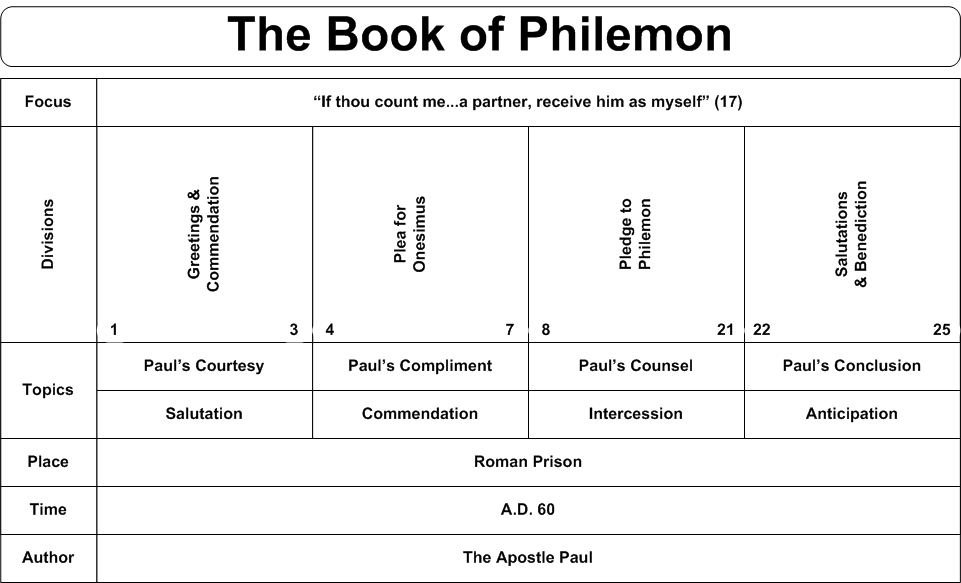
Philemon This is Paul's most personal and persuasive letter, written primarily to Philemon in order to induce him to accept back Onesimus, his runaway slave. Paul had met Onesimus in prison and led him to the Lord. Paul gives a number of compelling (almost manipulative) reasons why Philemon should freely and willingly decide to do what is best, The letter also provides insights into relationships among believers in the early church which have modern applications as well.


Philemon 1
1:1 Paul, a prisoner of Christ Jesus, and Timothy our brother, to Philemon, our beloved fellow worker, 2 to the beloved Apphia, to Archippus, our fellow soldier, and to the assembly in your house: 3 Grace to you and peace from God our Father and the Lord Jesus Christ.
4 I thank my God always, making mention of you in my prayers, 5 hearing of your love, and of the faith which you have with regard to (pros) the Lord Jesus, and toward (eis) all the saints; 6 that the your participation in the faith may become effective, by the knowledge of every good thing which is in us in Christ Jesus. 7 For we have much joy and comfort in your love, because the hearts of the saints have been refreshed through you, brother.
8 Therefore, though I have all boldness in Christ to command you that which is appropriate, 9 yet for love’s sake I rather beg, being such a one as Paul, the aged, but also a prisoner of Jesus Christ. 10 I beg you for my child, whom I have become the father of in my chains, Onesimus, 11 who once was useless to you, but now is useful to you and to me. 12 I am sending him back. Therefore receive him, that is, my own heart, 13 whom I desired to keep with me, that on your behalf he might serve me in my chains for the Good News. 14 But I was willing to do nothing without your consent, that your goodness would not be as of necessity, but of free will. 15 For perhaps he was therefore separated from you for a while, that you would have him forever, 16 no longer as a slave, but more than a slave, a beloved brother, especially to me, but how much rather to you, both in the flesh and in the Lord.
17 If then you count me a partner, receive him as you would receive me. 18 But if he has wronged you at all, or owes you anything, put that to my account. 19 I, Paul, write this with my own hand: I will repay it (not to mention to you that you owe to me even your own self besides).
20 Yes, brother, let me have joy from you in the Lord. Refresh my heart in the Lord. 21 Having confidence in your obedience, I write to you, knowing that you will do even beyond what I say. 22 Also, prepare a guest room for me, for I hope that through your prayers I will be restored to you. 23 Epaphras, my fellow prisoner in Christ Jesus, greets you, 24 as do Mark, Aristarchus, Demas, and Luke, my fellow workers. 25 The grace of our Lord Jesus Christ be with your spirit. Amen

Observations: 1:1-3 Paul identifies himself a prisoner of the Messiah Jesus, and writes (along with Timothy) to Philemon, and two others, as well as the entire assembly/church which meets in Philemon's house. The number of people who know about the contents of the letter adds pressure for Philemon to act in response to it. Paul wishes Philemon the covenantal blessings of grace and peace.
1:4-7 Paul thanks God for Philemon's love toward the saints and faith in the Lord Jesus (chiastic structure helps us see that faith is not towards the saints, as is further validated by the use of two different prepositions as noted in the text above). Verse 6 is crucial for understanding the letter. Paul prays that Philemon's fellowship or participation (koinonia feminine noun for “having in common” see verse 17 for the masculine form) in the faith might become effective/effectual by the experiential knowledge of every good thing which believers have in their union with Christ. Some translations have “sharing” of his faith, in an evangelistic sense, but Paul's objective is to encourage Philemon to forgive and accept Onesimus, not win others to Christ. Forgiving his runaway slave, and the debt of whatever Onesimus had taken from him when he left would require drawing on the grace that God had extended to him in Christ. Paul refers to how Philemon had used that grace to minister to others in refreshing the hearts of the saints through his generosity to those in need. And thus asks him to extend the same Christlike grace toward Onesimus.
1:8-16 Forgiving and accepting Onesimus was the right thing to do and Paul says he could command Philemon to do what was right, but instead he appeals to him, or even begs him, as the old prisoner of Christ (tugging on the heart strings) to forgive Onesimus. Paul pleads for him as his own child, whom he had led to the Lord while in prison with him. He gives Philemon more reasons to do so, saying that previously Onesimus was an unprofitable servant, but has now become a useful believing brother to both Paul and Philemon. Impressing upon Philemon that “he owes Paul favors” Paul states that Onesimus had ministered to him while in prison, doing the job that Philemon should have done in serving Paul for the furthering of the Good News of the Kingdom of Christ. Paul wanted to keep Onesimus, but didn't want to do so without Philemon's permission, so that any good deed would not be done under compulsion, but as a free will act of Philemon (so there is free-will!). Paul then gives another incentive, pointing out that Philemon would now have Onesimus forever, not as a slave but as a brother in Christ.
1:17-19 Although Paul wants Philemon to willingly accept Onesimus, he makes such a strong case that it would be impossible to refuse with any shred of honor. If Philemon considers Paul a fellow partaker (koinonos the masculine form of the feminine noun in verse 6), then he should receive Onesimus as he would Paul. If Onesimus had wronged him in anything, Philemon should put it on Paul's account. Paul says that he is writing the letter with his own hand to guarantee his pledge, and then reminds Philemon that he owes his very self to Paul, because of Paul's ministry to him. Paul's willingness to go to bat for an escaped slave is an example of the kind of love committed believers showed toward each other.
1:20-25 Paul appears pretty bold in asking Philemon to give him joy and refresh his poor old imprisoned heart by accepting back Onesimus. He says he has confidence that Philemon will not only comply (literally the word for “obey” or “listen under”) with his “request,” but go beyond it, in reinstating Onesimus without prejudice. He also asks Philemon to prepare a guest room in anticipation of God answering his prayers and bringing about Paul's release from prison (a parallel to God answering Paul's prayers to have Onesimus being released form the prison of his debt to Philemon). Speaking of parallels, one can't help but notice the allegorical parallel of the believer being restored to the Father by the work of Christ (where Onesimus is the believer, Philemon is the Father, and Paul is Christ). Paul sends greetings and prays that the grace of Christ would strengthen Philemon's spirit in doing the right thing.
Application: Believers must not harbor bitterness nor resentment towards believers who have wronged them, but extend Christlike forgiveness (regardless of whether or not they repent, to free themselves from bitterness) and acceptance to the repentant as God has done to us, so that our participation in the promises of the Gospel may make a difference in our lives, now and in the future.
Prayer: Heavenly Father, I praise You for the forgiveness and acceptance You've shown me in Christ, may I know and demonstrate similar grace toward others. Amen.


Digging Deeper


God in a nutshell: God has forgiven us by His grace and reinstated us in His graces, and expects us to do the same for others.

Build-a-Jesus: Jesus is the Lord and Master whom we must serve in order to be blessed, or face negative consequences.

Us in a nutshell: Believers need to draw upon God's grace to live so as to please Him, contending against those who teach falsely, and extending love to our fellow saints.

Where to Go for More:
Truthbase.net

2 John & 3 John Walking in Truth and Love

TMS Mt 28:19-20 The Great Omission
Mt 28:18 “And Jesus came and spoke to them, saying, "All authority has been given to Me in heaven and on earth.

19 Go therefore and
make disciples of all the nations,
baptizing them in the name of 
the Father and of the Son and of the Holy Spirit,
20 teaching them to observe/obey all things that I have commanded you;
and lo, I am with you always,
even to the end of the age." Amen

Observations: 28:19-20 What is the Great Commission of Jesus, to make obedient disciples, has become the Great Omission of the modern church. With a focus on evangelism, growth, missions, outreach, and a host of other good, but secondary things. Churches exist to bring glory to God by making reproductive disciples. Anything less is missing the mark. Baptizing does presuppose converts which are the result of evangelism, but it is subordinate (grammatically and practically to making disciples).
There is one main verb in 19-20, the imperative command to make disciples (followers of Jesus). The imperative is modified by three participles:

  • as you go/going (which means it's a lifestyle thing, starting where you are);
  • baptizing is more than a ritualistic getting wet, but is an immersion in the name/power of the triune God (see the upcoming Catacomb Church Blog for more about how to help people get plugged into the power of God);
  • teaching them to obey; this is the missing link of ministry, many focus on belief, but the Scriptures and Jesus focus on obedience for those who have believed. In some churches, people just show up on Sunday every now and then to make sure salvation is still by faith, and then go home to live lives that bring no glory to God (nor themselves in the final accounting).
For those who do obey Jesus and follow this command to make disciples (who can teach others to obey this command, ie, reproductive disciples), Jesus makes a promise of His abiding presence until He comes back for them at the end of this present age.
Application: The key test of a reproductive disciple is that they can repeat the process with someone else. See (and obey) the 7PASSAGES in the Sidebar.
Prayer: Lord, thanks that You give meaning and purpose in this life, as well as Your presence to those who believe and obey You, and glory in the next.   Help me embrace Your commission as the guiding force for my life. Amen.


2John & 3John These two tiny letters from John the Apostle are much easier to understand than his other writings. The first is addressed to an elect/chosen lady and her children. It's most likely that John has personified the church as a chosen lady (matching the greeting in verse 13, possibly envisioning the church as the Bride of Christ, and the believers as her children). The second is to a man named Gaius, who might have been any one of the three men by that name mentioned in Acts 19-20 or Romans 16, or an unknown church leader. In both epistles John encourages his readers to walk in truth and love, and then gives some specific warnings and instructions to keep the believers from being sidetracked.

2John 1
1:1 The elder, to the chosen lady and her children, whom I love in truth; and not I only, but also all those who know the truth; 2 for the truth’s sake, which remains in us, and it will be with us forever: 3 Grace, mercy, and peace will be with us, from God the Father, and from the Lord Jesus Christ, the Son of the Father, in/by/en truth and love.

4 I rejoice greatly that I have found some of your children walking in truth, even as we have been commanded by the Father.
5 Now I beg you, dear lady, not as though I wrote to you a new commandment, but that which we had from the beginning,
that we love one another.
6 This is love, that we should walk according to his commandments.
This is the commandment, even as you heard from the beginning,
that you should walk in it.

7 For many deceivers have gone out into the world, those who don’t confess that Jesus Christ came in the flesh. This is the deceiver and the Antichrist.
8 Watch yourselves, that we don’t lose the things which we have accomplished, but that we receive a full reward. 9 Whoever transgresses and doesn’t abide in the teaching of Christ, doesn’t have God. He who abides in the teaching, the same has both the Father and the Son.
10 If anyone comes to you, and doesn’t bring this teaching, don’t receive him into your house, and don’t welcome him, 11 for he who welcomes him participates in his evil works.
12 Having many things to write to you, I don’t want to do so with paper and ink, but I hope to come to you, and to speak face to face, that our joy may be made full. 13 The children of your chosen sister greet you. Amen.

Observations: 1:1-3 John, the beloved disciple and apostle identifies himself as an elder (presbuteros cf 1Pt 5:1). He personifies the church he truly loves as a “chosen or elect lady” (cf verse 13), and the believers as her children (a verse demonstrating the corporate aspect of election). The reason for the figure of speech isn't given, but perhaps there was a need to keep the identity or location secret to avoid persecution. However, everyone who knows (perfect tense) the truth loves the recipients for the sake of the truth in them. He uses the perfect tense to indicate that the knowledge of the truth occurred in the past with continuing results into the present, and then he stresses the permanently abiding nature of the truth in the into the future (eis the Age). He then wishes them God's covenantal blessings of grace, mercy (usual translation of hesed) and peace which will be with them by means of (en) truth and love (themes in 1John).
1:4-6 John rejoices that he found “some” (no word in the Greek, but it fits the context from the preposition ek) of her children walking in the truth according to the commandment. He repeats the concept of walking according to the commandment in verse 6, forming an inclusio around “love” at the end of verse 5 and beginning of verse 6. The chief commandment Jesus gave His followers according to John in 13:34 is love, for one another. He exhorts the church to continue to manifest the love Jesus modeled (self-sacrificial service of another's needs).
1:7 He warns them of Satan's agents, the false teachers who seek to deceive believers to keep them from following the truth. They don't acknowledge Jesus as the Messiah in the flesh. In 1John 4:3-4, he wrote of Jesus having come in the flesh (perfect tense). Here he uses the present tense “coming” possibly looking forward to the second coming. In any event, the false teachers are anti-Messiah (Christ=Messiah, the Anointed One). They deny that the Messiah came, and would return, since He didn't come the first time.
1:8 John tells them to watch out that they aren't swayed from believing the truth, so that “we” don't lose (literally apolllumi “destroyed”) what “we've produced/worked for,” but might receive a full reward. Note three things: 1) John includes himself in those who would suffer loss if the readers stray from the truth; 2) reward is the result of laboring or working in helping others walk according the truth; 3) reward can be full, or partial, or lost (as in experience destruction). The word for reward is also used of paying wages. No work, no wages. This is one of the more ignored passages in modern evangelicalism, and it destroys a lot of bogus theology.
1:9 Whoever transgresses (steps over the line) and doesn't abide in the teaching of Christ (as in love one another) doesn't have God. To have God was explained in 1John, of having an abiding, intimate relationship with Him. To not have Him, is to not have that “abiding in the vine" relationship (Jn 15) which results in loss of reward (see comments on Mt 7 “I never knew you”). This does not mean that people never had, nor lose their forgiveness/justification, but they lose out on the blessings of God now, and in the future kingdom. Whoever abides in the teaching of Christ (through obedience) has both the Father and Son (Jn 14:21). The distinction between the Father and Son probably points to Judaizers who claimed God was their Father, and didn't give allegiance to His Son (Mt 3:9), but were instead trying to get believers to follow OT ritual.
1:10-13 John was all for love, but love must be guided by truth and discernment (Phil 1:9-10) if one is to reap reward. In fact those who don't bring the teaching about walking in love and obedience to gain and keep reward should not be welcomed, nor allowed into the house (church?) for those who welcome them share in their evil works and punishment. John has more to say, but wants to speak in person, so that his joy might be made full. He closes with a greeting from a sister church.
Application: What work have you done that God will reward? Are you in danger of losing it by valuing the acceptance of people more than the praise of God?
Prayer: God, may I abide in Your truth, and Your commandments, and You, so that I keep away from what is false, and do the things for which You will reward me. Thanks for abiding with me. Amen.


3John 1 Imitate what is Good
1:1 The elder to Gaius the beloved, whom I love in truth. 2 Beloved, I pray that you may prosper in all things and be healthy, even as your soul prospers.
3 For I rejoiced greatly, when brothers came and testified about your truth, even as you walk in truth. 4 I have no greater joy than this, to hear about my children walking in truth.
5 Beloved, you do a faithful work in whatever you accomplish for those who are brothers and strangers. 6 They have testified about your love before the assembly. You will do well to send them forward on their journey in a way worthy of God, 7 because for the sake of the Name they went out, taking nothing from the Gentiles. 8 We therefore ought to receive such, that we may be fellow workers for the truth.
9 I wrote to the assembly, but Diotrephes, who loves to be first among them, doesn’t accept what we say. 10 Therefore, if I come, I will remember his deeds which he does, unjustly accusing us with wicked words. Not content with this, neither does he himself receive the brothers, and those who would, he forbids and throws out of the assembly. 11 Beloved, don’t imitate that which is evil, but that which is good. He who does good is of God. He who does evil hasn’t seen God.
12 Demetrius has the testimony of all, and of the truth itself; yes, we also testify, and you know that our testimony is true. 13 I had many things to write to you, but I am unwilling to write to you with ink and pen; 14 but I hope to see you soon, and we will speak face to face. Peace be to you. The friends greet you. Greet the friends by name.

Observations: 1:1-4 John writes to Gaius, whom he loves in truth (truly), and prays that Gaius might prosper in all things physical, including health, just as he is prospering spiritually. This raises the question of: “How does one have a prosperous soul?” Our soul consists of our mind, will/values, and emotions, and is what makes us distinctively us. It is what we exchange for things during our time on earth. It is what we must deny if we are to follow Christ, and lose if we are to gain heavenly or kingdom rewards (Lk 9:23-26). The testimony of the brothers let John know that his soul was prospering, by reporting how Gaius walked/live in the truth. He particularly demonstrated his commitment to truth by his love and service for others. John has no greater joy (as do most Biblical parents) than to hear that their children (in this case a spiritual one) walk in the truth. Worldling parents are proud that their children are successful in the world's eyes. Those who love God are most proud that their children are successful in God's sight. Being righteous is all about being careful to do what is right in God's sight, which means walking according to His commands, and loving others Biblically.
1:5-8 John commends Gaius for faithfully seeing to the needs of those itinerant ministers who were at or passing through his location. They were workers for the truth (verse 8) who went out (missionaries) for the sake of the Name of Jesus, receiving no support from the Gentiles (to whom they ministered). The recipients of Gaius' hospitality testified to the love he had shown them. John says he does well/good (good works) in sending them to their next destination provisioned in a manner worthy of the ambassadors of the Most High God. John says believers ought to receive/welcome such workers of the truth (as contrasted with 2John 10, where believers are told to reject the false teachers). Those who welcome and encourage workers for the truth (financially and otherwise) share in their work (sun-ergos) as fellow-workers.
1:9-11 John said he wrote (instruction/truth) to the church but one of Satan's agents, Diotrephes, was taken captive by pride (loves to be first) to do his will (cf 2Tim 2:24-26), and was opposing the written revelation of the apostles. If John comes to visit, he will highlight and admonish his deeds, which include maligning the apostles with wicked words (this usually happens to all who speak God's words, because Satan's agents are ubiquitous). Diotrophes wasn't just content to speak against the truth and those who communicated it, but he would reject those who brought itinerant workers who brought the truth and toss out of the chuch those who would welcome them. Here is a clear example of what Paul talked about in Acts 20:29-30. People would rise to position of power in the church, not to help others obey Jesus, but to do the devil's work. John counsels Gaius (in a good lesson for all believers) to not imitate what is evil, but follow the good examples. Those who do good, are of God. Those who do evil haven't seen God. In 1John is was made clear that to see God in John's thinking is to have an abiding, intimate relationship with Him.
1:12 In contrast to Diotrephes, Demetrius had a good testimony from all, and the truth as well. John even gave him honor with apostolic approval. We're not told what he did, but it would have been the opposite of Diotrephes, walking in truth and love for the service of others.
Like his last letter, John wants to say more, but hopes to do so in person. He wishes Gaius the covenantal blessing of peace, and extends greetings.
Application: Believers need to be workers for the truth and join with others in imitating what is good, and opposing evil in the church.
Prayer: Heavenly Father, I pray You would encourage and support those who work for sharing Your truth with others, and that You would restrain and rebuke the agents of the evil one who lead others astray. Amen.

Digging Deeper


God in a nutshell: God loves it when His children walk in the truth.

Build-a-Jesus: Jesus is the Messiah, who came in the flesh, and will come again to reward His faithful servants, who obey His command to love one another.

Us in a nutshell: We need to walk in truth and love to gain our reward, welcoming those who do so, and rejecting those who don't.

Where to Go for More:
Truthbase.net